
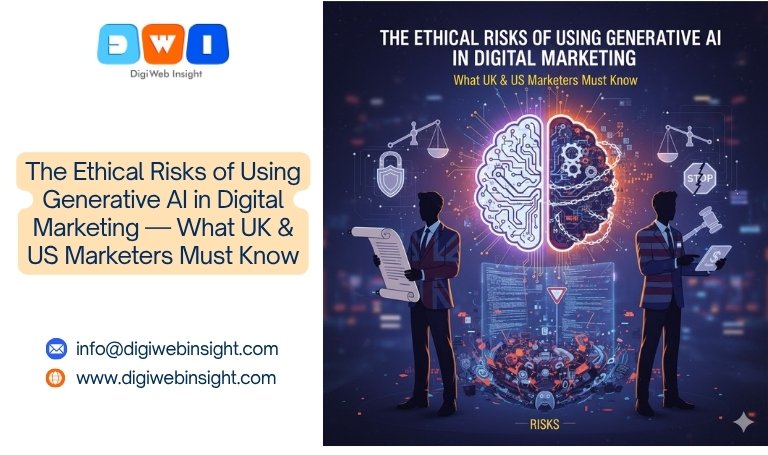
Generative AI has exploded from a niche concept into an indispensable tool for digital marketers. It promises unparalleled efficiency, hyper-personalization, and a relentless stream of content. Yet, this rapid adoption has raced ahead of ethical scrutiny, creating a minefield of legal and reputational dangers.
The ethical risks of using generative AI in digital marketing are not just theoretical; they have real-world consequences.
For marketers in the United Kingdom and the United States, navigating this new terrain is uniquely complex. You are not operating under one set of rules, but two distinct and evolving legal landscapes. What is considered a compliance issue in the UK might be a deception-based lawsuit in the US.
Understanding these risks is no longer optional. It’s a core requirement for building sustainable, trust-based marketing. Many businesses, from startups to any affordable SEO agency in the USA, are now forced to ask not just “Can we do this?” but “Should we?”
Unpacking the Core Ethical Risks of Generative AI in Digital Marketing
Before we compare the UK and US, it’s crucial to understand the fundamental challenges. These risks are universal and form the basis of all emerging regulations.
1. Algorithmic Bias and Digital Discrimination
Generative AI models are trained on vast datasets from the internet. The problem? The internet is filled with decades of human bias.
If an AI is trained on data that historically underrepresents women in executive roles, its “creative” output for a “CEO” image prompt will almost exclusively feature men. In marketing, this translates to:
- Biased Ad Targeting: Ad platforms might “learn” to show high-paying job ads predominantly to one demographic.
- Stereotyped Content: AI-generated ad copy or imagery can inadvertently perpetuate harmful racial, gender, or cultural stereotypes.
- Exclusionary Personalization: Personalization engines might deprioritize or “other” groups that don’t fit the biased norm.
2. Data Privacy and Consumer Surveillance
Generative AI is data-hungry. To create personalized marketing, it must learn from user behavior, personal data, and purchase history. This raises massive privacy concerns. How is this data being collected, stored, and used to train models? Consumers are increasingly aware and wary of “synthetic profiles”—AI-generated personas that predict their behavior, often without their explicit consent.
3. Deception, Transparency, and “Fake” Content
This is one of the most significant public-facing risks. Generative AI makes it trivially easy to create content that is not real, including:
- Fake Reviews: Generating hundreds of “authentic-sounding” 5-star reviews.
- AI-Generated Influencers: Using deepfake technology to create brand ambassadors who don’t exist, misleading consumers about product use.
- Undisclosed Chatbots: Designing AI chatbots to mimic human support agents, tricking customers into believing they are talking to a real person.
4. Intellectual Property and Copyright Chaos
This is a legal “black box” that has companies terrified. When an AI model generates an image, a blog post, or a line of code, who owns it?
The more pressing question is: how was the AI trained? Models like Stable Diffusion and ChatGPT were trained by scraping billions of data points, including copyrighted articles, photographs, and artwork. Lawsuits, like the one from Getty Images, allege this is mass-scale copyright infringement. For marketers, this means the “original” content your AI creates could be an uncredited and illegal derivative of someone else’s work, opening your company to litigation.
Navigating the Legal Maze: UK vs. US Compliance
While the risks above are global, the way they are regulated is dramatically different in the UK and US.
The UK: A Principles-First Approach (ICO & ASA)
The UK’s strategy is anchored in its comprehensive data protection framework, the UK-GDPR, and enforced by the Information Commissioner’s Office (ICO).
- The ICO’s Stance: The ICO’s guidance on AI is clear. Any processing of personal data for AI must be “lawful, fair, and transparent.” You cannot use AI in a way that is “unjustifiably detrimental” to people. This places a high burden on marketers to prove their AI systems are not discriminatory and have a lawful basis for using personal data.
- The ASA’s Stance: The Advertising Standards Authority (ASA) treats AI-generated ads just like human-generated ones. Under the CAP Code, all advertising must be truthful, not misleading, and socially responsible. The ASA has explicitly warned that AI cannot be used as an excuse for creating misleading ad claims or perpetuating harmful stereotypes.
External Link (DoFollow): Marketers in the UK should consider the ICO’s “Guidance on AI and data protection” as essential reading.
The US: An Anti-Deception & Rules-Based Approach (FTC)
The US lacks a single federal data privacy law like the GDPR. Instead, it has a “patchwork” of state-level laws (like California’s CCPA/CPRA) and a powerful federal enforcer: the Federal Trade Commission (FTC).
- The FTC’s Stance: The FTC’s primary weapon is its mandate to police “unfair or deceptive acts or practices.” They are less concerned with how your AI works and more concerned with what it does to the consumer.
- Hard-and-Fast Rules: The FTC has issued stern warnings and new rules specifically targeting AI-driven deception.
- AI-Generated Reviews are Banned: A new FTC rule that took effect in late 2024 explicitly prohibits the use of AI to create or “hijack” consumer reviews and testimonials.
- Transparency is Non-Negotiable: The FTC has warned that AI-driven “dark patterns” (tricking users into purchases) and undisclosed chatbots are deceptive practices.
- Exaggerated Claims: You cannot market your product as “AI-powered” if that claim is trivial or false. Your claims must be substantiated.
External Link: The FTC regularly posts guidance for businesses, like its blog post on “AI and Your Business,” which outlines its enforcement priorities.
A Practical Framework for Ethical AI Marketing
The ethical risks of using generative AI in digital marketing are serious, but they are manageable. The goal is not to avoid AI, but to deploy it responsibly.
1. Mandate a “Human-in-the-Loop” (HITL)
Never let generative AI run on autopilot. Every piece of AI-generated content—whether a blog post, an image, or an ad—must be reviewed by a skilled human marketer. This human checkpoint is your best defense against bias, factual errors (“hallucinations”), and brand-damaging creative. This is especially crucial when integrating AI tools into your core web design and development.
2. Conduct AI Ethics and Compliance Audits
Before you adopt any new AI tool, audit it.
- For UK Compliance: Does this tool process personal data? If so, how does it comply with UK-GDPR principles of fairness and transparency?
- For US Compliance: Could this tool be used to deceive a consumer? Does it create fake reviews? Does it obscure the truth?
- For All: Where does the tool get its training data? Is it a “black box,” or does the vendor offer transparency about IP and copyright?
This audit process should be standard for all marketing, especially in high-stakes areas like Pay Per Click (PPC) Marketing, where AI is used for both bidding and ad-copy generation.
3. Champion Radical Transparency
Trust is your most valuable asset. Be radically transparent with your audience.
- Label AI Content: If an image is AI-generated, label it.
- Disclose Chatbots: Your chatbot should immediately identify itself as an AI assistant.
- Update Privacy Policies: Be explicit about how you use AI and automated decision-making to personalize user experiences.
Conclusion: Ethics as Your Competitive Advantage
The ethical risks of using generative AI in digital marketing are not future problems; they are here now. Marketers in the UK and US face a complex web of privacy laws, advertising codes, and anti-deception rules.
But this challenge is also an opportunity. Companies that shy away from these questions will be left behind, while those who charge ahead recklessly risk legal action and a permanent loss of consumer trust.
The winners will be those who build a framework for ethical AI. By prioritizing human oversight, demanding transparency, and respecting consumer privacy, you can harness the power of AI not just to be more efficient, but to be more trustworthy.
Need help navigating the complexities of modern, ethical digital marketing? Contact the experts at DigiWeb Insight today to build a strategy that is both innovative and responsible.