
“Okay Google, find me a waterproof jacket made in Canada.” “Hey Siri, where can I buy local maple syrup near me?” “Alexa, reorder my favourite coffee beans.”
This is how shopping begins in 2026. If your online store isn’t the one providing the answer, you’re not just missing a click—you’re missing the entire customer.
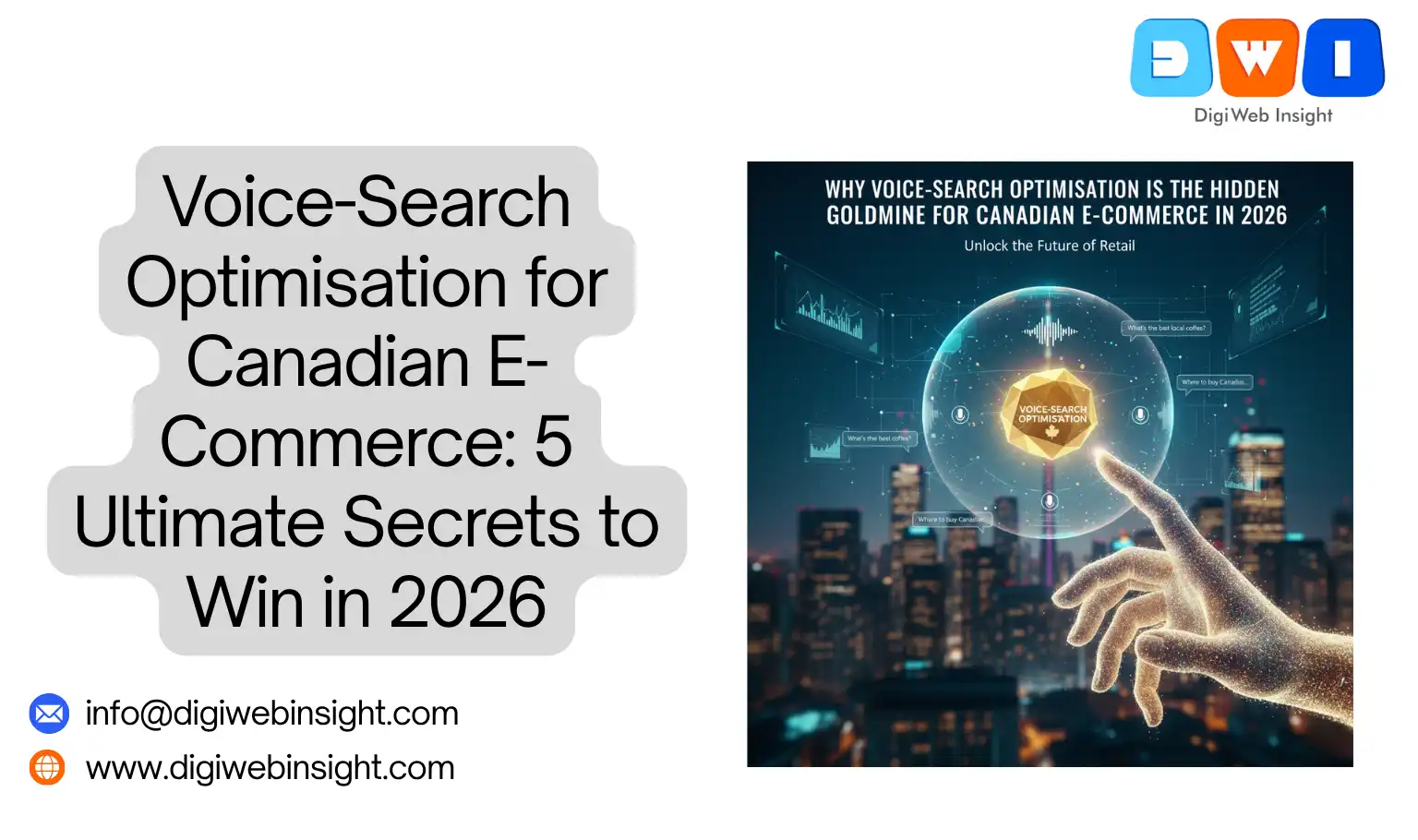
While many businesses are focused on text-based search, a quiet revolution is happening. The real “hidden goldmine” is mastering Voice-Search Optimisation for Canadian E-Commerce.
Why is it a goldmine? Because most of your competitors are ignoring it. Recent data from Statistics Canada shows that while AI adoption is growing, the majority of Canadian businesses still have no firm plans to implement AI strategies. This is your gap to win.
Voice search isn’t a far-off trend. It’s a present-day reality, and optimising for it is fundamentally different. It’s conversational, it’s fast, and it’s built on intent. Here are the 5 ultimate secrets you need to claim this goldmine.
1. Conversational Queries: The Heart of Voice-Search Optimisation for Canadian E-Commerce
We don’t talk like we type. When someone types, they might search for “best winter boots.” When they speak, they ask, “What are the warmest winter boots I can buy in Canada for under $200?”
The average voice search result is 29 words long. Your strategy must shift from short keywords to long-tail, conversational questions.
- Actionable Strategy: Create FAQ pages, blog posts, and product descriptions that answer the “who, what, where, when, why, and how” questions your customers are asking. Think about how a real Canadian shopper would ask for your product, and use that exact phrasing in your content. This is the core of Voice-Search Optimisation for Canadian E-Commerce.
2. Use Schema Markup to “Speak” to Voice Assistants
Schema markup is a “language” you add to your website’s code to help search engines understand your content. For voice search, this is non-negotiable.
When a voice assistant gives a direct answer, it’s often pulling from this structured data. For an e-commerce site, this includes:
- Product (price, availability, reviews)
- Local Business (address, hours)
- FAQPage (questions and answers)
When a user asks, “How much is the [Your Product]?” a voice assistant can pull that price directly from your schema and provide a spoken answer, often with a link to purchase.
- Actionable Strategy: Implement product and FAQ schema on your key pages. If you’re using a platform like Shopify (dominant in Canada), you can use apps like Schema Plus or JSON-LD for SEO. You can learn more about product schema directly from Schema.org’s official documentation.
3. Win the “Near Me” Battle with Local SEO
Here’s a stat that should shock every e-commerce owner: 76% of smart speaker users perform local voice searches at least once a week.
Voice search is overwhelmingly local. “Where can I buy…” or “…near me” are common queries. Even if you’re a “ships-to-all-of-Canada” e-commerce brand, you may have a head office, a warehouse, or partner with local stockists.
- Actionable Strategy: Your Google Business Profile is now a critical e-commerce tool. Keep your address, hours, and phone number (NAP) consistent everywhere. Create content that targets specific Canadian cities (e.g., “The Best Rain Gear for a Vancouver Winter”) to capture “near me” searches, even if the purchase is online.
4. Mobile Speed: The Engine of Voice Search
Where do most voice searches happen? Not just on smart speakers. They happen on the go, using the smartphones in our pockets.
Google knows this. Voice search results are pulled from pages that load incredibly fast. If your site is slow, you are invisible to voice search. Mobile-first indexing is now voice-first indexing.
- Actionable Strategy: Your site’s mobile experience is your voice search experience. Use Google’s PageSpeed Insights to test your site. Compress images, leverage browser caching, and ensure your site is fully responsive. If your site is lagging, it’s time to act. (If you need help, check out our [Insert Internal Link: e.g., “Complete Guide to Website Speed Optimization”]).
5. Aim for “Position Zero” to Become The Answer
When you ask Google a question, that answer box that appears at the very top, before any other results? That’s called the “Featured Snippet,” or “Position Zero.”
Studies show that 41% of all voice search answers come from a Featured Snippet.
Voice assistants are designed to give one answer, not ten. By winning the Featured Snippet, you are positioning your brand as the single, authoritative answer to a customer’s question.
- Actionable Strategy: The best way to win snippets is by providing clear, concise, and direct answers to common questions. Use bulleted lists, numbered steps (like this article!), and tables in your content. Answering a query like “How to clean suede boots” with a clear, numbered list on your shoe store’s blog is a perfect way to get “snippeted” and become the answer.
Conclusion: Don’t Let the Goldmine Go Unclaimed
The shift to voice is happening, and it’s moving faster than most businesses realize. While your competitors are still focused on traditional keywords, you have a golden opportunity.
Mastering Voice-Search Optimisation for Canadian E-Commerce in 2026 isn’t just about SEO; it’s about fundamentally integrating your business into the daily lives and conversations of your customers.
Start answering their questions, structure your data, and speed up your site. The future of e-commerce is speaking—make sure your brand is the one that answers.
Related Service
- SEO Company USA — Boost national visibility with expert SEO strategies.
- Web Design & Development — Build fast, conversion-optimized websites that Google loves.