When most agency owners and marketers in the US and UK think about AI Marketing in 2026, their minds jump to the usual suspects: e-commerce, D2C, and SaaS. We’re flooded with case studies on AI-driven product recommendations, automated funnels, and generative AI for social media.
This is where everyone is looking. And it’s precisely why it’s becoming a red ocean of competition.
The truth is, this mainstream focus is creating massive, high-value blind spots. There are entire sectors, cash-rich and desperate for a competitive edge, that are being almost completely overlooked. The future of agency growth isn’t about doing what everyone else is doing; it’s about applying the power of AI Marketing in 2026 to the niches everyone else finds “too hard” or “too boring.”
These ignored niches are where the real, defensible profit margins will be. Any affordable SEO agency in the USA or UK that plants its flag in one of these areas now will be in an unassailable position.
Here are the three most shockingly ignored niches.
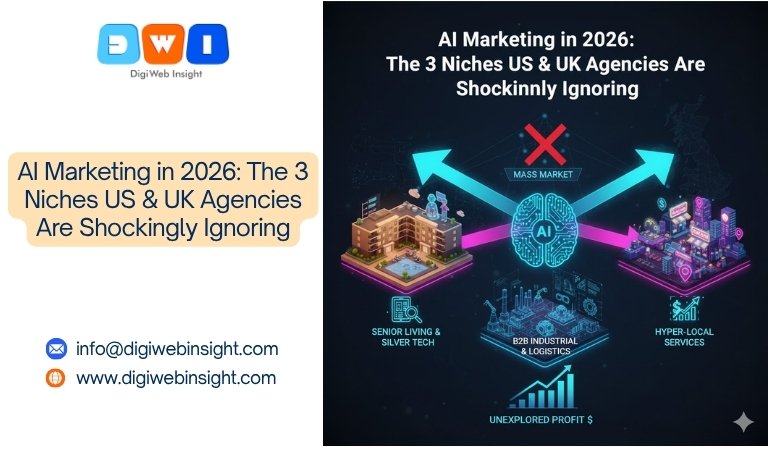
1. The “Silver Tsunami”: The Senior Living & Silver Tech Market
For decades, marketers have operated on the lazy, outdated assumption that older demographics are “not online.” This is dangerously false. The 65+ demographic is one of the wealthiest and fastest-growing online populations.
Yet, most agencies completely ignore them, or worse, market to them with patronizing, one-size-fits-all creative.
- Why It’s Ignored: It requires a nuanced understanding of accessibility, trust, and life-stage-specific needs. It’s not as “sexy” as marketing to Gen Z on TikTok.
- The AI Opportunity in 2026:
- AI-Driven Accessibility: The future of web design and development for this market is AI-powered personalization. Imagine AI that automatically adjusts font sizes, color contrast, and even navigation based on a user’s detected needs or past behavior.
- Empathetic AI Chatbots: This demographic values high-touch, human interaction. AI chatbots can be trained not for speed, but for empathy, patience, and clarity, guiding users through complex topics like healthcare options or retirement planning.
- Predictive Personalization: AI can analyze behavior to deliver content relevant to specific concerns—from financial planning to health and wellness or transitioning to senior living.
2. The “Un-Sexy” Giant: B2B Industrial, Manufacturing & Logistics
Ask a typical digital marketing agency if they want to market a new SaaS product or a “Variable Frequency Drive for HVAC systems.” 99 out of 100 will pick the SaaS.
B2B industrial marketing is seen as complex, technical, and boring. Its sales cycles are long, and the audience is a small pool of highly technical engineers and procurement officers. This is precisely why it’s a perfect fit for AI.
- Why It’s Ignored: It requires deep domain expertise. You can’t fake it.
- The AI Opportunity in 2026:
- Predictive Account-Based Marketing (ABM): AI can sift through signals that no human team could ever track—like a prospect’s R&D announcements, new factory permits, or even their key suppliers’ shipping delays. This signals intent long before a competitor ever knows they’re in the market.
- Technical Content Generation: Generative AI, when trained on a company’s own engineering documents and technical specs, can co-create highly accurate whitepapers, case studies, and comparison guides for a technical audience.
- AI-Powered Lead Scoring: The future of AI Marketing in 2026 for this niche is about qualifying, not just generating, leads. AI can score leads based on complex variables, ensuring the sales team only talks to procurement-ready prospects.
External Link (DoFollow): As industry leaders at Gartner point out, AI is moving from a general tool to a highly-specialized “Industrial AI” force, and its marketing applications are a key part of that.
3. The True “Main Street”: Hyper-Local, High-Stakes Services
Agencies have offered “Local SEO” to dentists, lawyers, and plumbers for years. But this is mostly a low-effort package. They aren’t applying high-level AI.
The opportunity isn’t just “ranking in the map pack.” It’s about dominating a 10-mile radius.
- Why It’s Ignored: It’s seen as small-time. But a high-end law firm or specialty medical clinic has a massive lifetime customer value.
- The AI Opportunity in 2026:
- Predictive Local Trends: AI can analyze local data (housing sales, weather patterns, new business registrations, geotagged social posts) to predict demand. Imagine an HVAC company’s Pay Per Click (PPC) Marketing budget automatically surging 48 hours before a heatwave, with ad creative AI-generated to speak to the specific local forecast.
- Hyper-Local Creative: AI can generate hundreds of ad variations—”Dealing with a leak in the [Neighborhood Name] area?”—making residents feel the brand is truly part of their community.
- Reputation & Sentiment Analysis: AI can monitor local forums, Nextdoor, and review sites to give brands a real-time pulse on their community reputation, flagging issues before they become 1-star review problems.
Conclusion: Stop Chasing, Start Specializing
The future of AI Marketing in 2026 will be defined by specialization. While most US and UK agencies are fighting over the same 10% of the market, the other 90% is wide open.
These three niches—Senior Living, B2B Industrial, and Hyper-Local Services—are high-value, low-competition, and perfectly suited for an AI-driven approach. The agencies that stop chasing the “sexy” and start solving complex, industry-specific problems will be the ones who win the next decade.
Are you ready to specialize? DigiWeb Insight is already exploring these frontiers.