For decades, email marketing has run on manual segmentation. You’d create lists based on simple data: “location,” “age,” “past purchases,” or “hasn’t opened in 90 days.” While better than nothing, this approach is static and based on past behavior, not future intent. In today’s hyper-competitive digital landscape, it’s no longer enough.
This is precisely why UK marketers are switching to AI-powered email segmentation.
It’s a seismic shift from broad buckets to one-on-one personalization at scale. Instead of you telling the system who is in what group, the AI analyzes millions of data points to predict who will buy, who will churn, and what message will resonate right now.
The result? Skyrocketing conversion rates. Here’s a breakdown of why this new approach is winning and how it’s fundamentally changing email marketing in the UK.
1. From Static Demographics to Predictive Behavioral Analysis
The old way of segmenting is flawed. A customer in your “Female, 30-40, London” segment isn’t a monolith. Some are loyal fans, some are discount-hunters, and some are seconds away from unsubscribing.
AI-powered email segmentation ignores these crude labels. Instead, it analyzes real-time behavioral data:
- Which pages have they visited in the last hour?
- What time of day do they actually open emails?
- What products have they viewed multiple times but not purchased?
- Do they respond to “New Arrivals” or “20% Off” subject lines?
The AI builds “micro-clusters” based on these predictive signals. It can identify a segment of “at-risk VIP customers who only buy when a new product drops” — a segment you would never be able to build manually. Sending a “We miss you” discount to this group would be a mistake, but a “First Look at Our New Collection” email would be a conversion machine.
2. Hyper-Personalization That’s Actually Personal
True personalization isn’t just using [FNAME] in the subject line. It’s about changing the entire content of the email to match the user’s intent.
With AI, you can create one email campaign with dynamic content blocks. The AI then assembles the “perfect” email for each individual user.
- User A (High Intent): Gets a block with the exact product they left in their cart.
- User B (Browsing): Gets a block featuring “Top Rated Products” from the category they viewed.
- User C (Loyal Fan): Gets a block with “New Arrivals” and no discount code.
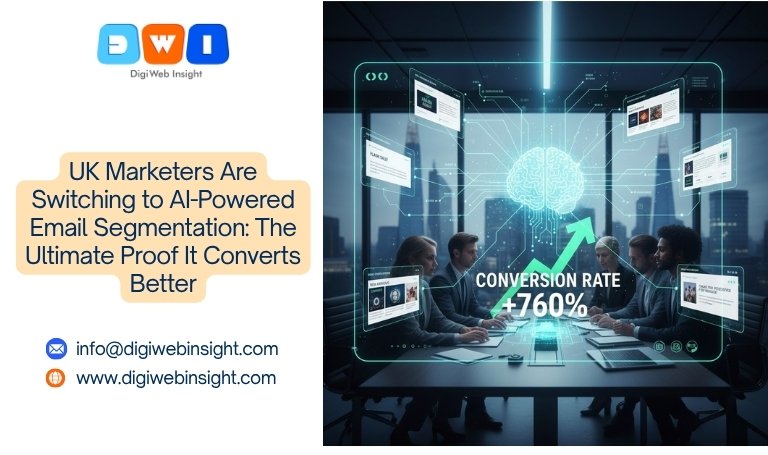
This level of granular personalization, delivered at scale, is why it converts so much better. Research shows that personalized emails can deliver a 760% increase in revenue compared to non-segmented campaigns. This is the kind of uplift that makes a tangible difference to a bottom line.
3. The UK Advantage: Navigating GDPR and a Crowded Market
The switch is particularly pronounced in the UK for two key reasons:
- Strict GDPR Compliance: The UK’s data privacy laws (UK GDPR) place a heavy emphasis on data minimization and purpose limitation. AI-powered systems can be more compliant by using data purposefully. Instead of “blasting” a list and risking annoying users who haven’t given specific consent, the AI can target only the users whose behavior indicates a legitimate interest, improving the customer experience and reducing the risk of complaints.
- A Highly Competitive Market: UK consumers are savvy and their inboxes are crowded. A generic email blast is digital noise. The only way to stand out is with radical relevance. As noted by the UK’s Data & Marketing Association (DMA), AI is reshaping the landscape by enhancing a marketer’s ability to engage audiences with precision.
4. Why AI-Powered Email Segmentation Boosts Conversions (The “How”)
It’s not magic; it’s just better data science. Here’s the practical application of how AI-powered email segmentation directly leads to more sales.
Predictive Churn & Re-engagement
The AI can assign a “churn risk” score to every subscriber. It identifies the subtle changes in behavior that signal a customer is losing interest before they unsubscribe.
- Old Way: You send a “We miss you!” email after 90 days of inactivity (when it’s already too late).
- AI Way: The AI detects a 30% drop in a user’s open rate and automatically triggers a high-value “Here’s a 15% Gift” or “What Went Wrong?” survey to win them back before they’re gone.
Dynamic List Management
Your lists are never static. An AI-powered system automatically moves users between segments based on real-time actions.
- A “New Subscriber” becomes a “First-Time Buyer” the moment they purchase.
- A “First-Time Buyer” becomes a “Loyal Customer” after their third purchase.
- A “Loyal Customer” who hasn’t opened in 4 weeks is moved to an “At-Risk” segment.
This ensures that no customer ever receives an irrelevant email. This level of automation is a core component of a modern web design and development strategy, where the website and email platform “talk” to each other constantly.
Automated Send-Time Optimization
AI doesn’t just know what to send; it knows when. It learns the individual habits of every user. It will hold an email and send it to User A at 7 PM on Tuesday (when they commute) and to User B at 10 AM on Saturday (when they do their shopping). This simple change can dramatically increase open and click-through rates.
The Bottom Line: Augment Your Team, Don’t Replace It
UK marketers are switching to AI-powered email segmentation not to fire their marketing teams, but to empower them.
It frees your human talent from the tedious, time-consuming work of building and managing endless static lists. It allows them to focus on what humans do best: strategy, creativity, and building your brand voice.
This AI-driven approach is the new standard for digital marketing. It’s the same principle behind effective Pay-Per-Click (PPC) marketing—using data to find the right person, with the right message, at the right moment.
An advanced email strategy is a crucial part of a holistic digital presence. As an affordable SEO agency in the USA and beyond, we know that getting traffic is only half the battle. Converting that traffic is what builds a business.
Are you ready to stop blasting and start converting? Contact DigiWeb Insight today, and let’s build an intelligent marketing system that drives real results.