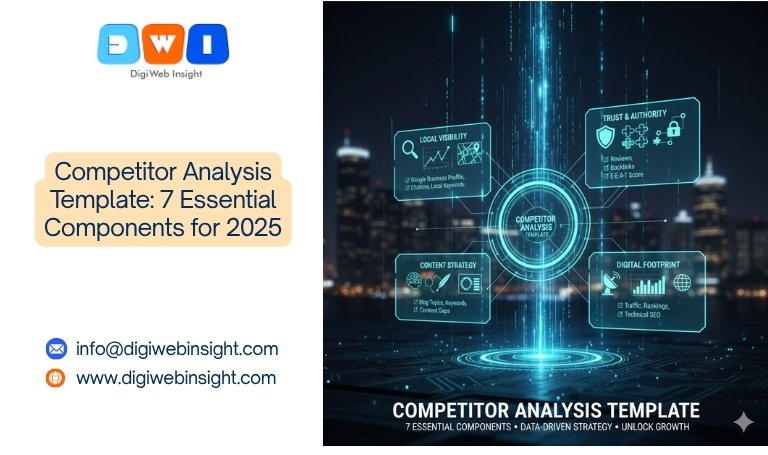
A competitor analysis template is one of the most powerful strategic tools in your business arsenal. In today’s crowded marketplace, you can’t afford to be in the dark about your competition. A structured analysis is the key to moving beyond guesswork and making data-driven decisions that give you a real, sustainable advantage.
This framework is not just a “nice to have”; it’s an essential process. It helps you identify market gaps, understand your rival’s strategies, anticipate their next moves, and find new opportunities for your own business.
But where do you start? A blank spreadsheet can be intimidating. This article provides the 7 essential components that every effective competitor analysis template must have.
1. Competitor Profile & Business Overview
This is the “at-a-glance” section of your template. It provides the high-level context you need before diving deeper.
For each competitor (you should track 3-5 direct and 1-2 indirect competitors), fill out the following:
- Company Name:
- Website URL:
- Year Founded:
- Location(s): (HQ and key markets)
- Company Size: (Employee count, estimated revenue)
- Mission Statement/Positioning: (How do they describe themselves?)
- Target Audience: (Who are they talking to?)
2. Product/Service Deep Dive
This is where you compare your offerings head-to-head. The goal is to identify their Unique Selling Proposition (USP).
- Core Product(s)/Service(s): What do they sell?
- Pricing Model: (e.g., one-time fee, subscription, freemium, per-project). How does it compare to yours?
- Key Features: List their main features. What do they have that you don’t? What do you have that they don’t?
- Perceived Quality: How is their product quality viewed in the market?
- Weaknesses/Gaps: What features are they missing? What do customers complain about?
3. Marketing & Content Strategy
How do your competitors attract and nurture their customers? This analysis reveals their brand voice and where they are investing their marketing budget.
- Content Marketing: Do they have a blog? What topics do they cover? How often do they post? Does their content follow E-E-A-T (Experience, Expertise, Authoritativeness, Trust) principles?
- Social Media: Which platforms are they on? What is their engagement rate? What is their brand voice (e.g., formal, witty, customer-service focused)?
- Email Marketing: Sign up for their newsletter. What do they send? How often? What do their funnels look like?
- Paid Advertising: Are they running Google Ads or social ads? What offers are they promoting?
External Link: For a masterclass in content marketing, check out HubSpot’s guide to building a content strategy.
4. SEO & Digital Footprint
A competitor’s digital presence is a goldmine of data. It shows you exactly what they are trying to rank for and how they are getting their traffic. A strong digital presence is often built on a foundation of solid web design and development.
- Estimated Monthly Traffic: (Use tools like Similarweb or Ahrefs for a benchmark)
- Top Organic Keywords: What keyphrases are they ranking for in Google?
- Backlink Profile: Who is linking to them? This shows their authority.
- Site Speed & Mobile-Friendliness: Is their site technically sound? A slow or broken site is a weakness you can exploit.
5. ## The SWOT Analysis: A Key Part of Your Competitor Analysis Template
This is a classic for a reason. Once you’ve gathered your data, a SWOT analysis helps you synthesize it. For each competitor, define their:
- Strengths: What do they do exceptionally well? (e.g., strong brand, huge ad budget, high-quality product)
- Weaknesses: Where are they failing? (e.g., poor customer service, high prices, outdated website)
- Opportunities: What external factors could they leverage? (e.g., new market trend, competitor’s misstep)
- Threats: What external factors could hurt them? (e.g., new regulations, changing consumer behavior)
External Link: Learn how to conduct a proper SWOT analysis with this guide from Atlassian.
6. Customer Experience & Brand Reputation
A brand is what its customers say it is. Look for unbiased feedback to understand their real-world performance.
- Review Sites: Check Google, Yelp, G2, Capterra, etc. What are the common themes?
- Social Sentiment: What are people saying about them on social media?
- Customer Service: How do they handle complaints? Is their support easy to access?
- Brand Voice: How is their brand perceived (e.g., innovative, reliable, cheap, premium)?
7. Sales Strategy & Distribution Channels
How do they actually make the sale? This is crucial for understanding their business model.
- Sales Channels: Is it 100% online? Do they have a B2B sales team? Do they use partners or resellers?
- Call to Action (CTA): What is the main action they want users to take? (e.g., “Request a Demo,” “Buy Now,” “Sign Up Free”)
- Sales Funnel: Is it a simple checkout, or a long-term nurture process? Do they use Pay-Per-Click (PPC) marketing to drive high-intent leads into their funnel?
Turn Your Template into Action
Your competitor analysis template is not just a data collection sheet—it’s a decision-making tool.
Once it’s filled out, ask yourself:
- What are the “gaps” in the market? What customer needs are not being met by anyone?
- What are my competitor’s biggest weaknesses? How can my strengths exploit them?
- What are they doing well that I can learn from? (Don’t just copy, innovate).
- What is the one thing I can do better than anyone else? This is your core advantage.
This template is a living document. Set a reminder to update it quarterly. By staying on top of the competitive landscape, you’ll be able to pivot faster, market smarter, and build a more resilient business.
If you’re ready to turn these insights into a powerful SEO and digital marketing strategy, DigiWeb Insight LLC can help. As an affordable SEO agency in the USA, we specialize in data-driven strategies that get you noticed.