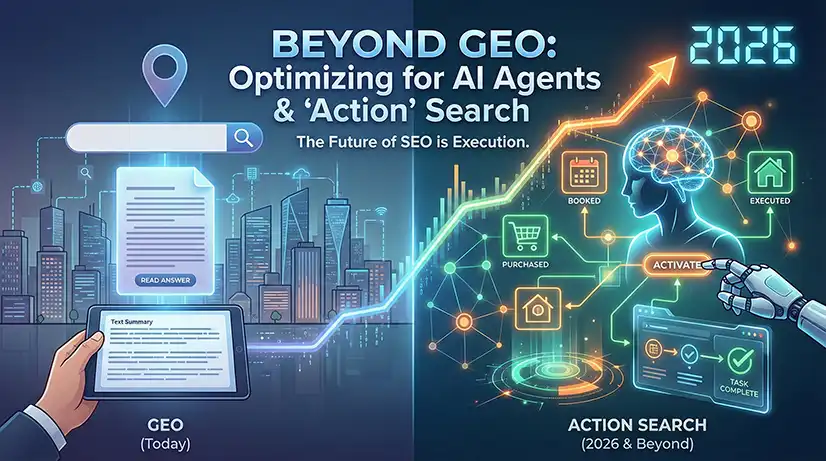
The digital marketing landscape is shifting beneath our feet faster than ever before. While most SEOs are still scrambling to understand Generative Engine Optimization (GEO) to rank in AI overviews, a new, more powerful wave is already forming. We are moving from the era of information retrieval to the era of task execution. If you want to survive the next algorithm shift, you must start optimizing for action search today.
In 2026, it won’t be enough for an AI to read your content; it needs to be able to use it. The rise of Large Action Models (LAMs) means AI agents—not just humans—will soon be your most important website visitors. They won’t just be looking for answers; they will be looking to perform tasks: booking appointments, buying products, or comparing detailed data sets.
This article explores why optimizing for action search is the inevitable successor to GEO and provides a technical roadmap to future-proof your digital presence.
What is Action Search?
To understand why optimizing for action search is critical, we must distinguish it from its predecessors.
- SEO (Search Engine Optimization): Optimizing for Blue Links. The goal is traffic.
- GEO (Generative Engine Optimization): Optimizing for LLMs (Large Language Models). The goal is to be the “cited answer.”
- Action Search: Optimizing for LAMs (Large Action Models). The goal is task completion.
Imagine a user in 2026 saying to their AI assistant, “Book the best-rated eco-friendly hotel in downtown Chicago for under $200.” The AI agent doesn’t just give a list of links; it navigates the web, filters options, checks availability, and executes the booking. If your site blocks the agent or lacks the structured data to facilitate this “handshake,” you don’t just lose a click—you lose the sale entirely.
1. Shift Your Mindset: From “Readability” to “Execute-ability”
The first step in optimizing for action search is realizing that your user interface (UI) is for humans, but your code structure is for agents.
GEO focuses on “Information Gain”—adding unique stats and quotes so an LLM cites you. Action Search focuses on “Frictionless Execution.” You need to ask yourself: Can a bot complete a conversion goal on my site without human intervention?
If you are already handling JavaScript heavy web development, you know that bots often struggle with client-side rendering. For AI agents, this is doubly true. They need clear, static paths to key conversion points.
2. Implement “Agentic” Schema Markup
Standard Schema.org markup (like Article or Product) is the baseline. However, optimizing for action search requires more specific “Action” schemas that define potential interactions.
You should implement PotentialAction properties within your structured data. This tells the AI agent explicitly what it can do on the page.
JSON
{
  "@context": "https://schema.org",
  "@type": "Hotel",
  "name": "EcoGreen Stay Chicago",
  "potentialAction": {
    "@type": "ReserveAction",
    "target": {
      "@type": "EntryPoint",
      "urlTemplate": "https://www.example.com/book?hotel_id=123"
    },
    "result": {
      "@type": "LodgingReservation",
      "name": "Book a room"
    }
  }
}
By explicitly defining the ReserveAction, you are handing the AI agent the keys to the transaction.
3. Expose Your APIs to Search
This is the most radical shift for 2026. Historically, APIs were private, backend tools. In the era of optimizing for action search, your API is your content.
Companies like Salesforce are already pioneering “Large Action Models” that interact directly with software interfaces. If you run an e-commerce store or a SaaS platform, consider creating a public “manifest” file (similar to robots.txt but for agents) that documents your API endpoints for search bots.
Note: Security is paramount here. You aren’t giving bots admin access; you are giving them “read” access to inventory and “write” access to cart additions, strictly controlled via token-less public endpoints or standardized AI protocols.
4. Prioritize “State-Aware” Content
AI agents are “state-aware”—they understand context over a sequence of steps. Optimizing for action search means your content must support this non-linear journey.
If an AI agent visits your pricing page, then your features page, and then your checkout, it builds a “state” of knowledge.
- Avoid orphaned pages: Every actionable page must be logically connected.
- Clear error handling: If a product is out of stock, the page must return a clear machine-readable status (e.g., HTTP 409 Conflict or a specific JSON error schema), not just a visual “Oops!” banner. Agents can’t “see” the banner, but they can read the status code.
This aligns perfectly with robust Technical SEO audits, ensuring that your HTTP responses are as clean as your visible text.
5. The Role of Entity Authority in Action Search
Trust is the currency of the future. An AI agent will not execute a transaction on a site it deems “risky.”
While GEO relies on E-E-A-T (Experience, Expertise, Authoritativeness, Trustworthiness) for citation, optimizing for action search relies on Entity Verification.
- Identity Proofing: Ensure your
Organizationschema is robust, linking to all verification platforms (Crunchbase, LinkedIn, BBB). - Consistent NAPs: Name, Address, and Phone data must be 100% consistent to verify you are a real-world entity capable of fulfilling a service.
6. Optimization for “Headless” Browsing
Many AI agents will browse your site in “headless” mode (without a graphical user interface).
- Speed is critical: Agents have timeout limits. If your script takes 5 seconds to load the “Buy” button, the agent assumes the action failed.
- Accessibility is SEO: The ARIA labels you use for screen readers are often the exact same tags AI agents use to navigate. Optimizing for action search is largely synonymous with optimizing for accessibility.
7. Measure “Agent Activity”
You can’t improve what you don’t measure. In 2026, your analytics implementation needs to evolve.
Start tagging bot traffic differently. Instead of blocking all bots, analyze the behavior of “good bots” (like ChatGPT-User or Google-Extended).
- Are they reaching your checkout pages?
- Where do they drop off?
- Are they triggering your
PotentialActionendpoints?
For detailed insights on tracking advanced metrics, check out our guide on PPC conversion tracking, which offers similar principles for monitoring non-human traffic sources.
Conclusion: The First Mover Advantage
The jump from GEO to optimizing for action search is significant. It requires moving resources from “content writing” to “technical structuring.”
However, the reward is massive. The first businesses to effectively communicate with AI agents will become the “default” choice for automated tasks. When a user asks their AI to “buy me running shoes,” the agent will choose the site that makes the purchase easiest for the agent, not necessarily the one with the prettiest banner image.
Start building your “action layer” today. The agents are coming, and they are ready to work.
Recommended External Reading
For a deeper dive into the mechanics of Large Action Models (LAMs), I highly recommend reading Salesforce’s guide on Large Action Models, which offers excellent foundational knowledge on how these systems operate.
Related Service
- SEO Company USA — Boost national visibility with expert SEO strategies.
- Web Design & Development — Build fast, conversion-optimized websites that Google loves.
- PPC Marketing (Pay-Per-Click) — Drive immediate, high-intent traffic for quick ROI.
- E-commerce SEO — Drive targeted shopper traffic and maximize online store revenue.
- Social Media Advertising — Turn paid campaigns into high-converting customer funnels.