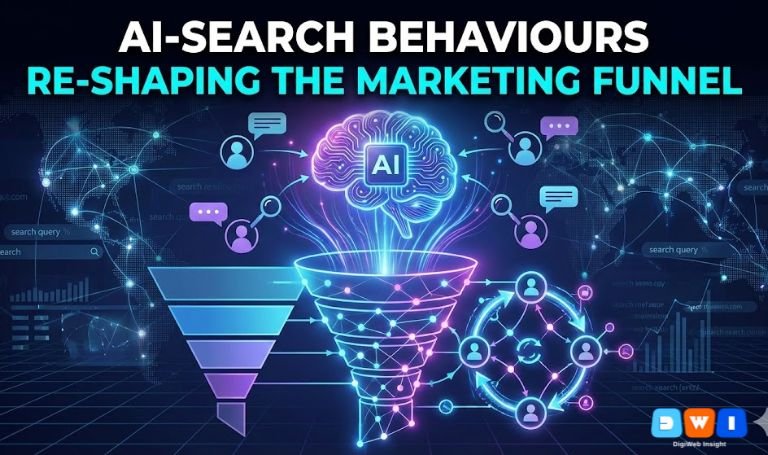
The traditional marketing funnel is undergoing its most radical transformation in two decades. For years, marketers relied on a predictable linear path: a user types a keyword, clicks a blue link, visits a website, and eventually converts. That predictable highway is now gone. AI-search behaviours have dismantled the old roadmap, creating a dynamic, multi-directional ecosystem where discovery and decision-making happen simultaneously.
As users increasingly turn to tools like ChatGPT, Google Gemini, and Perplexity for answers, they are no longer just “searching”; they are conversing. This shift requires a complete rethink of how we attract and convert customers. If your strategy is still stuck in 2023, you are likely optimizing for a ghost town.
Here is how AI-search behaviours are redefining the rules of engagement and what you must do to stay visible.
1. The Collapse of “Awareness” and “Consideration”
In the classic funnel, “Awareness” was distinct from “Consideration.” A user might search “best running shoes” (Awareness) and later search “Nike vs. Adidas running shoes” (Consideration).
Today, AI-search behaviours merge these stages into a single interaction. A user can ask an AI, “What are the best running shoes for flat feet under $100, and how do they compare?” The AI provides a synthesized answer, a comparison table, and recommendations in seconds. The user has moved from awareness to deep consideration without ever clicking a link or visiting a single brand website.
This “zero-click” reality means your top-of-funnel content must be optimized for citation, not just clicks. You need to be the source the AI trusts enough to quote.
2. From Keywords to Conversational Intent
The days of stuffing content with “best seo agency” keywords are fading. AI-search behaviours are driven by natural language and complex intent. Users are asking specific, multi-layered questions like, “Plan a 3-day marketing strategy for a small bakery using low-budget tools.”
To rank in this environment, your content needs to answer these complex queries comprehensively. It’s no longer about matching a keyword; it’s about matching the context. This is why partnering with experts in web design and development is crucial—to build structured, schema-rich pages that AI crawlers can easily digest and understand.
3. The Rise of “Answer Engine Optimization” (AEO)
As AI-search behaviours evolve, a new discipline is emerging: Answer Engine Optimization (AEO). Unlike traditional SEO, which fights for a position on a list of links, AEO fights for the “position zero” or the direct answer in an AI overview.
To succeed here, your content must be structured clearly. Use bullet points, bold text for key concepts, and direct answers to specific questions immediately following a heading. The goal is to make it as easy as possible for an AI model to extract your information and present it to the user.
If you are struggling to adapt your current content strategy to these new standards, working with an affordable SEO agency in the USA can help you pivot quickly without breaking the bank.
4. Trust and Authority Matter More Than Ever
AI models are trained to prioritize high-quality, authoritative information to avoid “hallucinations” (making things up). This means the E-E-A-T (Experience, Expertise, Authoritativeness, and Trustworthiness) guidelines are more critical than ever.
AI-search behaviours favor brands that demonstrate real-world experience. Generic, fluff-filled content will be ignored by AI algorithms. You need to showcase author credentials, cite reputable sources, and provide unique data or insights that can’t be found elsewhere.
For example, a generic article on “how to run ads” is less likely to be cited than a detailed case study with specific data points. Businesses utilizing Pay Per Click (PPC) marketing should document their unique wins and methodologies to build this authority.
5. The Funnel is Now a “Loop”
Perhaps the biggest change driven by AI-search behaviours is that the funnel is no longer a funnel at all—it’s a loop. Post-purchase, users continue to use AI to ask about product features, troubleshooting, or creative use cases.
If your content ecosystem supports these existing customers, the AI becomes a retention tool. It will surface your helpful guides and tutorials, reinforcing brand loyalty. Conversely, if you lack this support content, the AI might recommend a competitor’s resource, potentially poaching your customer.
This holistic approach requires a strong digital foundation. A comprehensive strategy from DigiWeb Insight can ensure all your digital assets—from your blog to your technical support pages—are aligned to capture users at every stage of this new “loop.”
Adapting to the New Reality
The shift in AI-search behaviours is not just a trend; it is the new operating system of the web. Users demand speed, precision, and synthesized answers. They don’t want to hunt; they want to find.
By focusing on high-value content, structured data, and genuine authority, you can ensure your brand remains visible. The marketing funnel hasn’t disappeared—it has just become smarter, faster, and more demanding. The opportunity lies in being the answer the AI chooses to give.
Key Takeaway: Stop optimizing for clicks and start optimizing for answers. The brands that provide the best raw data and clearest insights will own the future of search.
According to recent data from Search Engine Journal, conversational queries have seen a massive uptick, signaling that this behavior is here to stay.