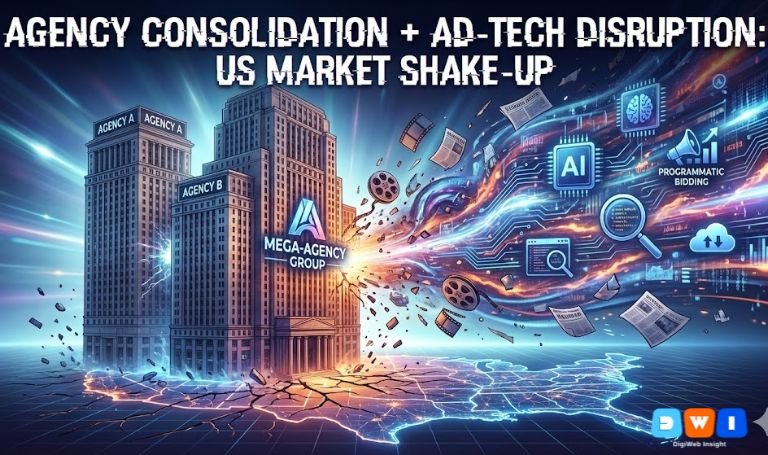
The US advertising landscape is currently enduring its most significant structural shift in decades. Late 2024 and 2025 have been defined by a twin force: massive agency consolidation + ad-tech disruption. These two trends are not operating in isolation; they are fueling each other, creating a high-stakes environment where only the most agile businesses will survive.
The headline event—the $13.5 billion merger between Omnicom and Interpublic Group (IPG)—has set the tone. But beneath the surface of these mega-mergers lies a deeper current of technological change driven by AI, privacy regulations, and a race for first-party data.
If you are a marketer, agency owner, or business leader, understanding this agency consolidation + ad-tech disruption is no longer optional. It is critical for survival. Here is how the market is changing and what it means for your strategy.
1. The Era of the “Mega-Holding” Company
The consolidation of agencies has reached a fever pitch. With the Omnicom-IPG deal finalizing, we are seeing the retirement of historic agency brands like DDB and FCB, which are being folded into larger networks like TBWA and BBDO.
This isn’t just about size; it’s about efficiency. The new “Mega-Holding” companies are designed to strip away administrative bloat and pool resources to invest in expensive AI infrastructure. For clients, this means fewer choices but potentially more powerful, integrated service offerings.
However, this agency consolidation + ad-tech disruption creates a vacuum. As the giants get bigger, they often lose the personal touch. This opens a massive door for boutique agencies and specialized firms, like an affordable SEO agency in the USA, to step in and offer the agility and dedicated attention that the behemoths can no longer promise.
2. The Ad-Tech M&A Frenzy: Racing for Data
While agencies merge to cut costs, ad-tech companies are merging to acquire data. The “cookie deprecation” saga may have evolved into a “user choice” model, but the panic for first-party data remains.
In 2025 alone, we have seen significant moves, such as Publicis acquiring identity specialist Lotame and The Trade Desk acquiring Sincera. These deals are not random. They are calculated moves to build “walled gardens” within the open web.
Advertisers can no longer rely on third-party data rental. You must own your data strategy. This is why agency consolidation + ad-tech disruption is pushing brands to bring their tech stacks in-house or partner with agencies that have proprietary data solutions.
3. AI: The Engine of Agency Consolidation + Ad-Tech Disruption
Artificial Intelligence is the invisible hand forcing this shake-up. Generative AI is capable of performing tasks that used to require armies of junior copywriters and media buyers.
Agencies are consolidating because they need capital to build enterprise-grade AI “brains” that can automate content creation and media optimization at scale. If your current marketing partner isn’t using AI to lower your costs or improve your speed to market, they are already behind.
For businesses looking to leverage this tech without the enterprise price tag, partnering with a forward-thinking web design and development team can help you integrate AI-driven chatbots and personalization tools directly into your digital presence.
4. The Rise of Retail Media Networks (RMNs)
A major byproduct of this shake-up is the explosion of Retail Media Networks. Retailers like Walmart, Amazon, and even smaller niche players are becoming ad networks. They possess the “closed loop” attribution data that advertisers crave.
This is disrupting the traditional ad-tech flow. Money is moving out of the “open exchange” and into these retail fortresses. Agency consolidation + ad-tech disruption is accelerating this shift, as holding companies rush to sign exclusive partnerships with these retail giants to gain access to their shopper data.
5. Privacy and the “Owned Stack” Renaissance
Finally, the disruption is driving a “Custom AdTech Renaissance.” Brands are tired of the “black box” of programmatic advertising where 15-20% of their budget vanishes in tech fees.
In response to opaque fees and privacy risks, sophisticated advertisers are building their own mini-stacks. They are curating their own supply paths and demanding total transparency.
To navigate this complex ecosystem, you need a partner who understands the technical nuances of performance marketing. Using Pay Per Click (PPC) marketing services that prioritize transparency and direct data ownership is the best defense against the opacity of the broader market.
Conclusion: navigating the Shake-Up
The wave of agency consolidation + ad-tech disruption is not slowing down. 2026 will likely see the “middle” of the market disappear, leaving only the massive consolidated giants and the nimble, hyper-specialized experts.
Your strategy must evolve. Do not cling to old agency models or outdated targeting methods. Embrace first-party data, demand transparency, and align yourself with partners who are agile enough to pivot as the technology changes.
For a comprehensive audit of your current digital strategy in this changing landscape, visit DigiWeb Insight.
According to recent reports from Digiday, ad-tech M&A volume surged by over 70% in the last year, proving that the race for technological dominance is just beginning.