
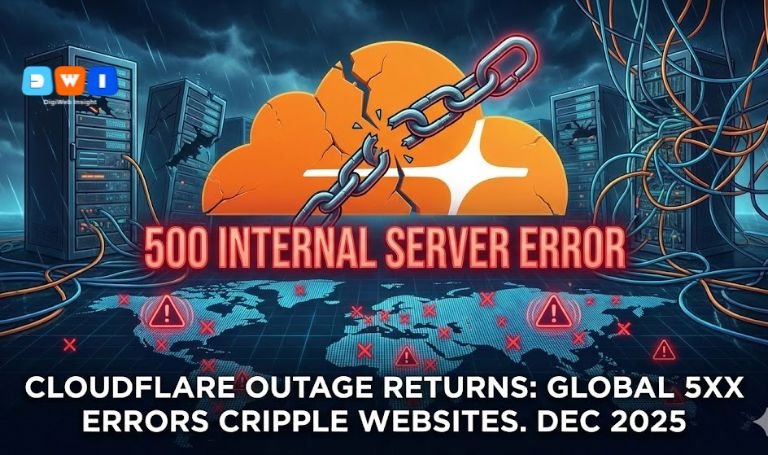
For the second time in less than a month, the internet’s backbone has fractured. On December 5, 2025, a massive Cloudflare Outage Returns to haunt digital businesses, reminding us just how fragile our centralized web infrastructure truly is. Starting at approximately 08:47 UTC, millions of users worldwide were greeted not by their favorite apps, but by a cold, white screen displaying “500 Internal Server Error” or “Bad Gateway.”
This wasn’t a minor glitch. It was a critical infrastructure failure that severed the connection between users and major platforms like Canva, Zerodha, LinkedIn, and Zoom. If your website suddenly flatlined yesterday, you weren’t alone—approximately 28% of all HTTP traffic served by Cloudflare was impacted during the peak of the incident.
Below, we break down exactly why this happened, the technical “own goal” that caused it, and what this means for your reliance on single-provider cloud services.
The Timeline: When the Cloudflare Outage Returns
The chaos began early on a Friday, a peak time for global business operations. According to Cloudflare’s official post-mortem, the incident timeline was sharp and destructive:
- 08:47 UTC: A configuration change was deployed to Cloudflare’s network.
- 08:48 UTC: Full global impact. Traffic to thousands of sites began failing immediately.
- 09:12 UTC: The bad change was reverted, and traffic normalized.
While the outage lasted only about 25 minutes, the damage was disproportionate. In the world of high-frequency trading and real-time communication, 25 minutes is an eternity. Users on social media platforms like X (formerly Twitter) flooded the feed with screenshots of broken dashboards, creating a viral storm of frustration.
Root Cause: A “React Vulnerability” Mitigation Gone Wrong
When the Cloudflare Outage Returns, the immediate suspicion is often a DDoS attack. However, this disruption—like the one in mid-November—was self-inflicted.
Cloudflare engineering teams were rushing to patch a newly disclosed industry-wide vulnerability affecting React Server Components (CVE-2025-55182). To protect their customers, they attempted to update their Web Application Firewall (WAF) rules to inspect larger data packets (increasing the buffer size from 128KB to 1MB).
The “Lua” Bug
The update triggered a hidden bug in Cloudflare’s legacy code. When the new rule was propagated, it interacted poorly with an internal testing tool that had been disabled. This caused a “nil value” exception in the Lua scripting language that powers much of their proxy logic.
In simple terms: The safety mechanism designed to protect the internet accidentally broke it. The code crashed, and instead of failing “open” (letting traffic through), it failed “closed,” dropping connections and serving 500 errors to the world.
Impact on Global Business and SEO
The ramifications of when a Cloudflare Outage Returns are immediate and costly.
- Financial Sector: In India, major stock trading platforms like Zerodha and Groww went dark during active market hours, leaving traders unable to exit positions.
- SaaS Productivity: Tools like Canva and Quillbot became inaccessible, halting workflows for creative professionals globally.
- E-commerce: Thousands of Shopify stores utilizing Cloudflare’s CDN faced checkout failures.
For website owners, these outages are a nightmare for SEO signals. While Google generally forgives brief downtimes, repeated instability can erode “Core Web Vitals” scores and user trust. Ensuring your site is resilient is no longer just a technical task—it’s a core business requirement.
If you are concerned about how your infrastructure handles these upstream failures, consulting with experts in web design and development can help you build redundancy plans, such as “failover” static pages that stay online even when your dynamic backend struggles.
Can You “Fireproof” Your Site?
The uncomfortable truth revealed when the Cloudflare Outage Returns is that total independence is difficult. Cloudflare acts as a reverse proxy; when it breaks, your site effectively disappears from the public internet, regardless of whether your origin server is healthy.
However, you aren’t helpless. Here are three strategies to mitigate the pain:
- Multi-CDN Strategy: Enterprise clients are increasingly looking at “multi-CDN” setups, where traffic can be routed to Akamai or Fastly if one provider fails.
- Status Page Communication: During an outage, your users assume you are broken. Having a status page hosted on a separate infrastructure (like Atlassian Statuspage) allows you to communicate clearly.
- Diversified Marketing Channels: If your site is down, your email list becomes your lifeline. Use Pay Per Click (PPC) marketing data to build robust customer lists so you can reach your audience directly via SMS or email when the web is dark.
Conclusion: The Cost of Centralization
As the dust settles, the tech community is left asking difficult questions. Is the internet too reliant on a single company? When the Cloudflare Outage Returns twice in a month, it suggests that the complexity of modern cloud infrastructure might be outpacing our ability to manage it safely.
For now, the patch is applied, and the green lights are back on. But for savvy business owners, this is a wake-up call to review your digital contingency plans.
To ensure your digital presence is built on a solid, SEO-friendly foundation that can weather these storms, visit DigiWeb Insight for a comprehensive audit. Additionally, if you need to recover lost visibility from recent downtime, our affordable SEO agency in the USA can help you regain your rankings.
… Cloudflare’s Trust Crisis – December 2025 Outage Analysis …
This video provides a deep-dive analysis into the December 5th outage, examining the technical “Lua bug” in detail and discussing the broader “trust crisis” emerging from Cloudflare’s repeated infrastructure failures.