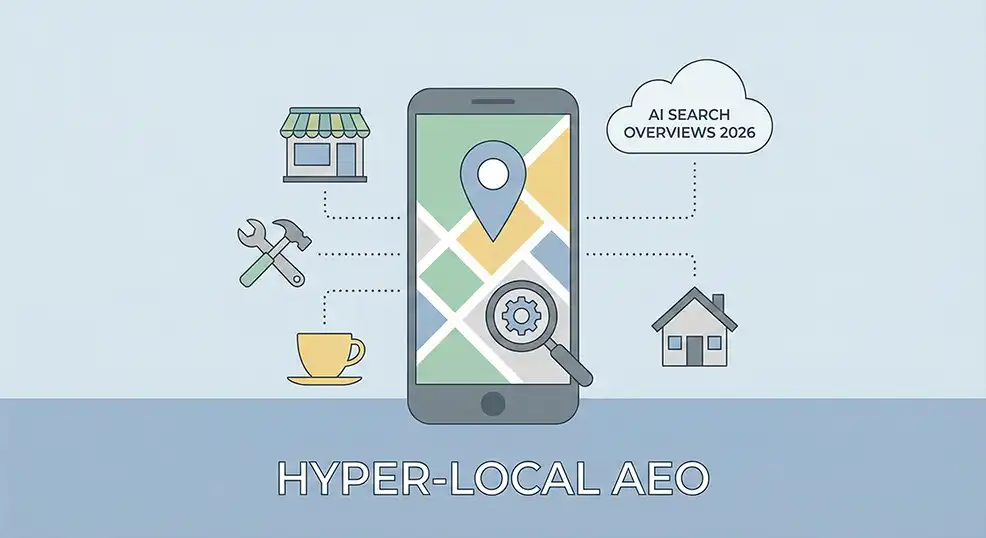
The “ten blue links” are dying. If you run a local business, you have likely noticed the shift already. Your customers aren’t just typing keywords into Google anymore; they are having conversations with it. This shift has birthed a new necessity: Hyper-Local AEO 2026.
For decades, the goal was to rank #1 on a list. But in the age of Gemini, ChatGPT, and Google’s AI Overviews (formerly SGE), there is often only one answer provided. If your business isn’t that answer, you are invisible.
The panic among small business owners is real, but so is the opportunity. Most of your competitors are still obsessing over traditional keywords. By pivoting to Answer Engine Optimization (AEO) now, you can secure your spot as the “trusted expert” that AI recommends.
Here is how to future-proof your visibility and rank in Google AI Overviews without spending a fortune on ads.
What is Hyper-Local AEO 2026?
We need to redefine how we look at search. Traditional SEO was about finding. AEO is about answering.
Hyper-Local AEO 2026 is the strategic process of optimizing your online presence so that AI models (like Google’s Gemini) cite your business as the definitive answer for local queries.
When a user asks, “Who is the most reliable emergency plumber in downtown Chicago?”, the AI doesn’t just look for keywords. It looks for trust, context, and sentiment. It reads reviews, checks local forums, and scans your service pages to see if you actually answer that specific need.
The difference is subtle but critical.
- SEO: You try to rank for “Plumber Chicago.”
- AEO: You optimize to be the answer for “Can I find a plumber in Chicago who works on Sundays?”
Why Traditional SEO Isn’t Enough Anymore
The “zero-click” reality is here. Users are getting their answers directly on the search results page. If you are relying solely on old-school backlink building and keyword stuffing, your traffic is going to plummet.
AI Overviews prioritize content that is direct, authoritative, and structured in a way machines can easily digest. If your website is a wall of marketing fluff, the AI will skip you.
Implementing Hyper-Local AEO 2026 strategies ensures that when the AI compiles its summary, your business is the one being referenced.
1. Optimize for “Conversational” Long-Tail Queries
People talk to AI like a friend. Your content needs to reflect that.
Stop targeting robotic phrases like “best roofer.” Start answering the specific, messy questions your actual customers ask on the phone. The AI is trained on natural language, so your content should mirror natural speech.
Instead of a generic “Services” page, create content that addresses specific scenarios. For example, write a blog post titled “What to do when your roof leaks during a storm in [Your City].”
This aligns perfectly with how users interact with voice search and AI assistants. By answering the question directly in the first paragraph, you increase the chances of being the featured snippet or the AI’s direct answer.
2. Leverage “Speakable” and FAQ Schema
This is the technical secret weapon of Hyper-Local AEO 2026.
AI models are smart, but you should make their job easier. Schema markup is code that helps search engines understand exactly what your content is. For local businesses, FAQ Schema is non-negotiable.
When you wrap your content in FAQ schema, you are essentially hand-feeding the answer to Google. You are saying, “Here is the question, and here is the exact answer.”
Additionally, look into “Speakable” schema, which is designed specifically for voice assistants (Google Assistant, Alexa). This markup identifies sections of an article that are best suited for audio playback (text-to-speech), making you the go-to source for voice searches.
Pro Tip: Not sure where to start with technical markup? OurLocal SEO Servicescan help you implement the right schema code to get noticed by AI.
3. Build “Brand Authority” Through Citations
In the world of AEO, a “link” is less valuable than a “citation.”
AI models are trained to look for consensus. If five different local news outlets, three neighborhood blogs, and a dozen Reddit threads all mention your restaurant as the “best vegan spot,” the AI trusts that consensus.
This means your off-page strategy needs to shift. Don’t just hunt for dofollow links. Hunt for mentions.
- Get featured in local “Best of” lists.
- Sponsor local charity events (and get mentioned on their site).
- Engage with the community on platforms like Nextdoor.
These consistent brand mentions tell the AI that you are a real, trusted entity in your specific geographic area.
4. Why Hyper-Local AEO 2026 Requires “Justification”
Google Maps has a feature called “Justifications.” You have probably seen them—little snippets under a map listing that say “Their website mentions ‘vegan pizza'” or “Sold here: organic coffee.”
These are powerful signals. AI looks for these justifications to verify that you offer exactly what the user is hunting for.
To optimize for this, ensure your website copy explicitly mentions the neighborhoods you serve and the specific services you offer. Do not just say “We serve the Greater Metro Area.” Say, “We provide same-day AC repair in Hyde Park, Lincoln Park, and the Gold Coast.”
You can read more about this specific tactic in our guide on Google Maps Justifications.
5. Prioritize “Freshness” in Your Content
AI models are hungry for the newest information. A static website that hasn’t been updated since 2023 is a red flag.
To win at Hyper-Local AEO 2026, you need a “living” website. This doesn’t mean rewriting your homepage every week. It means having an active blog or news section.
Update your Google Business Profile weekly. Post about seasonal offers, new staff members, or completed projects. Signals of recent activity reassure the AI that your business is open, active, and relevant right now.
6. The Role of Visual Search
We cannot talk about the future without mentioning visuals. As we discussed in our article on Visual Search SEO 2026, users are increasingly searching with their cameras.
Google Lens is integrated into the AI experience. If a user snaps a photo of a broken pipe, the AI might identify the part and recommend a local plumber who has that specific part listed in their inventory.
Ensure your images are high-quality, original (no stock photos!), and tagged with descriptive alt text that includes your location and service keywords.
7. Collect Review Sentiment, Not Just Stars
Finally, stars are not enough. A 5-star rating is great, but a 5-star review that says “They arrived in 20 minutes and fixed the leak for under $200” is gold for Hyper-Local AEO 2026.
AI reads the text of your reviews to understand sentiment and context. It uses this data to answer specific questions like “Who is the most affordable plumber?” or “Who has the fastest response time?”
Encourage your happy customers to be specific in their feedback. Ask them to mention the service they received and the location. This user-generated content acts as a powerful trust signal that no amount of ad spend can buy.
Conclusion: The Future is Conversational
The transition to Hyper-Local AEO 2026 might feel daunting, but it is actually a return to basics. It is about being helpful, being local, and being clear.
The businesses that survive the AI revolution won’t be the ones with the biggest ad budgets. They will be the ones that provide the best answers. By focusing on structured data, conversational content, and genuine local authority, you can ensure that when the AI speaks, it speaks about you.
For a deeper dive into how search engines are evolving, check out this resource from Search Engine Land on the future of Search Generative Experience.
The rules have changed. It is time to adapt your strategy and start answering the questions your customers are actually asking.