
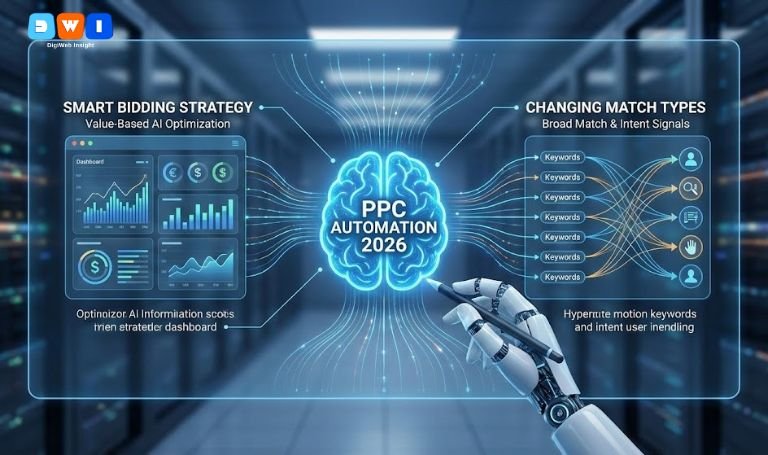
Is your Cost Per Acquisition (CPA) creeping up while your control over search terms goes down? You aren’t alone. PPC Automation 2026 updates have fundamentally changed how Google Ads manages traffic, forcing marketers to adapt or waste budget.
In late 2025, Google accelerated its shift toward “AI-first” advertising. The days of granular, manual bidding on single keywords are nearly gone. Today, the algorithm prioritizes intent over syntax, and value over volume.
If you are still fighting the algorithm with 2023 tactics, your campaigns will struggle. This guide explores the new rules of PPC Automation 2026 and how you can regain control over your ad spend.
The Shift: Why “Match Types” Are Different Now
One of the biggest changes in PPC Automation 2026 is the redefinition of keyword match types.
Historically, “Exact Match” meant the user typed exactly what you bid on. Now, Google’s AI interprets “Exact Match” as “Exact Intent.” This means your ad might show for a query that doesn’t contain your keyword at all, provided the AI believes the user wants your product.
This shift has made Broad Match the default preference for Google’s Smart Bidding. When paired with Smart Bidding, Broad Match no longer blindly chases traffic; it analyzes millions of data points—from user location to past search history—to predict conversion probability.
Key Takeaway: You cannot view match types as strict filters anymore. They are now “guide rails” for the AI.
PPC Automation 2026: Bidding for Value, Not Clicks
The second major pillar of PPC Automation 2026 is the move from “Maximize Conversions” to Value-Based Bidding.
In previous years, automation often chased “easy” conversions—cheap leads that didn’t necessarily convert into paying customers. Google’s updated bidding models now require you to feed them First-Party Data.
By uploading “Offline Conversion Data” (e.g., which leads actually bought a product), you train the automation to bid higher only for high-quality users. If you aren’t feeding offline data back into Google Ads, you are flying blind.
For businesses struggling to set up these technical feedback loops, professional pay-per-click (PPC) marketing services are essential to bridge the gap between CRM data and ad platforms.
3 Ways to Maintain Control in an Automated World
While PPC Automation 2026 offers efficiency, it lacks nuance. Here is how to stop the AI from overspending on irrelevant traffic:
1. Aggressive Negative Keyword Lists
Since you can’t strictly control what you do rank for, you must strictly control what you don’t rank for. Review your Search Term Reports weekly. If the AI matches “luxury design” with “cheap DIY tips,” block “cheap” and “DIY” immediately.
2. Use “Brand Exclusions” in Performance Max
Performance Max (PMax) campaigns love to steal credit for branded searches. Ensure you add a Brand Exclusion list to your PMax campaigns so the automation focuses on finding new customers, not just retargeting people who already know you.
3. Optimize Landing Page Experience
Automation looks at post-click behavior. If your site loads slowly or lacks relevance, the AI will stop showing your ads to premium users. Investing in quality web design and development ensures your Quality Score remains high, lowering your costs.
The Role of SEO in PPC Automation
Interestingly, PPC Automation 2026 relies heavily on the content of your landing page to understand context. If your page has poor SEO, the dynamic search ads (DSA) and PMax assets won’t generate relevant headlines.
A holistic strategy is vital. Your organic search efforts feed the data that paid automation uses. Partnering with an affordable SEO agency in USA can ensure your site content is optimized to support both organic rankings and paid quality scores.
Conclusion
PPC Automation 2026 is not about surrendering control; it is about steering a faster vehicle. The improved Broad Match and Smart Bidding capabilities can drive massive scale, but only if you provide the right data inputs and negative guardrails.
Don’t let the “black box” drain your budget. Audit your bidding strategies today and switch to value-based optimization.