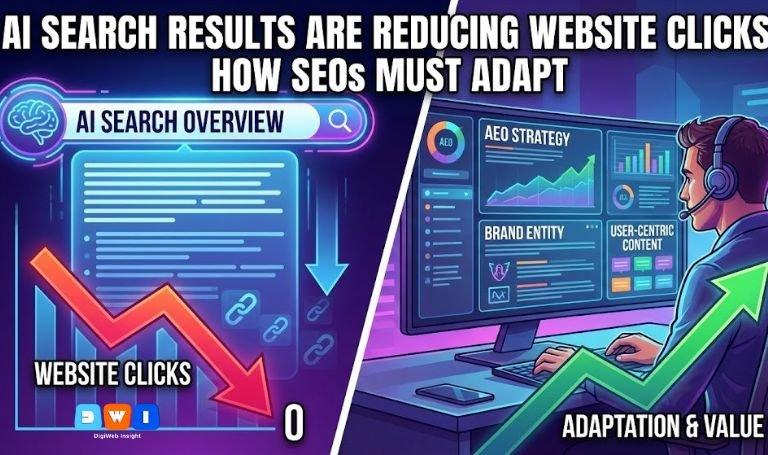
In late 2025, the SEO industry is facing a reality we all feared but expected: AI search results are reducing website clicks at an unprecedented rate.
Gone are the days when ranking #1 guaranteed a 30% click-through rate (CTR). With Google’s AI Overviews (formerly SGE) now fully mature and occupying the entire “above the fold” real estate on mobile, users are getting their answers without ever visiting a website.
Industry data confirms this trend. A recent report dubbed this phenomenon “The Great Decoupling”—where search volume and impressions are at all-time highs, but organic traffic to informational pages is plummeting. If your analytics show flat traffic despite high rankings, you aren’t alone.
Here is why AI search results are reducing website clicks and, more importantly, 5 strategic pivots you must make to survive.
The “Zero-Click” Reality of 2025
The core of the problem is simple: Google has evolved from a search engine into an answer engine.
When a user asks, “How do I fix a leaky faucet?” or “Best CRM for small business 2025,” the AI Overview provides a comprehensive, synthesized answer. It pulls data from multiple sources, lists pros and cons, and even offers step-by-step guides. The user is satisfied. The search ends. No click happens.
This shift has pushed the “Zero-Click” rate to over 60% for informational queries. For publishers relying on ad revenue from pageviews, this is catastrophic. However, for businesses selling products or services, the intent is still there—it just looks different.
5 Ways SEOs Must Adapt Now
To thrive in an era where AI search results are reducing website clicks, you cannot rely on the old playbook of “write 2,000 words and wait.” You need to optimize for visibility inside the AI answer.
1. Shift from “Keywords” to “Answer Engine Optimization” (AEO)
Traditional SEO was about keywords. AEO is about being the source of the AI’s answer.
- Structure is King: AI models love structure. Use
<h2>and<h3>tags as questions and answer them immediately in the first sentence of the following paragraph. - The “Inverted Pyramid”: Don’t bury the lead. Give the direct answer first (for the AI), then expand on the details (for the human who clicks).
- Schema Markup: Use
FAQPageandHowToschema to feed structured data directly to the bot.
2. Optimize for “Brand Mentions” & Citations
In 2025, a brand mention is the new backlink. AI models like Gemini and ChatGPT cite sources they “trust,” even if they don’t always link to them.
- Focus on Digital PR. Getting your brand mentioned in authoritative industry reports or news sites trains the AI to associate your brand with specific topics.
- If you need help building this authority, working with an affordable SEO agency USA can help you earn the high-quality mentions that matter.
3. Target “Experience-Based” Queries (The Human Edge)
AI can summarize facts, but it cannot have experiences. It has never tasted a pizza, used a specific software tool, or felt the frustration of a broken car part.
- Double down on content that AI cannot generate: personal case studies, contrarian opinions, and video reviews.
- Google’s “Hidden Gems” system prioritizes this content. If your article says “I tested this…” instead of “Here are the features…”, you are more likely to earn the click.
4. Diversify Your Traffic Sources
If AI search results are reducing website clicks from Google, you must find traffic elsewhere.
- Email Marketing: Own your audience. An email list is immune to algorithm updates.
- Social & Video: Platforms like TikTok and YouTube are search engines in their own right.
- Paid Media: While organic reach dips, pay per click PPC marketing ensures you appear for high-intent transactional keywords where AI summaries are less intrusive.
5. Focus on UX and Conversion, Not Just Traffic
With fewer visitors, every click is more valuable. You can no longer afford a high bounce rate.
- Audit your site’s User Experience (UX). Is it fast? Is it mobile-perfect?
- If your design is outdated, it hurts your credibility with both users and AI bots. A modern interface is crucial—consider professional web design development to ensure every visitor you do get counts.
Why “Reducing Clicks” Isn’t the End
It is easy to panic when you see that AI search results are reducing website clicks. But looking closer, the clicks that remain are often higher quality.
Users who click through an AI Overview are deeply interested. They read the summary and decided, “I need more depth.” These users convert at a higher rate. The “tire-kickers” are gone, satisfied by the summary. The serious buyers are the ones visiting your site.
Conclusion
The era of easy traffic is over. As AI search results are reducing website clicks, the winners will be those who adapt their strategy from “chasing volume” to “chasing value.”
Focus on AEO, build a brand that AI trusts, and ensure your website converts the traffic it gets.
Need a strategy overhaul? Visit DigiWebInsight to future-proof your SEO against the AI revolution.