
The “Less is More” Approach to Rankings
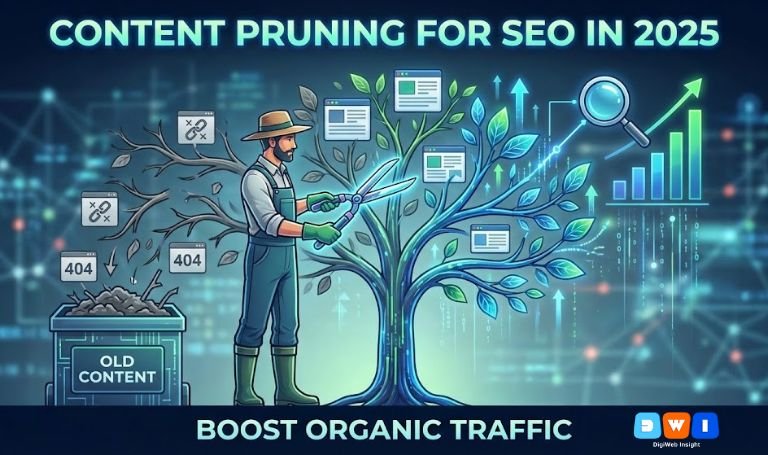
Imagine your website is a garden. If you let weeds and dead branches grow unchecked, the healthy plants struggle to survive. The same logic applies to digital marketing. Content Pruning for SEO in 2025 is no longer just a maintenance task; it is a critical strategy for growth.
Many website owners believe that having more pages automatically equals more traffic. However, Google’s algorithms have evolved to prioritize quality over quantity. If your site is bloated with outdated, thin, or irrelevant content, it drags down your overall authority. By strategically removing or improving these underperforming pages, you can skyrocket your organic traffic.
What is Content Pruning?
Content pruning is the process of auditing your website to identify and remove content that is no longer adding value. This isn’t about deleting everything; it’s about refining your digital footprint.
When you master Content Pruning for SEO in 2025, you help search engines understand exactly what your site is about. This ensures that Google’s “crawl budget” is spent on your high-value pages—like your core services or high-converting landing pages—rather than wasting resources on blog posts from 2018 that have zero views.
Why Digital Agencies Must Prune Now
For any Affordable SEO Agency USA based, keeping a client’s site lean is essential. Old content can suffer from “keyword cannibalization,” where multiple pages compete for the same search terms, confusing Google and lowering rankings for both.
Furthermore, user experience (UX) is a ranking factor. Users who land on broken or outdated pages bounce quickly. Sometimes, the solution isn’t just deletion but a revamp involving Web Design Development to merge thin pages into one robust, authoritative resource.
Step-by-Step Guide to Effective Pruning
To implement Content Pruning for SEO in 2025 safely, follow this simple framework:
1. The Audit
Start by listing all your URLs. Use tools to gather data on traffic, backlinks, and conversions over the last 12 months.
2. Identify the Dead Weight
Look for pages with:
- Near-zero traffic.
- Outdated information (e.g., “Trends from 2019”).
- Duplicate content issues.
3. Decide: Improve, Remove, or Redirect
- Improve: If the topic is still relevant but the content is thin, update it.
- Remove (404/410): If the page has no value, no links, and no traffic, delete it.
- Redirect (301): If the page has backlinks but the content is old, redirect it to a relevant, newer page.
Balancing Organic and Paid Strategies
While you wait for your pruning efforts to take effect, you don’t have to lose momentum. A balanced strategy often uses Pay Per Click (PPC) Marketing to drive immediate traffic to your newly polished core pages while your organic authority rebuilds.
Following Google’s Guidelines
It is vital to follow established best practices. According to Google Search Central, focusing on creating helpful, reliable, and people-first content is key. Pruning removes the “unhelpful” noise, aligning your site directly with these EEAT (Experience, Expertise, Authoritativeness, and Trustworthiness) principles.
The Future of Your Content Strategy
Implementing Content Pruning for SEO in 2025 allows you to move forward with a stronger foundation. A cleaner site loads faster, ranks better, and converts more visitors. Don’t be afraid to cut the dead weight—your traffic will thank you for it.
For a comprehensive audit of your digital presence, reach out to DigiWebInsight today.