For decades, a stark divide has defined the marketing agency landscape in the US and UK. On one side, the Goliaths: multinational holding companies with entire floors of data scientists, multi-million-dollar analytics budgets, and proprietary predictive models. On the other, the Davids: the small, scrappy, creative-led agencies with all the hustle but none of the data-science muscle.
For these small agencies, “data analytics” has long been a source of frustration. Drowning in a sea of disconnected GA4, CRM, and social media exports, they are often “data-rich but insight-poor.” They spend dozens of non-billable hours each month manually wrangling CSVs and building static PowerPoint reports that tell clients what happened, not what to do next.
But that era is definitively over.
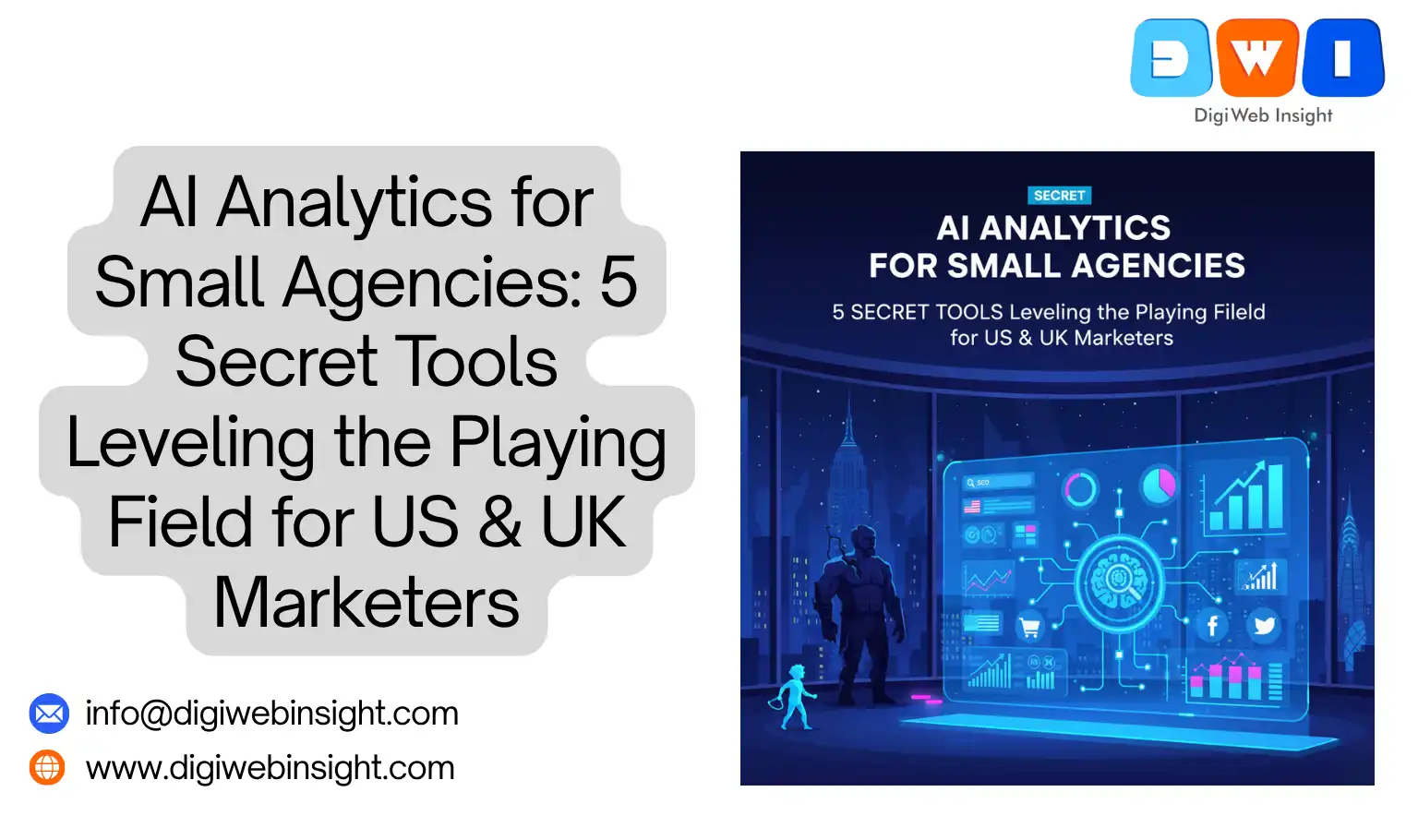
A new, democratic revolution is underway, powered by AI Analytics for Small Agencies. This isn’t just another buzzword; it’s the single greatest equalizer the marketing industry has ever seen. Affordable, powerful, and user-friendly AI tools are now capable of performing the work of an entire data science team, right from a single subscription.
This article breaks down the five essential categories of AI analytics tools that are enabling small US and UK agencies to stop competing on price and start winning clients with enterprise-level insights.
The “Analysis Paralysis” Trap: Why Small Agencies Are Drowning
The old model of agency reporting is broken. It’s a time-consuming, low-value process that both agencies and clients have come to dread.
The typical workflow looks like this:
- Pull raw data from Google Analytics, Google Ads, Meta Ads, LinkedIn, and the client’s CRM.
- Spend hours in Excel or Google Sheets trying to make the numbers match.
- Paste static charts into a bloated slide deck.
- Present a “report” that is, at best, a 30-day-old snapshot of the past.
This process is purely reactive. It answers “what,” but almost never “why.” When a client asks, “Why did our leads from London drop 40%?” the honest answer is often, “We’ll have to dig in and get back to you”—a response that kills an agency’s credibility.
What is AI Analytics for Small Agencies (And Why Is It a Revolution?)
AI Analytics for Small Agencies fundamentally changes this entire dynamic. It moves an agency from a reactive data-entry-clerk role to a proactive strategic partner.
It’s not just a faster dashboard. It’s the application of artificial intelligence to:
- Automate (Descriptive): Automatically pull all data from all sources into one place.
- Diagnose (Diagnostic): Find the hidden correlations. Instead of you finding the 40% drop, the AI alerts you to it and also tells you, “This drop correlates with a 300% increase in competitor ad spend in the same region.”
- Forecast (Predictive): Use historical data to predict future outcomes, such as “Our model forecasts a 25% decline in Campaign A’s performance next month” or “This list of 100 leads is 90% likely to convert.”
- Recommend (Prescriptive): Suggest a specific course of action, such as, “We recommend shifting 30% of the budget from Campaign A to Campaign B to maximize ROI.”
This is the new-age “David’s Slingshot.” It allows a three-person agency in Manchester to deliver insights that are faster, deeper, and more actionable than a 30-person analytics department at a legacy firm in London.
The 5 AI Tools Leveling the Playing Field
No single tool does it all. The key is building a small, powerful “stack” that covers the most critical functions. Here are the five categories of AI Analytics for Small Agencies that are making the biggest impact.
1. The AI-Powered Business Intelligence (BI) Platform
What it is: This is your agency’s new central “brain.” It’s a platform that connects to all your disparate data sources (GA4, ad platforms, CRMs, e-commerce stores) and unifies them in one interactive, intelligent dashboard.
Examples: Microsoft Power BI, Tableau, Zoho Analytics.
The AI “Magic”: The killer feature is Natural Language Query (NLQ). Your team no longer needs to know complex database languages. They can simply type a question in plain English, just like in a search bar.
- Old Way: “Hey, data team, can you build a report that shows conversion rates for our new blog posts, segmented by traffic source and UK city? Get it to me by Friday.”
- New Way: (An account manager types) “Show me conversion rates for new blog posts from the last 30 days, broken down by source and city.”
The AI generates a beautiful, accurate, and interactive visualization in seconds. This allows a junior account manager to answer a C-suite-level question in the middle of a client meeting, instantly proving their value.
2. The Predictive Lead & Churn Model
What it is: This is an AI layer (often built into modern CRMs) that analyzes all your past customer behavior to predict the future. It’s the end of the “all leads are created equal” mindset.
Examples: Features within HubSpot’s AI, Salesforce Einstein, or dedicated predictive platforms.
The AI “Magic”: This AI runs thousands of variables to create two critical things: predictive lead scoring and customer churn risk. Instead of just handing a client 500 “leads,” you hand them 40 “9-star leads” that the AI has flagged as 90% likely to convert based on their job title, on-site behavior, email engagement, and 1,000 other micro-data points.
Benefit for US/UK Agencies: This is the ultimate client retention tool.
- For Client Acquisition: You can prove which of your marketing-generated leads are actually high-value.
- For Client Retention: You can proactively tell a client, “Mr. Client, our AI model flags these 40 customers as ‘high churn risk’ in the next 60 days. We’ve already designed a re-engagement campaign to save them.” This is an invaluable, high-level strategic service.
3. The AI-Driven Content & SEO Analytics Tool
What it is: This is the evolution of keyword research. These tools use AI and Natural Language Processing (NLP) to analyze the semantic meaning and topical authority of content, not just keywords.
Examples: SurferSEO, MarketMuse, Clearscope.
The AI “Magic”: Instead of just telling you a keyword has “1,000 searches a month,” these tools analyze the top 20-ranking pages for that query. The AI deconstructs their structure, identifies the common questions they answer, finds the “content gaps” they all missed, and generates a data-driven brief. It tells you, “To rank, your article must be 2,500 words, include these 40 subtopics, and answer these 15 user questions.”
Benefit for US/UK Agencies: This is how you end the subjective guesswork of content marketing. You can go to a client with a data-backed guarantee, not just a “good idea.” As we’ve covered before, this is a core part of how AI is making traditional keyword research obsolete. It allows a small agency to create content that consistently outranks competitors with 10x the budget.
4. The Automated Ad Optimization & Attribution Platform
What it is: These are AI platforms designed to solve two of the biggest problems in digital marketing: “Where should I spend my next dollar?” and “How do I know what’s really working?”
Examples: AdCreative.ai, Albert.ai, or the increasingly powerful AI features within Google and Meta’s own platforms.
The AI “Magic”: These tools perform two miracles. First, they use AI to generate and test thousands of ad creative variations (images, headlines, CTAs) in hours, a task that would take a human team months. Second, they use advanced attribution modeling to track the entire customer journey, not just the “last click,” and then reallocate the budget in real-time to the best-performing-audiences-on-the-best-performing-channels.
Benefit for US/UK Agencies: Small agencies can’t win by out-spending; they must win by out-smarting. This AI allows them to maximize the ROAS on a tiny budget, proving their worth to a client from day one.
5. The Real-Time Market & Sentiment Analysis Tool
What it is: This is an enterprise-level “market research department” in a box. These AI-powered social listening tools scan millions of data points across social media, news sites, blogs, and review forums.
Examples: Brandwatch, Sprout Social, Brand24.
The AI “Magic”: This goes far beyond counting “mentions.” The AI uses sentiment analysis to tell you how people feel (positive, negative, neutral) and why. It uses image recognition to find your client’s logo in photos, even if the brand wasn’t tagged. It can alert you in real-time: “Warning: Negative sentiment for Client X is up 300% in the last hour, centered around their new packaging.”
Benefit for US/UK Agencies: The ability to offer “Real-Time Brand Health Monitoring” or “PR Crisis Alerts” is a massive differentiator. It elevates your agency from a marketing provider to an essential, strategic brand guardian. You can spot a competitor’s weakness or a PR crisis before the client even knows it’s happening.
Your 4-Step Roadmap to Becoming an AI-Powered Agency
This new world of AI Analytics for Small Agencies can be intimidating. But you don’t need a data science degree to get started.
- Start with Your Biggest Pain. Don’t buy AI for AI’s sake. Buy a solution to your worst problem. Do you spend 20 hours a month on manual reports? Start with an AI-Powered BI tool (Tool 1). Is your content strategy all guesswork? Start with an AI SEO tool (Tool 3).
- Train Your People to Ask Better Questions. The AI is the “what” finder. Your human strategists are the “so what” translators. The new essential skill is not VLOOKUP; it’s the ability to interrogate the data and build a story.
- Integrate, Don’t Just Stack. Your tools must talk to each other. A fragmented AI stack is just as bad as a fragmented manual process. Look for tools with robust integrations (or use platforms like Zapier) to ensure data flows seamlessly.
- Sell Insights, Not Reports. This is the most important step. Change your client-facing language and deliverables. Stop selling “Monthly Reporting” as a line item. Start selling “Weekly Growth & Insight Briefings.” Use your AI tools to find the insights, then use your human brain to present the strategic action plan. That is what clients will pay a premium for.
The Great Equalizer is Here
The future of agency work is not about the size of your payroll; it’s about the intelligence of your stack. The Goliaths of the industry are often slow, bureaucratic, and stuck on legacy systems. Small, agile agencies in the US and UK have a massive advantage: they can adapt today.
AI Analytics for Small Agencies is not a future trend. It is the new baseline for survival and the single greatest opportunity for growth. The tools are here, they are affordable, and they are leveling the playing field for good. The only question left is: how fast can you adapt?
Related Service
- SEO Company USA — Boost national visibility with expert SEO strategies.
- Web Design & Development — Build fast, conversion-optimized websites that Google loves.
- PPC Marketing (Pay-Per-Click) — Drive immediate, high-intent traffic for quick ROI.
- E-commerce SEO — Drive targeted shopper traffic and maximize online store revenue.
- Social Media Advertising — Turn paid campaigns into high-converting customer funnels.