
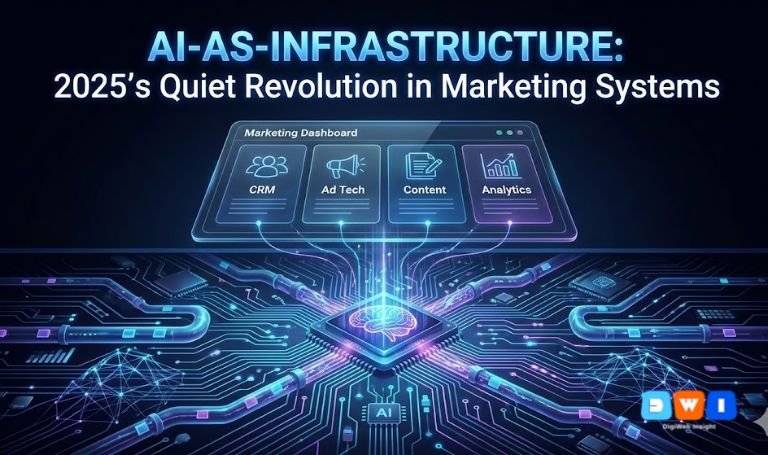
In 2023 and 2024, Artificial Intelligence was loud. It was flashy. It was ChatGPT writing poems and Midjourney creating art. But as we settle into 2025, the noise has quieted down, yet the impact has deepened. We are witnessing a fundamental shift from “AI as a tool” to AI-as-infrastructure.
This new paradigm is not about the chatbots your customers see; it is about the invisible “nervous system” connecting your data, your CRM, and your ad spend. AI-as-infrastructure is the quiet revolution that is turning disjointed marketing stacks into self-healing, self-optimizing ecosystems.
If you are still treating AI merely as a content generator, you are missing the bigger picture. The real value has moved to the backend, where AI-as-infrastructure is solving the oldest problem in marketing: fragmentation.
Here is how this structural shift is redefining the industry and why it is the most critical trend for your business this year.
1. The Shift from “Co-Pilot” to “Autopilot”
For the last two years, the metaphor for AI was the “Co-Pilot”—an assistant that sat next to you, waiting for instructions. AI-as-infrastructure changes the seat assignment. The AI is now the engine.
In this new model, marketing systems don’t just wait for human input; they proactively manage data flow. Imagine a scenario where your lead generation form breaks. In the old world, you would find out three days later when leads dropped to zero. With AI-as-infrastructure, the system detects the anomaly in real-time, diagnoses the API failure, and reroutes traffic to a backup landing page automatically.
This “self-healing” capability is the hallmark of infrastructure-level AI. It ensures that the operational foundation of your business is always on, allowing your human team to focus on creative strategy rather than technical firefighting.
To ensure your digital storefront is ready for this level of automation, partnering with experts in web design and development is the first step toward building a compatible tech stack.
2. AI-as-Infrastructure in Data Pipelines
Data has always been the oil of the digital economy, but it has often been crude and unrefined. Marketers spend countless hours cleaning Excel sheets and fixing tagging errors.
AI-as-infrastructure solves this by embedding intelligence directly into the data pipeline. We are seeing the rise of “Agentic ETL” (Extract, Transform, Load) processes. Instead of a human writing rules to categorize customer data, the infrastructure itself understands context.
For example, if a customer interacts with a “price” page multiple times, the AI-as-infrastructure layer automatically tags them as “price-sensitive” and updates their profile across your email, SMS, and ad platforms instantly. No manual upload required. This creates a unified view of the customer that is actually accurate.
This seamless data flow is essential for high-performance campaigns. When your data is clean, your Pay Per Click (PPC) marketing becomes exponentially more efficient, as bidding algorithms are fed higher-quality signals.
3. The End of “Siloed” Intelligence
Historically, marketing tools were silos. Your email tool didn’t know what your social tool was doing. AI-as-infrastructure acts as the universal translator between these disparate systems.
We are moving toward “Headless AI” architectures where a central “brain” sits in the middle of your stack. This brain dictates strategy to the limbs (your email tool, your ad manager, your website).
If a user complains on Twitter (X), the central AI-as-infrastructure brain picks up the sentiment and instantly tells your email platform to pause promotional blasts to that specific user for 48 hours. This prevents the embarrassment of sending a “Buy Now!” email to a furious customer. This level of coordination was previously impossible without an army of staff.
4. Reducing Technical Debt with Intelligent Code
Marketing operations teams are often bogged down by “technical debt”—old code, broken tracking pixels, and slow-loading scripts. AI-as-infrastructure is beginning to manage the code layer itself.
New platforms are emerging where the AI monitors site performance and “refactors” code on the fly. It optimizes image sizes, defers non-essential scripts, and ensures Core Web Vitals are green, all without a developer opening a code editor.
This backend optimization is critical for SEO. Google’s crawlers favor fast, error-free sites. By letting AI-as-infrastructure handle the technical heavy lifting, you improve your organic rankings automatically. For businesses needing a strategic overhaul of their organic presence, an affordable SEO agency in the USA can help align these technical gains with content strategy.
5. The “Invisible” ROI of AI-as-Infrastructure
The most interesting aspect of this revolution is that it is largely invisible to the end consumer—and that is the point.
When AI-as-infrastructure is working, the customer simply experiences a frictionless journey. The pages load instantly, the product recommendations are uncannily accurate, and the support chat knows exactly what they ordered yesterday.
For the CFO, the ROI comes from efficiency. AI-as-infrastructure reduces the “compute cost” of wasted ad spend and the “labor cost” of manual data entry. It creates a leaner, faster, and more profitable marketing machine.
According to a recent analysis by Gartner, the shift toward “foundational” AI technologies is expected to drive the majority of enterprise value by 2026, surpassing simple generative tools.
Conclusion: embrace the Plumbing
The era of “AI as a toy” is over. We have entered the era of AI-as-infrastructure. This quiet revolution is not about generating more content; it is about building better systems.
For marketing leaders, the mandate is clear: stop looking for the next shiny tool and start looking at your foundation. Is your infrastructure intelligent? Is it connected? Is it self-correcting?
By investing in AI-as-infrastructure, you are not just buying software; you are future-proofing your business against the complexity of the modern digital landscape.
If you are ready to audit your current stack and see where intelligent infrastructure can fit in, visit DigiWeb Insight for a comprehensive consultation.