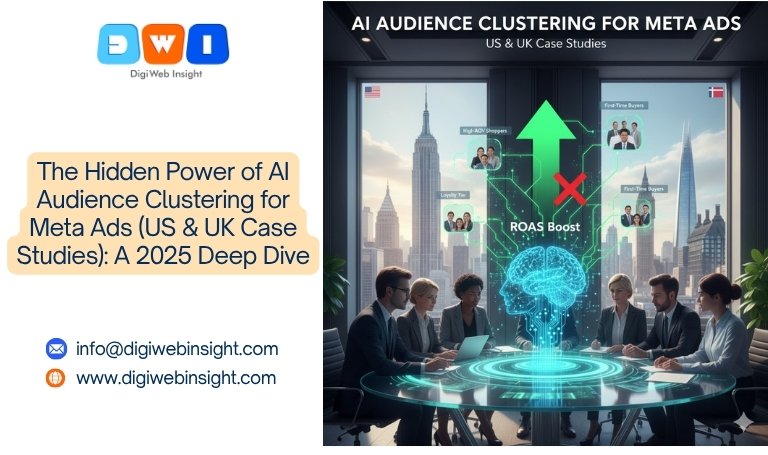
Meta’s “Advantage+” audiences have simplified ad targeting, but they’ve also created a new problem: everyone is fishing in the same broad pond. As costs rise, savvy marketers in the US and UK are looking for an edge. They’re finding it in a strategy that moves beyond Meta’s native tools. This is the hidden power of AI audience clustering for Meta ads, and these US & UK case studies prove it’s a game-changer.
This technique involves using external AI tools to analyze your own customer data (from your CRM, website, or Shopify store) to find small, hyper-specific “clusters” of customers that Meta’s algorithm would never find on its own.
Instead of just targeting a “Lookalike of All Purchasers,” you can target a “Lookalike of Cluster-B: High-AOV, Weekend-Only Shoppers Who Responded to a 10% Discount.” The results are a dramatic increase in ROAS (Return on Ad Spend) and a sharp decrease in wasted ad spend.
What Is AI Audience Clustering vs. Meta’s Advantage+?
It’s a crucial distinction.
- Meta Advantage+ Audience: You give Meta a broad goal (e.g., “purchases”), and its AI tries to find users within a large demographic. It’s a “black box” system that works on Meta’s data.
- AI Audience Clustering: You use an AI platform to analyze your first-party data. The AI finds patterns in behavior, purchase history, and engagement to create distinct, data-backed segments.
You are no longer relying on Meta to find your audience; you are telling Meta exactly who your best (and most hidden) customers are. This data-driven approach is the engine behind all high-performance Pay-Per-Click (PPC) marketing.
The “Hidden Power” Revealed: Why This Approach Dominates
The true power of this strategy is its ability to uncover intent and behavior that simple demographic targeting misses. It moves past “35-45, lives in London” and into “Users who buy on the first visit, but only after viewing 3+ ‘how-to’ guides.”
This allows you to:
- Reduce Customer Acquisition Cost (CAC): You stop wasting money showing ads to irrelevant people.
- Increase ROAS: You’re only targeting lookalikes of your best customer segments.
- Improve Personalization: You can write different ad copy for different clusters (e.g., one ad for “bargain hunters” and another for “brand loyalists”).
📈 US Case Study: A Niche E-Commerce Brand
The Problem: A US-based online store selling high-end sustainable activewear was seeing its Meta ad costs skyrocket. Their broad “yoga + sustainability” targeting was pulling in low-intent clicks, and their Lookalike audiences were fatigued.
The Solution: AI-Powered Clustering They used an AI tool to analyze their 70,000-customer list. Instead of one “Purchaser” audience, the AI identified four distinct clusters:
- “The Eco-Loyalist”: High LTV, multiple repeat purchases, always buys full price.
- “The New Year’s Resolution”: Buys once in January, high cart value, never returns.
- “The Gifter”: Buys only in November/December, ships to a different address.
- “The Instagram Follower”: Clicked through from Instagram, bought one low-cost item, highly engaged with emails.
The Result: They paused their old campaigns and launched new ones targeting Lookalikes of just “The Eco-Loyalist” (Cluster 1) for their main campaigns. They used retargeting on “The Instagram Follower” (Cluster 4) with a “new collection” ad.
The result was a 75% increase in ROAS and a 40% decrease in CAC within 30 days.
🇬🇧 UK Case Study: A B2B SaaS Company
The Problem: A UK-based B2B SaaS company was using Meta Ads to generate demo sign-ups. Their campaigns, targeting job titles and interests, produced a high volume of leads, but most were low-quality (students, small businesses, etc.) and didn’t convert.
The Solution: Leveraging AI Clustering for Meta Ads This company needed to find enterprise-level decision-makers. They used an AI platform to analyze their website visitor data, collected via a solid web design and development data-capture setup.
The AI clustered visitors based on pages viewed, time on site, and resources downloaded. It found a tiny but powerful cluster:
- “The Enterprise Buyer”: Visited the “Pricing” and “Integration” pages, downloaded a “Security Whitepaper,” and spent over 5 minutes on the site.
The Result: They created a Lookalike audience in the UK based only on this “Enterprise Buyer” cluster. The lead volume dropped, but the lead quality skyrocketed. Their sales team reported a 200% increase in qualified sales demos from Meta ads, transforming the channel from a “maybe” to their most profitable one.
This strategy is a perfect example of what a top-tier affordable SEO agency in the USA or UK would recommend: use data to refine your traffic and focus on quality, not just quantity.
How to Start Using AI Audience Clustering
You don’t need to be a data scientist to do this, but you do need the right tools.
- Consolidate Your Data: Get your customer data (Shopify, CRM, etc.) and pixel data in one place.
- Use an AI Tool: Platforms like Pecan.ai (a leader in predictive AI for marketing) or similar services can analyze this data for you and reveal the clusters.
- Upload & Test: Create Custom Audiences in Meta from these new clusters.
- Build Lookalikes: Create 1% Lookalike audiences from your strongest clusters.
- Run Targeted Campaigns: Write unique ad copy that speaks directly to the needs and motivations of each cluster.
The Bottom Line: Stop Guessing, Start Knowing
The hidden power of AI audience clustering for Meta ads is that it removes the guesswork. You stop letting Meta’s broad AI find a customer and start telling it exactly which customer to find.
This is the future of performance marketing. It’s about combining your own valuable first-party data with the power of AI to create ad campaigns that are smarter, cheaper, and more effective.
Ready to unlock the hidden power in your own customer data? Contact DigiWeb Insight today, and let’s build an advertising strategy that truly performs.