
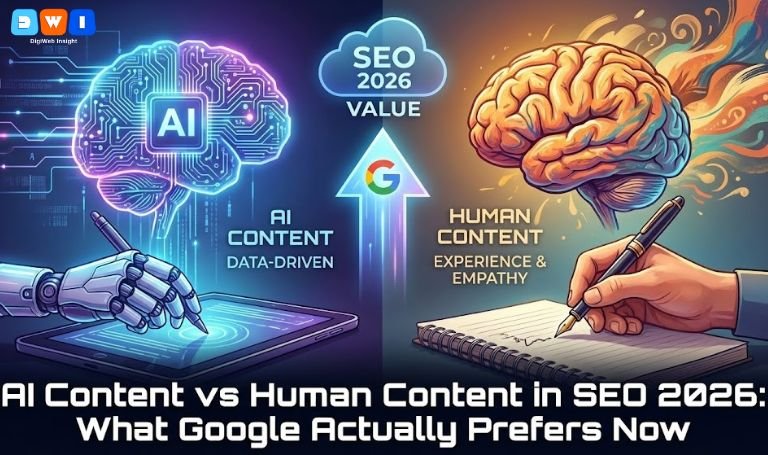
AI Content vs Human Content in SEO 2026 is the defining debate for digital marketers this year. As we step further into an era dominated by Large Language Models (LLMs), the line between machine-generated text and human creativity is blurring. However, Google’s algorithms are sharper than ever at distinguishing “noise” from “value.”
If you are worried about your rankings dropping or wondering if you should fire your writers in favor of software, you need to understand the nuances of this shift.
The Reality of AI Content vs Human Content in SEO 2026
The battle isn’t simply “Robot vs. Person.” It is about utility.
In the past, Google penalized automated content specifically. Today, the stance has evolved. Google’s primary goal is satisfying the user, regardless of who (or what) wrote the answer. However, the nuance of AI Content vs Human Content in SEO 2026 lies in the “Hidden Gems” update and the “Helpful Content” system.
Google now craves unique perspective. AI is excellent at summarizing existing knowledge, but it cannot create new knowledge. It cannot have opinions, experiences, or real-world testing data. This is where human content wins.
Why Google Still Craves the “Human Touch”
When analyzing AI Content vs Human Content in SEO 2026, the biggest differentiator is E-E-A-T (Experience, Expertise, Authoritativeness, and Trustworthiness).
AI can feign Expertise, but it cannot demonstrate Experience.
- AI: Can list the specs of a camera.
- Human: Can tell you how the camera feels heavy after shooting a 4-hour wedding.
That specific detail—the “experience”—is what Google’s ranking systems are prioritizing to fight the flood of generic AI spam. If your content lacks this personal depth, it will likely be de-indexed or buried, regardless of your keyword optimization.
To ensure your strategy aligns with these quality standards, consider consulting an Affordable SEO Agency in USA that specializes in E-E-A-T optimization.
The Hybrid Model: A Winning Strategy
Smart webmasters aren’t choosing sides; they are merging them.
The most effective approach to AI Content vs Human Content in SEO 2026 is the “Cyborg Method.” Use AI to handle data processing, outlining, and basic drafting. Then, have a human expert inject tone, personal anecdotes, and verified facts.
This ensures you get the efficiency of AI with the trust signals of a human. It creates a seamless user experience (UX) that keeps visitors on the page longer—a crucial ranking factor. A clunky, obviously AI-written wall of text often leads to high bounce rates, which signals to Google that the page is low quality.
Improving your site’s layout to keep readers engaged is just as important as the text itself. If your bounce rates are high, it might be time to look into professional Web Design & Development.
Risks of Pure AI Content in 2026
Relying 100% on AI is dangerous.
The debate of AI Content vs Human Content in SEO 2026 often ignores the legal and ethical risks. AI hallucinations (false facts) are still prevalent. If your finance or health blog gives wrong advice because ChatGPT made it up, you risk a manual penalty or even legal action.
Furthermore, “AI loops” are degrading quality. As AI models scrape the web, they are beginning to train on other AI content, leading to a “copy of a copy” effect where information becomes diluted and generic.
When to Use Which?
Here is a quick breakdown to help you decide:
- Use AI for: Product descriptions, meta tags, data summaries, and brainstorming ideas.
- Use Humans for: Opinion pieces, reviews, case studies, and thought leadership.
If you are running paid campaigns to drive traffic to these pages, quality is non-negotiable. Low-quality landing pages increase your ad costs. Learn more about optimizing your spend with our Pay Per Click (PPC) Marketing guide.
Final Verdict on AI Content vs Human Content in SEO 2026
Ultimately, AI Content vs Human Content in SEO 2026 is not a zero-sum game. Google prefers helpful content.
If an AI writes the perfect answer to “What is the capital of France?”, Google is fine with that. But for complex queries requiring nuance, empathy, and judgment, the human element is irreplaceable.
Focus on building a brand voice that resonates. Use AI as a tool, not a crutch. For more technical details on Google’s automation policies, you can read their official guidance on AI-generated content.
By balancing technology with authenticity, you safeguard your rankings for the future.