For the last decade, the B2B marketing gospel has been simple: “If you’re B2B, you must be on LinkedIn Ads.”
It’s pitched as a silver bullet. A place where you can target a “Director of IT at a 500-person software company in Ohio” with pinpoint accuracy.
So you set up your campaign. You target that perfect audience. You launch your ad. And then you see it.
$25 per click. $50 per click. $100+ per click.
Your $5,000 “test budget” is gone in a week, and you have two “leads” to show for it—both from students.
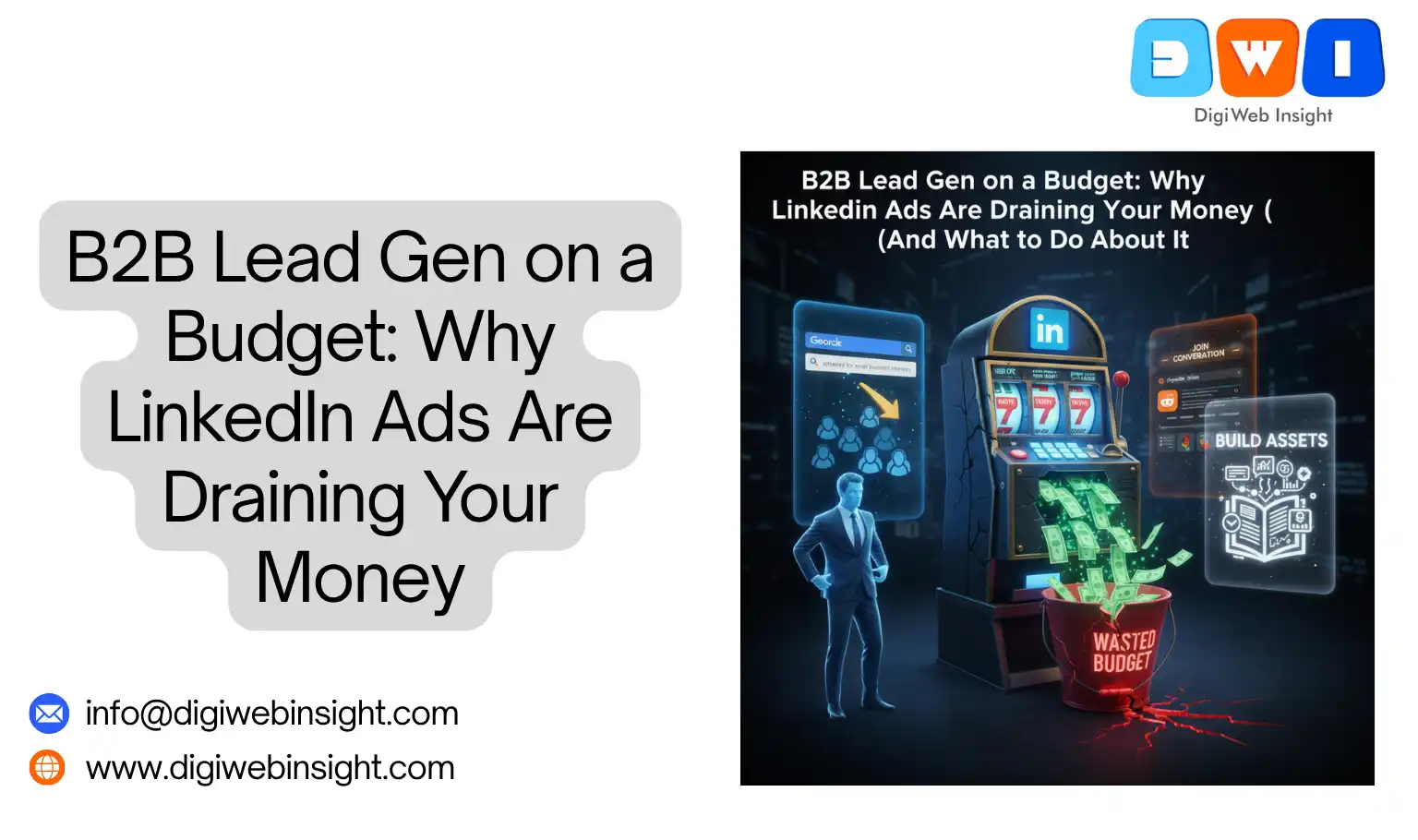
This is the painful reality for most businesses. LinkedIn Ads are a high-stakes casino, and for most, the house always wins. If you’re trying to achieve B2B lead gen on a budget, it’s one of the worst places to start.
It’s an expensive echo chamber, not a lead-gen machine.
In this guide, we’ll break down the three exact reasons LinkedIn is draining your money. More importantly, we’ll show you three powerful, cost-effective alternatives that will drive better leads for a fraction of the price.
The “Why”: 3 Reasons LinkedIn Ads Are Draining Your Budget
Before you can fix the problem, you have to diagnose it. The issue isn’t that LinkedIn Ads “don’t work.” It’s that they work in a very specific, expensive way that isn’t a good fit for 90% of businesses seeking efficient growth.
1. The “C-Suite” Saturation (Everyone Is Fishing in the Same Puddle)
You want to target a “VP of Marketing”? So does every single MarTech SaaS, every agency, and every consultant on the planet.
You are all in a massive, real-time bidding war for the same 50,000 eyeballs.
This hyper-targeting is a blessing and a curse. It allows you to find your perfect audience, but it also creates an environment of insane competition, driving CPCs to unsustainable levels. According to authoritative breakdowns from WebFX, it’s not uncommon for clicks to cost $50 to $100+ in competitive B2B niches. For B2B lead gen on a budget, this is a non-starter.
2. It’s a “Networking” Platform, Not a “Buying” Platform
Think about your own behavior on LinkedIn. You’re scrolling to see who got a new job, to read a post from an industry leader, or to check a notification. You are in a professional networking or career mindset.
You are not there to buy a new $10,0_00_ enterprise software package.
LinkedIn Ads are interruptive. You are paying top-dollar to interrupt someone’s day, hoping they’re in the 0.1% of that audience who is actively in-market for your solution.
You are paying a Bottom-of-Funnel (BOFU) price for a Top-of-Funnel (TOFU) interruption.
3. The “Weak Intent” Problem
This is the most important concept.
- Weak Intent (LinkedIn): A “Director of IT” sees your ad for “New Cloud Security Software.” They aren’t looking for it. They’re not in pain. They might click out of curiosity. This is a cold, low-intent lead.
- Strong Intent (Google): A “Director of IT” goes to Google and types, “best cloud security software for 500-person company compliance.” This user has a problem. They are in pain. They are actively hunting for a solution.
LinkedIn targeting is based on who someone is (a job title). Google targeting is based on what someone needs right now (their intent). For B2B lead gen on a budget, you must spend your money on intent, not identity.
The “What to Do About It”: 3 Alternatives for B2B Lead Gen on a Budget
Okay, so LinkedIn is out (for now). Where do you put that $5,000 budget to get an actual, measurable ROI?
Here are three strategies that outperform LinkedIn for budget-conscious B2B brands.
Alternative 1: The “Surgical Intent” Play (Long-Tail Google Ads)
Don’t abandon PPC. Just move your budget from “interrupting” to “answering.”
The key is to avoid the same trap as LinkedIn. Don’t bid on the obvious, expensive, broad keywords like “CRM Software” (which costs a fortune). Get surgical.
- The “How-To”: Go after long-tail, high-intent keywords that your buyer would type when they’re in pain.
- Bad Keyword: “Marketing Automation” (Cost: $60/click)
- Good Keyword: “hubspot vs marketo for small saas” (Cost: $8/click)
- Bad Keyword: “Business Insurance” (Cost: $55/click)
- Good Keyword: “liability insurance for plumbing subcontractors” (Cost: $12/click)
Why it Works: The user searching “liability insurance for plumbing subcontractors” is a 10x more qualified lead than the user searching “business insurance.” You’ll get fewer clicks, but the Cost Per Acquisition (CPA) will be dramatically lower. This is the cornerstone of B2B lead gen on a budget.
(Internal Link Idea: This strategy is 10x more powerful when you pair it with the GA4 landing page audits for PPC we covered recently. You need to send that high-intent traffic to a high-intent page.)
Alternative 2: The “Community” Play (Reddit Ads)
Yes, Reddit. If LinkedIn is the stuffy corporate boardroom, Reddit is the bar after work where the real conversations are happening.
- The “How-To”: Your audience is already gathered for you in hyper-specific communities (subreddits).
- Selling to IT managers? Target
r/sysadminorr/ITManagers. - Selling to salespeople? Target
r/sales. - Selling to marketers? Target
r/marketingorr/PPC.
- Selling to IT managers? Target
- Why it Works:
- Cost: The CPCs are a fraction of LinkedIn’s. We’re talking $0.50 – $2.00, not $50.
- Context: You can target a conversation, not just a person.
- Honesty: Users on Reddit are there to learn and solve problems. You can’t hit them with a hard “BUY NOW” pitch. But a post that says, “We wrote a 5,000-word guide on the sysadmin-to-CISO career path. No email required.” will get huge, high-quality engagement.
(Internal Link Idea: We’ve written about this before. The right Reddit Ads for B2B strategies focus on providing value, not a hard sell. It’s a game-changer.)
Alternative 3: The “Compound Interest” Play (Hyper-Specific Content SEO)
This is the ultimate B2B lead gen on a budget strategy. It’s the only one where the ROI improves over time.
Instead of renting an audience on LinkedIn, you build an asset that attracts them for free.
- The “How-To”: Stop writing “5 Tips for Marketing.” Start writing 3,000-word “pillar” posts that answer your ideal customer’s most expensive, painful questions.
- Bad Post: “Why Cybersecurity is Important”
- Good Post: “The 7-Step Playbook for Multi-Location Service Area Businesses (SABs)”
- Bad Post: “What is SaaS?”
- Good Post: “The Ultimate 7-Day SaaS Onboarding Email Sequence (With Templates)”
Why it Works: One “Good Post” that ranks #1 on Google for a high-intent keyword will generate more qualified leads over its 3-year lifespan for free than a $50,000 LinkedIn Ad campaign ever will. It’s an asset. It’s your 24/7, automated, lead-gen machine. It’s the highest-leverage activity a B2B marketer can do.
So, When Should You Use LinkedIn Ads?
This guide isn’t to say LinkedIn Ads are useless. They are just a very specific, expensive tool for a specific job.
You should only consider LinkedIn Ads when:
- You Have an Enterprise Budget: You’ve already maxed out Google Ads and SEO, and you’re moving into “brand awareness” at scale.
- You’re Doing Account-Based Marketing (ABM): Your entire goal is to get your brand in front of 500 specific people at 50 target companies. The cost per lead doesn’t matter; the account is the prize.
- You’re Recruiting: It’s still the best platform on earth for finding talent.
For 90% of businesses, LinkedIn should be the last platform you add to your marketing mix, not the first.
Conclusion: Stop Renting, Start Building
The promise of LinkedIn Ads is a siren song that has shipwrecked thousands of marketing budgets. It’s a “pay-to-play” system that favors big brands with endless cash.
If you’re running B2B lead gen on a budget, you have to be smarter. You have to be more strategic.
- Stop interrupting. Start Answering (with long-tail Google Ads).
- Stop targeting job titles. Start Joining (with Reddit Ads).
- Stop renting an audience. Start Building (with Content SEO).
This is how you get off the ad-spend treadmill. This is how you build a sustainable, scalable lead-gen engine that drives real, profitable growth.
Related Service
- SEO Company USA — Boost national visibility with expert SEO strategies.
- Web Design & Development — Build fast, conversion-optimized websites that Google loves.
- PPC Marketing (Pay-Per-Click) — Drive immediate, high-intent traffic for quick ROI.
- E-commerce SEO — Drive targeted shopper traffic and maximize online store revenue.
- Social Media Advertising — Turn paid campaigns into high-converting customer funnels.