1. Executive Summary: The Agentic Revolution in 2025
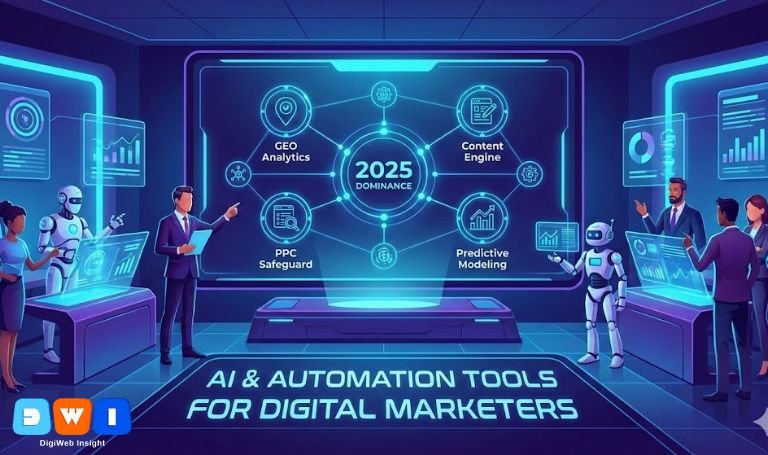
The digital marketing landscape of 2025 bears little resemblance to the ecosystem of just two years prior. We have transitioned from an era of “AI experimentation”—characterized by novelty chatbots and basic text generation—into the age of “Agentic AI.” In this new paradigm, AI and Automation Tools for Digital Marketers are no longer mere assistants; they are the central nervous system of competitive business operations. The shift is fundamental: tools now possess the capability to plan, execute, and iterate on complex workflows autonomously, moving beyond simple prompt-and-response interactions to managing entire lifecycle marketing campaigns with minimal human intervention.
According to McKinsey’s The State of AI 2025 report, the adoption of AI has reached a saturation point where 88% of organizations now employ AI in at least one business function.1 However, usage alone is no longer a differentiator. The report highlights a stark divergence between “pilots” and “scalers.” While nearly two-thirds of companies remain in the experimental phase, high-performing organizations—those generating tangible EBIT (Earnings Before Interest and Taxes) impact—are distinguishing themselves by redesigning entire workflows around AI agents rather than simply bolting AI onto existing manual processes.1
For small businesses and digital agencies, this evolution presents a “paradox of choice.” The market has exploded with over 11,000 AI tools, each promising to revolutionize operations.3 Yet, the barrier to entry for high-quality output has collapsed, leading to a content deluge. As generative AI makes creating average content free and instant, the value of “average” has plummeted to zero. Success in 2025 depends not on the ability to generate content, but on the ability to orchestrate distinct, high-authority brand signals across a fragmented media landscape that now includes “AI Answer Engines” alongside traditional search and social platforms.
This exhaustive research report serves as a strategic blueprint for navigating this complex environment. It moves beyond generic feature lists to provide a deep, operational analysis of the most effective AI and Automation Tools for Digital Marketers. We dissect the critical shift from SEO to “Generative Engine Optimization” (GEO), the rise of predictive analytics for small business (SMB) budgets, and the necessity of “Human-in-the-Loop” (HITL) frameworks to maintain brand authenticity. By leveraging the specific tools and strategies detailed herein—from the visibility tracking of LLMrefs to the PPC safeguards of Optmyzr—marketers can build a technological infrastructure that drives sustainable growth in an automated world.
2. The New Frontier: Generative Engine Optimization (GEO)
2.1 From Blue Links to AI Answers
The most disruptive trend of 2025 is the migration of user intent from traditional search engines to Generative AI platforms. Users are increasingly bypassing Google’s “ten blue links” in favor of synthesized answers provided by Large Language Models (LLMs) such as ChatGPT, Claude, Gemini, and Perplexity.4 This behavior shift has birthed a new discipline: Generative Engine Optimization (GEO).
Unlike traditional SEO, which optimizes for keywords and backlinks to rank a URL, GEO optimizes for “citations” and “brand authority” to ensure a brand is mentioned in the AI’s generated response. A study by Bluefish on 2025 holiday shopping trends revealed that AI engines function as the new “front door” for product discovery, with platforms like ChatGPT and Perplexity often recommending different brands to different demographics even for identical queries.5 For example, a budget-conscious shopper asking for “best laptops” might get a different recommendation set than a premium shopper, with the AI synthesizing data from reviews, sentiment, and “authority signals” rather than just keyword matching.6
Consequently, AI and Automation Tools for Digital Marketers must now include capabilities to track, analyze, and optimize for this “share of voice” in AI conversations. The goal is to maximize “Fact Density”—the number of credible, citeable facts associated with a brand in the AI’s training data—and “Semantic Proximity,” ensuring the brand is linguistically linked to key commercial entities.7
2.2 LLMrefs: The GEO Analytics Command Center
In the vacuum created by the obsolescence of traditional rank trackers, LLMrefs has emerged as the definitive analytics platform for the GEO era. While legacy tools like Ahrefs and Semrush are scrambling to add AI features, LLMrefs was architected from the ground up to monitor the “black box” of LLM outputs.4
Core Capabilities and Strategic Value
- Multi-Model Visibility Tracking: LLMrefs does not just track Google. It monitors brand mentions across the entire spectrum of major AI engines, including ChatGPT, Google AI Overviews (SGE), Perplexity, Gemini, Claude, Grok, and Meta AI.4 This is critical because a brand might be dominant in Google Search but invisible in ChatGPT, which represents a growing share of commercial intent.
- The LLMrefs Score (LS): Measuring “ranking” in a chat interface is notoriously difficult since answers vary. LLMrefs solves this with the proprietary “LLMrefs Score,” a weighted metric that aggregates visibility, sentiment, and citation frequency into a single KPI. This allows agencies to report on “AI Authority” with the same clarity they previously reported on “Keyword Rankings”.8
- Citation Gap Analysis: The tool performs a “gap analysis” for the generative age. It identifies specific queries where competitors are cited as authoritative sources but your brand is excluded. This insight is actionable: it tells marketers exactly which topics they lack “semantic authority” in.9
- Source Attribution Intelligence: One of the most powerful features is the ability to see where the AI found its information. LLMrefs filters and displays the source URLs cited by the engines. This reveals the “feeding grounds” of the AI—whether it’s pulling from Reddit threads, Wikipedia, specific news outlets like CNET, or competitor blogs. For a PR strategy, this is gold dust; it tells you exactly where to secure coverage to influence the AI.4
Pricing and Accessibility
Despite its enterprise-grade capabilities, LLMrefs is priced aggressively to capture the SMB market:
- Free Plan: Allows for basic testing with limited keywords, serving as a proof-of-concept for skeptics.11
- Pro Plan ($79/month): This tier unlocks tracking for 50 keywords, 500 prompts per month, and global geo-targeting across 20+ countries. It also includes unlimited team members and projects, making it exceptionally agency-friendly compared to the per-seat pricing of legacy tools.4
Strategic Implication: For digital marketing agencies, LLMrefs offers a vital new service line: “AI Visibility Optimization.” As clients begin to ask, “Why did ChatGPT recommend my competitor?”, agencies equipped with LLMrefs can provide data-backed answers and a roadmap to fix it.
2.3 Surfer SEO: Semantic Engineering at Scale
If LLMrefs is the speedometer, Surfer SEO is the engine tuner. In 2025, Surfer continues to dominate the content optimization space by evolving beyond simple keyword density into deep semantic analysis. The platform’s integration of AI focuses on “Information Gain”—the unique value a piece of content adds to the web—which is a primary ranking factor for both Google and AI algorithms.7
The AI-Driven Workflow
Surfer’s “Content Editor” uses Natural Language Processing (NLP) to analyze the top-ranking pages for a given topic and extract not just keywords, but the underlying entities, questions, and structural elements that signal relevance.
- Topic Clusters: Surfer helps build “Topical Maps,” ensuring a website covers a subject exhaustively. This is crucial for GEO, as AI models favor domains that demonstrate “depth of expertise” across a cluster of related topics rather than isolated successful pages.12
- AI Humanizer: Recognizing the risk of purely AI-generated content being devalued, Surfer includes tools to refine and “humanize” drafts, ensuring they maintain a natural tone while hitting all semantic targets.13
- Integration: Its seamless connection with Jasper and WordPress creates a unified pipeline where content is strategized, drafted, optimized, and published without leaving the ecosystem.
Pros & Cons:
While Surfer is indispensable for serious SEOs, its mid-tier pricing and lack of a free trial can be a hurdle for the smallest businesses.4 However, the ROI from securing top rankings for high-intent keywords typically justifies the investment for any business relying on organic traffic.
3. High-Velocity Content Engines: Quality at Speed
3.1 The Commoditization of Syntax
With the release of GPT-4 and Claude 3.5, the marginal cost of producing grammatically correct text has hit zero. However, the cost of producing high-converting, brand-aligned content remains high. The best AI and Automation Tools for Digital Marketers in this category are those that bridge this gap, allowing for high velocity without sacrificing the “E-E-A-T” (Experience, Expertise, Authoritativeness, and Trustworthiness) signals required by search engines.
3.2 WordRocket: The Headless Content Powerhouse
WordRocket represents a new breed of “headless” AI writing tools designed for power users and SEOs who want direct access to top-tier models without the markup. Its “Bring Your Own Key” (BYOK) model allows users to plug in their own OpenAI or Anthropic API keys, dramatically reducing costs for high-volume generation.14
Strategic Advantages
- One-Click Long-Form: WordRocket specializes in generating comprehensive, 2,000+ word articles from a single prompt. Unlike chat interfaces that often struggle with length and coherence, WordRocket maintains structure throughout long documents, automatically injecting SEO-critical HTML elements like tables, lists, and schema-ready FAQs.15
- Programmatic SEO: The tool is ideal for programmatic strategies where a business needs to create hundreds of landing pages (e.g., “Best AI Tools for [Industry] in [City]”). Its ability to template these pages while varying the content ensures scalability without duplicate content penalties.
- Pricing Flexibility: By separating the software fee (starting at ~$14/mo or a lifetime deal) from the token cost (paid directly to the AI provider), WordRocket offers one of the most economical scaling paths for agencies.16
Strategic Insight: WordRocket is best deployed for “Top of Funnel” informational content where structure and comprehensiveness are key. It should be paired with human editors who inject the “Experience” element of E-E-A-T—personal anecdotes, proprietary data, or contrarian viewpoints—that the AI cannot hallucinate.14
3.3 Jasper: The Enterprise Brand Guardian
While WordRocket is for the SEO technician, Jasper is for the Brand Manager. Jasper has successfully pivoted from a generic writing assistant to an enterprise marketing platform centered on “Brand Voice” integrity.17
Feature Deep Dive
- Brand Voice & Knowledge Base: Users can upload style guides, past successful campaigns, and product documentation. Jasper “reads” these to learn the brand’s specific tone, jargon, and forbidden terms. This ensures that a LinkedIn post written by Jasper sounds like it came from the same company as a white paper written by Jasper.17
- Campaign Acceleration: Jasper’s “Campaigns” feature allows marketers to turn a single brief into a multi-channel asset package—blog post, email sequence, press release, Google Ad copy, and social media captions—in minutes. This solves the “fragmentation” problem where different channels often drift off-message.13
- Enterprise Security: Unlike open models where data privacy can be a concern, Jasper offers enterprise-grade security assurances, making it the tool of choice for larger SMBs and corporations.13
3.4 Claude: The Nuanced Editor
Claude (by Anthropic) has carved out a niche as the “writer’s AI.” In 2025, it is widely regarded as producing more natural, less robotic prose than its GPT counterparts.
- Context Window: Claude’s massive context window allows it to digest entire books or massive datasets, making it the superior tool for summarizing complex reports or repurposing long-form content into shorter pieces without losing nuance.18
- Artifacts: The “Artifacts” feature—a side-by-side workspace for code and documents—makes iterative editing significantly smoother. Marketers use Claude not just for generation, but for high-level editing and “red-teaming” their strategies.13
3.5 Mastering Headlines with AI Power Words
Regardless of the tool used, the headline remains the single most critical element of content. In 2025, with attention spans shorter than ever, “Power Words” are essential for breaking through the noise. AI tools can be prompted to inject these specific psychological triggers into headlines to boost Click-Through Rates (CTR).19
Table 1: 2025 Power Word Categories for High-CTR Headlines
| Category | Psychological Trigger | Key Power Words | Example Headline |
| Urgency | Fear of Missing Out (FOMO) | Limited, Expiring, Deadline, Now, Instant | “Get Instant Access: This Limited Offer Expires Tonight” |
| Curiosity | Information Gap | Secret, Confessions, Unveiled, Hidden, Banned | “Confessions of a CEO: The Hidden AI Strategy Unveiled“ |
| Authority | Trust & Safety | Proven, Guaranteed, Authentic, Scientific, Official | “Scientifically Proven Methods to Guarantee ROI in 2025″ |
| Sloth | Desire for Ease | Effortless, Simple, Hack, Cheat Sheet, Template | “The Effortless Cheat Sheet for Simple SEO Wins” |
| Exclusivity | Social Status | Exclusive, Insider, Members-Only, Premier, Elite | “Join the Elite: Insider Tactics for Premier Marketers” |
Source: Analysis of high-performing headlines.19
Strategic Application: When using Jasper or WordRocket, explicitly prompt the AI: “Generate 10 headlines for this article using ‘Curiosity’ and ‘Urgency’ power words. Ensure the sentiment is positive but urgent.” This directs the AI away from generic titles like “5 Tips for SEO” toward high-converting options like “5 Hidden SEO Hacks You Need Now.”
4. PPC and Advertising Automation: The Fight for Control
4.1 The “Black Box” Problem in Paid Media
By 2025, paid media platforms like Google Ads and Meta have aggressively pushed advertisers toward fully automated solutions like “Performance Max” (PMax) and “Advantage+.” These “black box” systems automate targeting, bidding, and creative delivery.22 While they offer scale, they often obscure data and can lead to significant budget wastage on low-quality inventory. The role of AI and Automation Tools for Digital Marketers in PPC has shifted from doing the bidding to policing the algorithms.
4.2 Optmyzr: The Professional’s Safeguard
Optmyzr is the premier tool for PPC professionals who refuse to blindly trust the platforms. Founded by former Google executives, it provides the transparency and control mechanisms that Google’s native interface increasingly hides.23
Critical Features for 2025
- The Rule Engine: This is Optmyzr’s standout feature. It allows marketers to build complex, “if-this-then-that” logic that runs 24/7. For example: “If a PMax asset group has a ROAS below 200% for 5 days AND spend is >$500, pause it and send me a Slack alert.” This level of granular control is impossible within Google Ads itself.24
- PMax Audits & Insights: Performance Max is notoriously opaque. Optmyzr cracks the black box, showing which channels (Search, Shopping, Display, YouTube) are actually driving conversions. This allows marketers to see if Google is dumping their budget into low-value Display ads to claim “cheap clicks”.25
- Blueprints: For agencies scaling operations, Blueprints allow for the creation of standardized workflows. An agency can define a “New Client Onboarding” blueprint, and the system ensures every step—from keyword exclusion lists to conversion tracking checks—is executed across the team.25
Pricing and Target Audience
Optmyzr is a professional tool with pricing to match:
- Essential Plan: Starts at ~$208/month.
- Premium Plan: Starts at ~$272/month.While not cheap, for any business spending over $5,000/month on ads, the savings from preventing wasted spend (“bleeding budgets”) typically cover the software cost many times over.26
4.3 Adzooma: The Accessible Alternative
For smaller businesses or freelancers who find Optmyzr’s complexity and price point too high, Adzooma offers a compelling alternative. It focuses on accessibility and speed rather than deep, custom logic.27
- The “Opportunity” Engine: Adzooma analyzes accounts 24/7 and presents “Opportunities” (e.g., “Add these negative keywords,” “Fix conflicting negative keywords,” “Increase budget on high-performing campaign”). Users can approve these suggestions with a single click, gamifying the optimization process.27
- Unified Dashboard: It brings Google, Microsoft, and Meta ads into a single view, which is a massive time-saver for small teams managing multi-channel campaigns.28
- Pricing: Adzooma is aggressively priced. It offers a functional Free Plan for basic reporting and a Silver Plan at ~$69/month, making it accessible to virtually any business size.29
Comparison: Optmyzr vs. Adzooma
| Feature | Optmyzr | Adzooma |
| Target Audience | PPC Pros, Agencies, Enterprise | SMBs, Freelancers, Boutique Agencies |
| Core Philosophy | Deep Control & Custom Logic | Speed & Simplicity |
| Automation | Custom “Rule Engine” (Unlimited complexity) | Pre-built “Automation Rules” (Basic) |
| PMax Support | Deep Insights & Audits | Basic Reporting |
| Pricing | High ($208+/mo) | Low (Free – $69/mo) |
| Learning Curve | Steep | Shallow (Plug & Play) |
Strategic Recommendation: If you manage significant spend (>10k/mo) or require complex, custom automations, Optmyzr is non-negotiable. For straightforward local business accounts or smaller e-commerce stores, Adzooma provides 80% of the value for 20% of the cost.
5. Social Media Automation: Visuals and Velocity
5.1 The Content Treadmill
Social media in 2025 is dominated by short-form video (Reels, TikTok, Shorts) and high-fidelity visuals. The demand for volume is relentless. AI and Automation Tools for Digital Marketers in this sector must solve the “creation bottleneck”—the inability of small teams to produce enough visual assets to feed the algorithms.
5.2 Predis.ai: The All-in-One Creator
Predis.ai is a game-changer because it collapses three tools—ChatGPT (copy), Canva (design), and Hootsuite (scheduling)—into one.
- Prompt-to-Post: A user can type, “Create a promotional post for our new vegan leather handbag, focusing on sustainability,” and Predis.ai will generate the image (or video), the caption, the hashtags, and the design layout all at once.30
- Competitor Spying: Its AI analyzes competitor feeds to decode their strategy. It can tell you why a competitor’s post went viral (e.g., “Used ‘Urgency’ power words,” “Bright color palette,” “Posted at 6 PM”), allowing you to reverse-engineer their success.31
- E-commerce Integration: For web design and development clients running Shopify or WooCommerce stores, Predis.ai connects directly to the product catalog to auto-generate product videos.32
5.3 Ocoya: The Automation Workhorse
While Predis.ai shines in creation, Ocoya is built for speed and distribution. It positions itself as a “content automation platform” rather than just a scheduler.30
- Travis AI: Ocoya’s built-in copywriter creates marketing copy in 26 languages, tailored for each platform (e.g., shorter for Twitter, professional for LinkedIn).
- Template Library: It boasts a massive library of 10,000+ templates, allowing for rapid asset generation.
- Cross-Platform Scheduling: Its primary strength is the ability to blast content to all major networks simultaneously with a few clicks, making it ideal for agencies managing volume.30
Strategic Insight: For brands relying on unique, brand-specific visuals, Predis.ai’s generation capabilities offer more value. For brands that need to keep the “content lights on” with high frequency and standard templates, Ocoya is the efficiency king.
6. Email Marketing & CRM: The End of “Batch and Blast”
6.1 Hyper-Personalization at Scale
The days of sending the same newsletter to 10,000 people at the same time are over. In 2025, email marketing is driven by “Behavioral AI.” AI and Automation Tools for Digital Marketers must now track individual user actions and trigger personalized messages in real-time.
6.2 MailerLite: The SMB Champion
MailerLite continues to win the SMB market by offering enterprise-level features at a price point accessible to startups.
- Smart Sending: Instead of guessing the best time to send, MailerLite’s AI analyzes the historical open data of each specific subscriber. If Subscriber A opens emails at 8 AM and Subscriber B at 8 PM, the system holds the email and delivers it to each at their optimal moment.33
- AI Writing Assistant: Integrated directly into the email editor, the AI helps rewrite subject lines for better open rates and polishes body copy to be more persuasive.34
- Affordability: With a free plan for up to 1,000 subscribers and paid plans starting around $10/month, it remains one of the most cost-effective ways to build an owned audience.34
6.3 Encharge: The SaaS & B2B Specialist
For B2B companies and SaaS products, Encharge offers automation that goes deeper than simple opens and clicks. It integrates with the product itself.
- Behavioral Triggers: Encharge connects to tools like Segment, Stripe, and HubSpot. It can trigger emails based on specific user behaviors inside a software product. Example: “User signed up 3 days ago but hasn’t uploaded a profile picture -> Send ‘Complete Your Profile’ email sequence.” This direct link between product usage and communication is critical for reducing churn.36
- Lead Scoring: It uses AI to score leads based on their interaction data, surfacing the “hottest” leads to the sales team automatically.36
7. Democratizing Data Science: Predictive Analytics for All
7.1 The Crystal Ball for Small Business
Historically, predictive analytics—knowing who will buy or who will churn—was the domain of Fortune 500 companies with teams of data scientists. In 2025, AI and Automation Tools for Digital Marketers have democratized this power.
7.2 Pecan AI: No-Code Predictive Modeling
Pecan AI allows marketing teams to build sophisticated predictive models without writing a single line of SQL or Python code.37
- Churn Prediction: By connecting to CRM data, Pecan can predict which customers are at high risk of churning in the next 30 days. This allows marketers to proactively trigger retention campaigns (via tools like Encharge) before the customer leaves.38
- LTV Forecasting: Pecan predicts the future Lifetime Value (LTV) of new customers within days of their acquisition. This is a superpower for PPC managers; it allows them to bid more aggressively for customers predicted to be “high value” even if their initial purchase is small.38
- Pricing: While it has enterprise tiers, Pecan’s “Starter” tier (~$950/mo) brings legitimate data science capabilities to mid-market companies.39
7.3 Zoho Analytics: The Conversational Analyst
For businesses needing insight without the high price tag, Zoho Analytics leverages “Zia,” an AI assistant.
- Natural Language Querying: Users can ask Zia questions in plain English: “Show me a chart of sales by region for the last quarter compared to last year.” Zia understands the intent, queries the database, and generates the visualization instantly. This removes the technical barrier to data analysis.40
- Auto-Analysis: Zia automatically scans data for anomalies (e.g., a sudden drop in traffic from a specific source) and alerts the user, acting as an always-on analyst.40
8. Strategic Implementation: Building the Ultimate AI Stack
8.1 The “Hybrid” Workflow
Success in 2025 does not come from finding one “magic bullet” tool. It comes from assembling a “stack” of integrated AI agents that cover the entire marketing lifecycle.
Recommended AI Stack for a Modern Digital Agency:
| Function | Tool | Role in Workflow |
| Strategy & Ops | Motion + Zapier | AI project management and workflow connectivity.17 |
| Visibility (GEO) | LLMrefs | Tracking brand visibility in AI answers.4 |
| Content Strategy | Surfer SEO | Semantic optimization and topic clustering.12 |
| Creation | WordRocket + Jasper | High-velocity drafting and brand voice consistency.14 |
| Visuals | Predis.ai | Auto-generating social assets and videos.30 |
| Traffic (PPC) | Optmyzr | Safeguarding budget and auditing platform algorithms.25 |
| Retention | MailerLite | AI-optimized delivery and personalization.33 |
| Analytics | Pecan AI | Predicting churn and LTV to inform strategy.38 |
8.2 The Human-in-the-Loop (HITL) Imperative
While these tools are powerful, the McKinsey report emphasizes that the most successful companies are those that prioritize “Human-in-the-Loop” processes.1 AI is an engine, not a driver.
- Strategic Oversight: Humans must define the goals (e.g., “Target the healthcare vertical”) while AI executes the tactics (e.g., “Generate 50 healthcare-focused blog posts”).
- Creative Oversight: AI can generate 100 headline variations, but a human must select the one that truly resonates with the cultural zeitgeist.
- Ethical & Brand Oversight: Humans must verify facts and ensure that AI-generated content aligns with brand values, preventing “hallucinations” that could damage reputation.41
8.3 Avoiding the “Average” Trap
The widespread adoption of tools like ChatGPT and Jasper creates a risk of “regression to the mean.” If everyone uses the same models to write the same content optimized by the same tools, all marketing begins to look identical. To dominate in 2025, marketers must differentiate by:
- Injecting Proprietary Data: Use tools like Pecan AI to feed your unique customer data into your strategy.
- Training Custom Models: Use Jasper’s “Brand Voice” to train the AI on your specific, unique tone.
- Focusing on E-E-A-T: Ensure content includes personal stories, case studies, and contrarian opinions that AI cannot generate on its own.42
9. Conclusion: The Agentic Future is Now
The era of manual digital marketing is closing. The AI and Automation Tools for Digital Marketers highlighted in this report—from the visibility tracking of LLMrefs to the predictive power of Pecan AI—are not optional upgrades; they are the baseline requirements for competitiveness in 2025.
The businesses that will thrive are those that view these tools not as replacements for human creativity, but as exoskeletons that amplify it. By automating the repetitive (reporting, scheduling, data entry, basic drafting) and augmenting the complex (predictive modeling, strategic planning, creative ideation), small businesses can operate with the efficiency and scale of large enterprises.
As we move further into the “Agentic Era,” the ability to configure, manage, and optimize these digital workforces will become the most valuable skill in the marketing ecosystem. The tools are ready; the challenge now lies in the strategy of their deployment.