
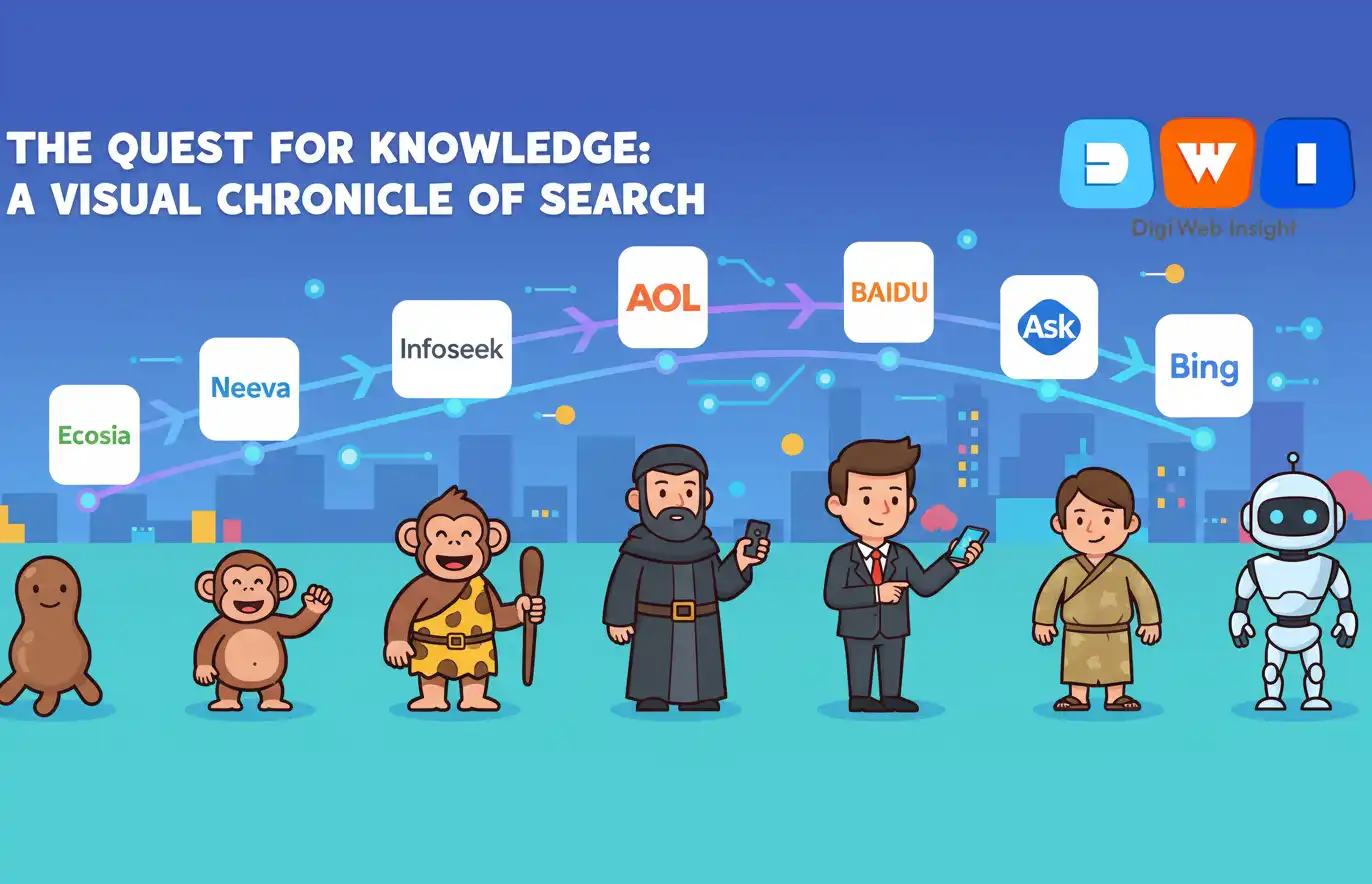
Imagine trying to find a specific book in a library that has no card catalog, no librarian, and books piled randomly on the floor. That was the internet in the early 1990s.
We take finding answers for granted today. You type a query, and milliseconds later, you have the world at your fingertips. But the journey to get here was not a straight line.
Understanding the history of search engines gives us a fascinating glimpse into how the internet grew from a small network of scientists into the global nervous system it is today. This wasn’t just about better code; it was about figuring out how humans think and organize information.
Let’s walk through the five distinct eras that define this digital revolution.
1. The Pre-Web Era: Archie and the File Hunters (1990–1993)
Most people assume the history of search engines starts with Google, but it actually began years before Larry Page and Sergey Brin met.
In 1990, the internet was mainly a collection of files stored on FTP (File Transfer Protocol) servers. There were no webpages as we know them. Enter Archie.
Created by Alan Emtage, a student at McGill University, Archie was the great-grandfather of search. It didn’t search the contents of files. Instead, it visited anonymous FTP sites, created a database of file names, and allowed users to search that database.
If you didn’t know the exact name of the file you wanted, Archie couldn’t help you.
Shortly after, tools like Veronica and Jughead appeared. These were designed for the Gopher protocol system (an early alternative to the Web). While primitive, they laid the groundwork for the indexing technology we use today.
2. The History of Search Engines Explodes: Crawlers & Directories (1994–1997)
As the World Wide Web (WWW) began to overtake Gopher and FTP, the need for better tools became urgent. This era introduced two competing philosophies: the “Crawler” and the “Directory.”
The First True Crawlers
In 1994, WebCrawler launched. It was the first search engine to index the full text of web pages, not just titles. This was a massive leap forward.
Soon after, Lycos and AltaVista joined the race. AltaVista, in particular, was a beast. It offered unlimited bandwidth and allowed complex searches. For a brief moment in the history of search engines, AltaVista was the undisputed king, handling millions of hits daily.
The Human Touch
On the other side of the spectrum was Yahoo!. Started by Jerry Yang and David Filo, Yahoo wasn’t initially a search engine run by algorithms. It was a directory.
Humans actually sat down, reviewed websites, and categorized them. It was like a digital phone book. While accurate, it couldn’t keep up with the explosive growth of the web.
3. The Google Revolution (1998–2005)
The turning point in the history of search engines happened in a garage in Menlo Park.
Before 1998, search engines ranked results mostly by counting how many times a keyword appeared on a page. This was easy to cheat. If you wrote “best pizza” 100 times at the bottom of your page, you ranked #1 for pizza.
Google changed everything with PageRank.
Larry Page and Sergey Brin realized that a link from Site A to Site B was essentially a vote of confidence. Their algorithm analyzed the quality and quantity of these links to determine authority.
The results were cleaner, more relevant, and less spammy. Google quickly dominated the market, pushing competitors like AltaVista and Excite into obscurity. This era also birthed the SEO industry, as businesses realized the value of appearing in organic search results.
Interested in how we apply these principles today? Check out our SEO Services to see how organic ranking works.
4. The Era of Context and Mobile (2006–2015)
As smartphones entered our pockets, the history of search engines took another sharp turn. Typing exact keywords became annoying on small screens. We started asking questions.
Search engines had to get smarter. They needed to understand intent, not just keywords.
- Universal Search (2007): Google stopped separating results. Suddenly, news, images, videos, and maps appeared on the same main results page.
- The Knowledge Graph (2012): Search engines began understanding “entities.” If you searched for “Leonardo da Vinci,” it knew he was a person, an artist, and connected to the Mona Lisa.
- Mobile-First Indexing: By 2015, more searches happened on mobile than desktop. Google updated its algorithms to favor mobile-friendly websites, a shift often called “Mobilegeddon.”
This period also saw strict quality updates, like Panda and Penguin, which punished low-quality content and spammy link practices.
5. AI and the Future of Search (2016–Present)
We are currently living through the most rapid evolution in the history of search engines.
It started with voice search (Siri, Alexa) and has moved into complex Artificial Intelligence. Google’s BERT update allowed the engine to understand the nuance of words in sentences, rather than just treating them as a bag of keywords.
Today, we are seeing the rise of Generative AI. Tools like ChatGPT and Google’s Search Generative Experience (SGE) are changing the game again. instead of giving you a list of ten blue links, search engines are beginning to synthesize answers for you.
For reliable information on how these standards are maintained, organizations like the World Wide Web Consortium (W3C) continue to set the benchmarks for open web standards.
Why This History Matters
Looking back at the history of search engines, we see a clear pattern. It always moves toward less friction and more relevance.
From the command-line interface of Archie to the conversational AI of today, the goal remains the same: connecting humans to knowledge as fast as possible.
For website owners and marketers, this teaches us a vital lesson. You cannot trick the system forever. The algorithms always catch up. The only future-proof strategy is to create helpful, user-focused content that provides real value.
As we look ahead, one thing is certain: the timeline of search is far from finished. We are just turning the page to the next chapter.
Related Service
- Web Design & Development — Build fast, conversion-optimized websites that Google loves.