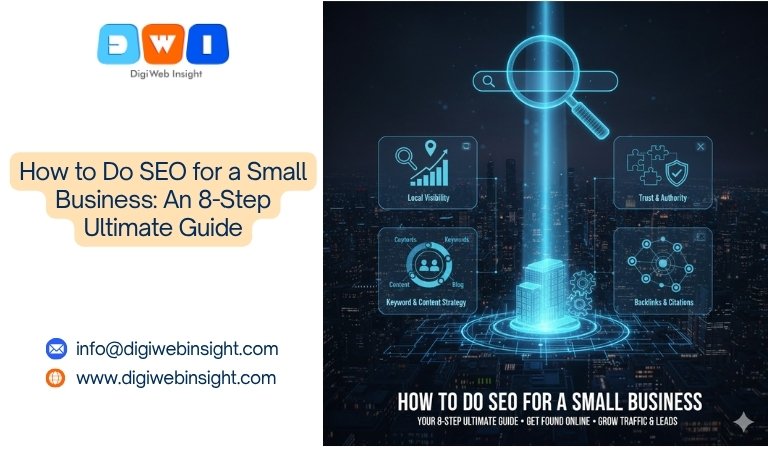
As a small business owner, you wear countless hats. You’re the CEO, the salesperson, the accountant, and the marketer. In that marketing role, you’ve probably heard one acronym more than any other: SEO. But figuring out how to do SEO for a small business can feel like trying to solve a complex puzzle with no instructions.
Search Engine Optimization (SEO) is the process of making your website more visible to people who are actively searching for your products or services on search engines like Google.
Why does it matter? Because your customers are searching. They’re on their phones typing “best coffee shop near me” or “emergency plumber in [Your City].” If you’re not on the first page, you are invisible.
The good news is that you don’t need a massive corporate budget to succeed. This guide provides an 8-step framework to help you build a powerful, effective SEO strategy.
1. Master Your Local SEO: The Google Business Profile (GBP)
For 99% of small businesses, your single most important SEO tool is free: your Google Business Profile (GBP). This is the information box that appears in Google Maps and on the right side of Google search results. It is the #1 factor for ranking in the “map pack.”
- Claim and Verify: Go to Google Maps and find your business. Click “Claim this business” and follow the verification steps.
- Complete Every Section: Do not skip anything. Add your services, hours (including holiday hours), photos, website, phone number, and a detailed description.
- NAP Consistency: Your Name, Address, and Phone number (NAP) must be identical everywhere online.
- Use Posts and Q&A: Regularly use the “Posts” feature to share updates or offers. Proactively answer common questions in the Q&A section.
2. Find Keywords Your Customers Actually Use
You can’t be the answer if you don’t know the question. Keyword research is the process of finding the phrases your customers are typing into Google.
As a small business, you should avoid broad, highly competitive keywords like “shoes” or “marketing.” Instead, focus on two types:
- Local Keywords: “plumber in brooklyn,” “best bakery downtown chicago”
- Long-Tail Keywords: “how to fix a leaky faucet,” “what to look for in a wedding photographer”
These keywords have lower search volume but much higher intent, meaning the person searching is more likely to be ready to buy or hire.
3. Create Genuinely Helpful, E-E-A-T Content
Google’s primary goal is to provide users with helpful, reliable answers. To do this, it rewards content that demonstrates E-E-A-T:
- Experience: Do you have real, first-hand experience with the topic?
- Expertise: Do you have the necessary knowledge or skills?
- Authoritativeness: Are you a go-to source for this topic?
- Trustworthiness: Is your site secure (HTTPS)? Are your reviews positive?
Instead of writing content just to rank, write to help. Create service pages that clearly explain your value. Write blog posts that answer your customers’ most common questions.
External Link: To fully understand this concept, read Google’s official documentation on “Creating helpful, reliable, people-first content.” (This is a high-authority, DoFollow link).
4. Build a Strong Technical Foundation
Your website’s technical health is the foundation on which all your other SEO efforts are built. If Google can’t crawl or understand your site, it won’t rank it.
This is where a professional web design and development team is invaluable. Key technical basics include:
- Mobile-Friendliness: Your site must look and work perfectly on a smartphone.
- Site Speed: Your pages should load in under 3 seconds.
- Simple Navigation: Users and Google should be able to easily find all your pages.
- On-Page SEO: Every page should have a unique Title Tag (the blue link in search) and Meta Description (the text snippet below it) that describes what the page is about.
5. ## The Core Principles: How to Do SEO for a Small Business
It’s easy to get lost in the details. At its core, understanding how to do SEO for a small business comes down to three things:
- Visibility (Local & Technical): Can Google find you and verify where you are? (GBP, Citations, Technical SEO).
- Relevance (Content & Keywords): Do you provide the answer to what the user is searching for? (Blog posts, Service pages).
- Authority (Trust & Backlinks): Does the rest of the internet trust you? (Reviews, Links from other sites).
By focusing on these three pillars, you’ll always be moving in the right direction.
6. Build Local Citations for Trust
A “citation” is any online mention of your business’s Name, Address, and Phone number (NAP). Think of online directories like Yelp, Yell, or the local Chamber of Commerce.
The key here is consistency. Your NAP must be identical across all these listings. Inconsistencies (e.g., “St.” on one site and “Street” on another) can confuse Google and hurt your local ranking.
External Link: There are many citation-building tools, but you can learn the fundamentals from this guide to local citations from Moz.
7. Manage and Encourage Online Reviews
Reviews are a powerful trust signal for both Google and potential customers. A steady stream of recent, positive reviews on your Google Business Profile shows that you are an active, reputable business.
- Ask for them: Make it easy for happy customers to leave a review. Send a follow-up email with a direct link.
- Respond to them: Thank positive reviewers. More importantly, respond professionally and helpfully to negative reviews. It shows you care.
8. Know Your Options: SEO vs. PPC
It’s important to know the difference between SEO and its paid counterpart, PPC.
- SEO (Organic): This is what we’ve discussed. It’s an investment in building “free,” long-term traffic. It takes time (months, even a year) but builds a sustainable asset.
- Pay-Per-Click (PPC) Marketing: These are the paid ads at the very top of Google. You pay every time someone clicks. It’s a fantastic way to get instant traffic and leads while your SEO is building.
The best strategy for most small businesses is to use both: PPC for immediate leads and SEO for long-term, sustainable growth.
Final Thoughts: When to Ask for Help
You can do much of this yourself. But as your business grows, your time becomes your most valuable asset. If you find yourself spending more time trying to be an SEO expert than running your business, it’s time to get help.
Working with an affordable SEO agency in the USA can provide the expertise and data-driven strategy needed to accelerate your growth, letting you focus on what you do best.
Ready to take the next step? DigiWeb Insight LLC specializes in creating tailored SEO strategies that get small businesses found.