
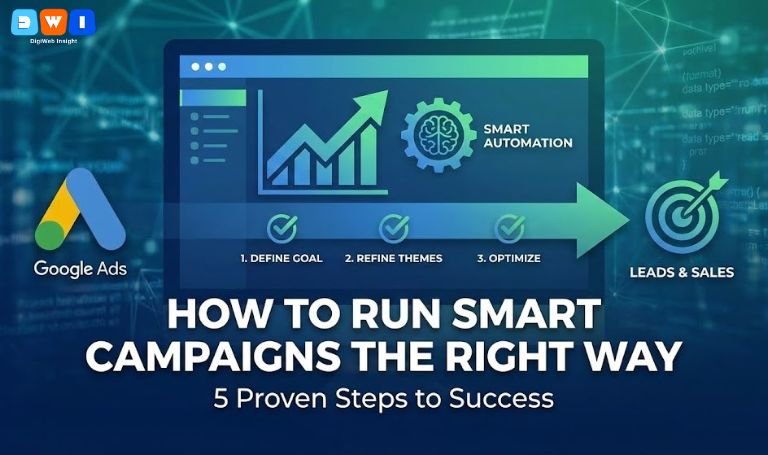
Google Ads can be intimidating for small business owners. The complex interfaces and endless metric options often lead to paralysis. Enter Google Smart Campaigns: Google’s automated solution designed to get ads up and running in minutes.
While they are easy to set up, they are even easier to mess up.
Many businesses treat Smart Campaigns as a “set it and forget it” magic button, only to find their budget drained weeks later with zero new customers to show for it. The automation is powerful, but it needs guidance. If you want to avoid wasted spend, you need to learn how to run Smart Campaigns the right way.
This guide breaks down the essential steps to ensure your automated ads actually deliver results, transforming them from a budget drain into a lead-generating asset.
What Are Google Smart Campaigns?
Before diving into strategy, it is crucial to understand what you are using. Smart Campaigns (formerly Google Ad Express) rely heavily on Google’s machine learning. You provide a goal, some ad text, and budget parameters, and Google’s algorithm decides when, where, and to whom your ads are shown across Search, Maps, and the Display Network.
The benefit is speed and simplicity. The downside is a significant lack of control compared to standard Search campaigns. Because you have less control, the inputs you provide must be incredibly precise.
Here is how to run Smart Campaigns the right way to maximize your return on investment.
1. Define a Singular, High-Value Goal
The very first step Google asks for is your goal. This seems simple, but it is where many go wrong.
Google offers options like “get more calls,” “get more website sales,” or “get more store visits.” Do not choose arbitrarily.
If you are a local plumber, “get more calls” is likely your lifeblood. If you are an e-commerce shop, “website sales” is key.
The mistake to avoid: Choosing a vague goal like “website traffic” just to get people to your site. Smart Campaigns will find the cheapest clicks, not necessarily buying customers. To run these campaigns effectively, align the system’s goal directly with how your business makes money.
2. Master “Keyword Themes” (Not Just Keywords)
This is the biggest differentiator between Smart Campaigns and regular ads. You do not bid on specific keywords; you select “keyword themes.”
Google uses these themes to match your ads to broad search intent. If you choose a theme like “landscaping,” your ad might show up for someone searching for “how to mow a lawn” (low intent) rather than “landscaper near me” (high intent).
To figure out how to run Smart Campaigns the right way, you must be specific with themes.
- Bad Theme: Plumbing
- Good Theme: Emergency Drain Repair Service
Select 7-10 highly specific themes that describe exactly what you offer. The tighter the theme, the better the AI can target the right users.
3. Craft Ad Copy That Pre-Qualifies
Since Smart Campaigns cast a wider net than standard search ads, your ad copy needs to do some heavy lifting to filter out bad clicks.
Don’t just say “We sell shoes.” Say “Premium Leather Boots – Starting at $200.”
By including specifics like price points, service areas, or specific specialties, you discourage people who aren’t the right fit from clicking. This saves your budget for genuine prospects. Specificity is key to improving your ad relevance.
4. Optimize Your Destination (The Landing Page)
You can build the perfect ad, but if you send traffic to a confusing or slow website, you will fail. A common pitfall is sending paid traffic directly to a generic homepage.
Homepages are usually too broad. If your ad is about “Water Heater Repair,” the page they land on must immediately say “Water Heater Repair” and have a big, bold phone number or form.
If your current website isn’t set up to convert visitors into leads, you need to fix that foundation first. Consider investing in professional Web Design & Development to create dedicated landing pages that match your ad goals. A good landing page experience is essential for Google’s algorithms to favor your ads.
5. Monitor and Refine (The “Smart” Part)
While Google handles the bidding, you must handle the strategy. Knowing how to run Smart Campaigns the right way means checking in weekly.
Smart Campaigns provide a simplified dashboard. Pay attention to:
- Search phrases: Google shows you some of the actual terms people searched before clicking your ad. Are they relevant? If you see irrelevant terms, toggle them off immediately.
- Conversion Actions: Are the calls you are getting actually leading to business?
If you find that despite your best efforts, Smart Campaigns aren’t delivering the detailed data or results you need, it might be time to upgrade to expert-managed campaigns. Our team acting as an Affordable SEO Agency in USA can help transition you to more advanced strategies.
Conclusion
Google Smart Campaigns are a viable entry point for digital advertising, provided you respect the process. They are not magical money machines; they are tools that require sharp inputs to generate quality outputs.
By defining clear goals, tightening your keyword themes, and ensuring your website is ready to convert, you now know exactly how to run Smart Campaigns the right way. Start smart, monitor closely, and scale what works.
For more in-depth explanations on how Google matches ads to searches, you can read Google’s official support documentation on search intent and matching.