
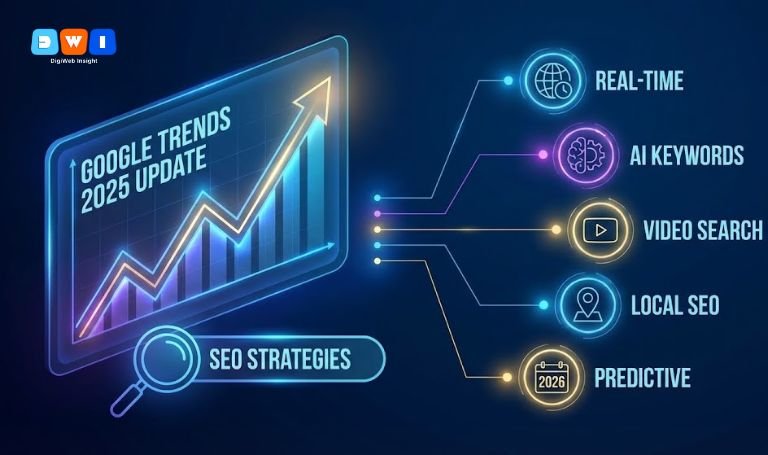
The search landscape has shifted dramatically this year. With the rise of AI Overviews and “zero-click” searches, relying solely on historical volume data is no longer enough. Mastering How to Use Google Trends for SEO (2025 Update) is essential for staying ahead of the curve.
While traditional tools tell you what users searched for last month, Google Trends tells you what they are searching for right now. In late 2025, Google updated its “Trending Now” engine to detect emerging topics 10x faster than before. If you aren’t using this real-time data, you are likely optimizing for the past, not the future.
In this guide, we will break down exactly How to Use Google Trends for SEO (2025 Update) to uncover hidden opportunities and drive massive traffic.
Mastering How to Use Google Trends for SEO (2025 Update)
To succeed in the current SEO climate, you must move beyond basic keyword comparisons. You need to leverage real-time insights to capture “breakout” traffic before your competitors do.
1. Capitalize on “Trending Now” for Newsjacking
One of the biggest changes in 2025 is the speed of data. The “Trending Now” feature is updated every few minutes, offering a live pulse of the internet.
- The Strategy: Check the “Trending Now” tab daily for your industry.
- The Action: If a relevant topic spikes, create a quick blog post, social video, or update an existing page immediately. This “newsjacking” technique signals to Google that your site is active and authoritative on current events.
For businesses needing help executing fast-paced content, a professional Affordable SEO Agency in USA can streamline this process.
2. Identify “Breakout” Keywords for AI Optimization
When a keyword is marked as “Breakout” in Google Trends, it means search volume has grown by over 5000%. These are often new terms that standard keyword tools haven’t even indexed yet.
- Why it matters: New terms often have zero competition.
- The Fix: Target these “Breakout” terms to rank at the top of AI Overviews before big brands catch on.
3. Validate Video & Visual Search Demand
With visual searches growing by 70% this year, text isn’t the only way to rank. You can toggle Google Trends from “Web Search” to “YouTube Search” or “Image Search.”
- The Strategy: Before filming a video, check if the topic is rising on YouTube.
- The Benefit: Ranking videos in Google Search is often easier than ranking text articles.
If your website isn’t optimized for multimedia, consider investing in modern Web Design & Development to support these formats.
4. Leverage “Near Me” and Local Seasonality
National trends don’t always apply locally. A winter jacket trend peaks in October for New York but might not peak until December for Texas.
- How to do it: Filter results by “Subregion” or “City.”
- The Goal: Time your content and Pay Per Click (PPC) Marketing campaigns to match the specific peak interest of your target location.
5. Predict Trends Using “Year in Search” Data
Google’s annual “Year in Search” report is a goldmine for predictive SEO. By analyzing the macro-trends of 2025, you can forecast what will be popular in Q1 of 2026.
- Look for patterns in “How to” and “Why is” queries.
- Create evergreen content that answers these fundamental questions.
Conclusion
Learning How to Use Google Trends for SEO (2025 Update) is about speed and precision. By using real-time data to find breakout terms, analyzing local nuances, and optimizing for video, you can outperform competitors with much larger budgets.
Start monitoring your niche today. The sooner you spot a trend, the easier it is to rank.
For a deeper dive into search behavior, check out the official Google Trends Help Center.
If you are ready to build a comprehensive digital strategy that integrates these insights, visit DigiWebInsight to get started.