
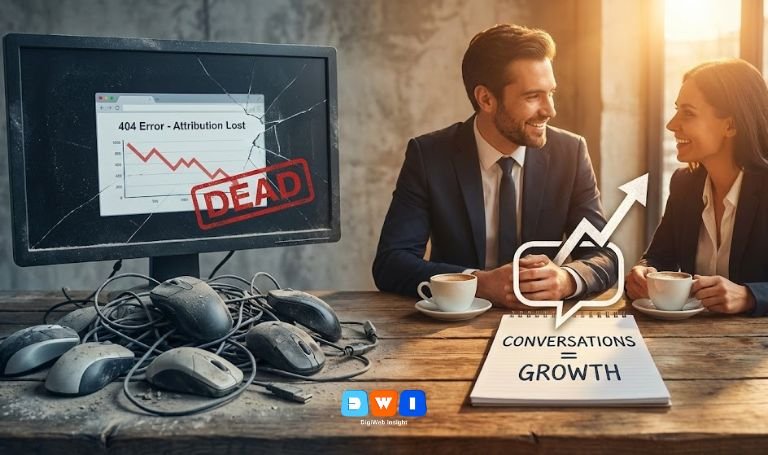
Let’s be honest for a second. How much time do you spend staring at your dashboard, trying to make the numbers match up?
You look at Facebook Ads Manager, and it claims credit for 50 conversions. You look at Google Analytics, and it claims those same conversions came from Organic Search. The math doesn’t add up, and you’re left scratching your head.
You aren’t alone. This is the great lie of modern digital strategy: the belief that we can perfectly track every single touchpoint a customer makes before they buy. We call this marketing attribution, and frankly, it is broken.
Relying solely on software to tell you where your customers come from is like trying to drive a car by only looking in the rearview mirror. You might see where you’ve been, but you’ll miss what’s right in front of you.
The Problem with “Perfect” Marketing Attribution
Here is the reality: The customer journey is no longer a straight line. It’s a mess.
A potential client might see your LinkedIn post on Monday (untracked). They might listen to a podcast mentioning your brand on Wednesday (untracked). Then, two weeks later, they search for your company name, click an ad, and buy.
Traditional marketing attribution software looks at that sequence and says, “Great job! That Google Ad did 100% of the work.”
But you know that isn’t true. You are leaving credit on the table for the brand-building work that actually influenced the decision. If you make budget decisions based on this flawed data, you might cut the very channels that are feeding your funnel. It’s a classic case of “flying blind.”
This is especially dangerous if you are running complex campaigns, like pay-per-click (PPC) marketing. If you only look at the last click, you undervalue the awareness campaigns that made that click possible.
Why Conversations Beat Clicks
So, if software is unreliable, what do we do? We have to get back to basics. We have to stop tracking clicks and start tracking conversations.
This means moving away from a purely quantitative approach (what the code tells you) to a qualitative approach (what the humans tell you). It sounds simple, but it changes everything.
When you invest in high-quality web design and development, you aren’t just building a pretty page; you are building a venue for these conversations.
1. The “Self-Reported” Attribution Revolution
The easiest way to fix your marketing attribution problem is to just ask.
Add a required field to your checkout or contact form that asks, “How did you hear about us?” and leave it as an open text box. No drop-downs. No pre-selected options.
You will be shocked by the answers. People will say things like “I heard you on a podcast” or “My colleague recommended you in a Slack group.” No software on earth can track that. This is the “Dark Funnel,” and it’s where your best customers are hiding.
2. Validating Your SEO Efforts
You might think your affordable SEO agency in the USA is just driving random traffic. But when you start reading those self-reported answers, you’ll see patterns. You’ll realize that a blog post you wrote three years ago is still driving high-value leads today.
This connects the dots between your content efforts and your revenue in a way that Google Analytics never could.
Stop Looking Under the Streetlight
There is an old joke about a man looking for his keys under a streetlight. A police officer asks, “Did you lose them here?” The man says, “No, I lost them in the park, but the light is better here.”
That is exactly what we do with marketing attribution. We obsess over the data we can easily see (clicks, impressions) because the light is better there. But the keys—the real human motivations—are out in the dark.
It is time to get comfortable with the unknown. By combining your digital data with actual customer feedback, you get a 360-degree view of your performance. You stop guessing and start knowing.
If you are ready to move beyond vanity metrics and build a digital strategy that actually impacts your bottom line, you need to accept that the map is not the territory.
According to a recent study by Gartner, purely digital attribution is becoming less effective due to privacy changes. The future belongs to those who can blend data with human insight.