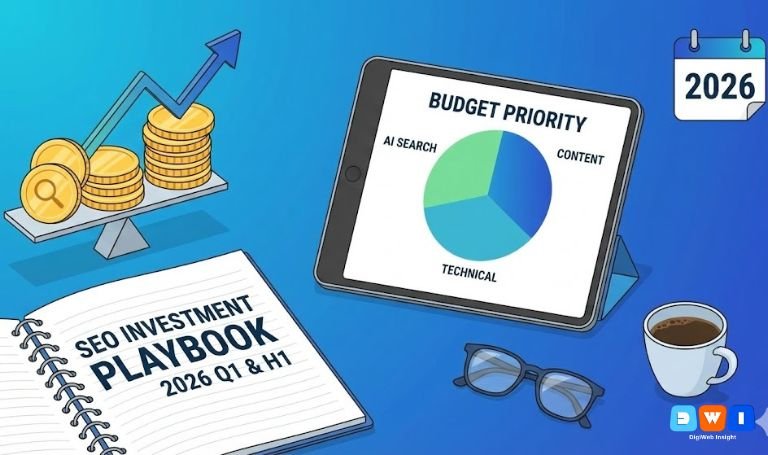
The fiscal landscape for digital marketing is undergoing a seismic shift. As we approach 2026, the traditional “rankings-first” approach is dead. The rise of AI-driven “Answer Engines” (like SearchGPT and Google’s Gemini-infused overviews) has forced marketing leaders to rethink their allocation strategies completely.
To prioritize SEO budgets effectively in 2026, CMOs must move beyond simple traffic acquisition. The new goal is “Answer Engine Optimization” (AEO) and comprehensive brand visibility. If you are still funding SEO like it’s 2024, you are funding a ghost town.
This playbook outlines exactly how to prioritize SEO budgets for the first half of 2026, balancing defensive core stability with offensive AI innovation.
The 70/20/10 Rule to Prioritize SEO Budgets
A static budget is a failed budget. The most effective strategy for 2026 is a dynamic portfolio approach. Marketing leaders are increasingly adopting a “Defensive vs. Offensive” split to ensure stability while capturing new demand layers.
When you prioritize SEO budgets, consider this allocation model:
- 70% Defensive (The Core): Technical health, site speed, and maintaining existing rankings.
- 20% Offensive (The Growth): Creating entity-rich content and targeting long-tail AI queries.
- 10% Experimental (The Future): Testing new “Agentic SEO” protocols and AI-specific schema.
This structure ensures you don’t lose your current organic foothold while aggressively pursuing the new “zero-click” search landscape.
1. Q1 Strategy: Stabilize and Audit
The first quarter of 2026 is about cleaning house. Before you scale, you must ensure your digital infrastructure is “machine-readable.” AI agents don’t browse websites like humans; they scrape for structured data.
To prioritize SEO budgets in Q1, allocate funds to:
- Technical “Agent” Audits: Ensure your
robots.txtand sitemaps are optimized for AI crawlers (likeGPTBot). - Schema Markup Overhaul: Move beyond basic schema. Implement complex “Organization” and “Product” schema that explicitly tells AI models who you are and what you sell.
- Content Refresh: Update old “SEO” content to be “Answer” content. Remove fluff and focus on direct, expert-led answers.
If your technical team is stretched thin, partnering with a specialist in web design and development can accelerate this foundational work, ensuring your site is ready for the AI era.
2. H1 Strategy: Scale “Entity Authority”
Once the foundation is set, H1 is the time to expand. AI models rely on “Knowledge Graphs”—webs of interconnected facts. To rank in AI overviews, your brand must be a recognized “Entity” in that graph.
When you prioritize SEO budgets for H1, shift spend toward:
- Digital PR & Brand Mentions: AI weighs brand authority heavily. You need citations from Tier 1 publications, not just backlinks from random blogs.
- Video & Visual Search: Investment in “multimodal” content is non-negotiable. Video snippets are increasingly being cited in AI answers.
- Author Experience (E-E-A-T): Budget for real subject matter experts to review and byline your content. “Generic” content is being de-indexed at record rates.
Why You Must Prioritize SEO Budgets for “Zero-Click”
The scariest metric for many CMOs is the decline in click-through rates (CTR). However, this doesn’t mean SEO is failing; it means the funnel has changed. Users are getting answers directly on the SERP (Search Engine Results Page).
If you fail to prioritize SEO budgets toward “Zero-Click” optimization, your brand disappears from the conversation entirely. Being the “cited source” in an AI answer drives high-intent brand awareness, even if the click happens later.
This requires a mental shift. You are no longer paying for clicks; you are paying for share of mind.
- Defend Your Branded Search: Ensure no competitor appears in the AI summary for your own brand name.
- Capture “Comparison” Queries: AI users love asking “Best X vs Y.” Ensure your content feeds the AI the right comparison data.
For businesses struggling to adapt to this new metric, an affordable SEO agency in the USA can help execute these advanced “citation” strategies without the enterprise price tag.
Balancing Paid and Organic Spend
A common mistake is slashing organic spend to fund rising PPC costs. This is short-sighted. Paid media rents attention; SEO owns it. However, the two must work together.
To prioritize SEO budgets intelligently, use your PPC data to inform your organic strategy.
- Use Pay Per Click (PPC) marketing to test new “question-based” keywords.
- If a specific question converts well in paid search, immediately commission a comprehensive organic guide to own that term permanently.
- Retarget users who engaged with your “Zero-Click” snippets on social platforms.
This integrated approach lowers your overall Customer Acquisition Cost (CAC) and builds a resilient marketing engine.
The Role of “Agentic AI” in Budgeting
By late 2026, “Agentic AI” (bots that perform tasks for users) will be a significant traffic source. These agents will book appointments, buy products, and research software without human intervention.
Smart CMOs will prioritize SEO budgets to prepare for this now.
- Create an
llms.txtfile: This is a new standard proposed to help LLMs understand your site map and permissions explicitly. - API-First Content: Ensure your product data is accessible via API, not just HTML, allowing shopping bots to read your inventory in real-time.
Ignoring this is like ignoring mobile optimization in 2012. It is not optional.
Conclusion: The “Safe” Bet is the Riskiest One
The safest-looking option—sticking to your 2024 budget allocation—is actually the most dangerous move you can make. The platforms have changed. The users have changed. Your budget must change too.
To successfully prioritize SEO budgets in 2026, you must be willing to cut funding for “vanity traffic” (low-intent blog views) and reinvest it into technical infrastructure, entity authority, and multimedia content.
Summary Checklist for CMOs:
- Audit: Is your site blocked by AI crawlers? (Fix this in Q1).
- Allocate: Shift 20% of budget to “Answer Engine” experiments.
- Integrate: Align your SEO and PPC teams to share data weekly.
- Measure: Stop tracking just rankings; start tracking “Share of Voice” in AI overviews.
If you need a strategic partner to help you navigate these shifts and allocate your resources effectively, visit DigiWeb Insight for a comprehensive consultation.
According to recent insights from Search Engine Journal, the most critical move for 2026 is stabilizing your technical foundation in Q1 to support AI discovery in H1.