
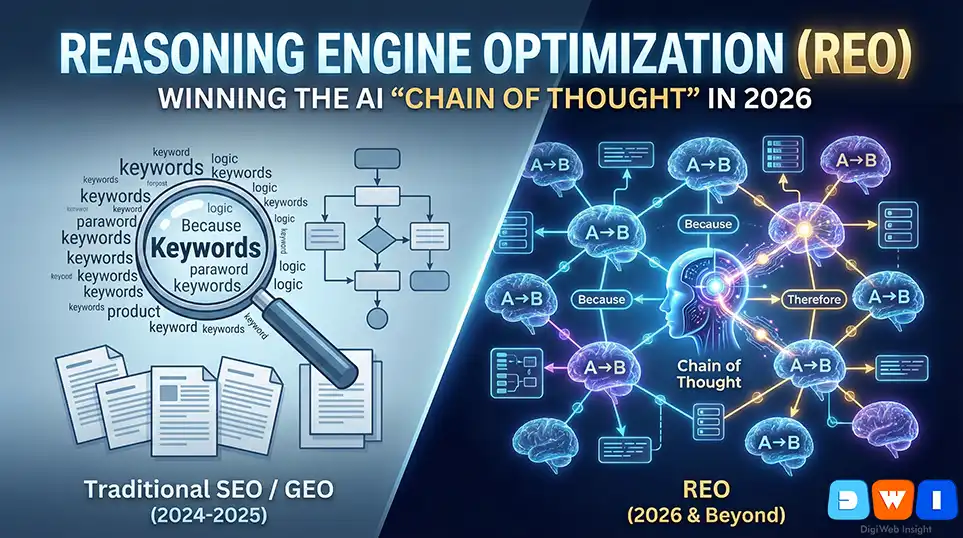
The era of “keywords” is dead. The era of “answers” (GEO) is peaking. We are now entering the era of Reasoning Engine Optimization.
In 2024 and 2025, we watched Large Language Models (LLMs) like GPT-4 and Gemini learn to read and summarize. But in 2026, the game has changed again. New models—often called “System 2” thinkers—don’t just retrieve information; they reason through it. They use a process called “Chain of Thought” (CoT) to break down complex queries, verify logic, and synthesize new conclusions.
If your content provides the answer but not the logic, you will be ignored.
Reasoning Engine Optimization (REO) is the strategic practice of structuring your digital presence so that AI reasoning models can effectively use your content as a valid node in their logical deduction chains. This is not about convincing a human to click; it is about convincing an AI that your data is the “truth” upon which a conclusion should be built.
This guide will break down exactly how these engines think and how you can re-engineer your content to survive the shift from Search to Reasoning.
The Core Shift: Probabilistic vs. Deterministic Search
To master Reasoning Engine Optimization, you must understand the fundamental shift in how AI processes a user’s request.
- Traditional SEO (The Librarian): The engine matches keywords. “You asked for X, here is a book about X.”
- GEO (The Summarizer): The engine reads the top results and summarizes them. “Most sources say X is Y.”
- REO (The Detective): The engine is given a complex problem. It gathers evidence, checks for contradictions, tests the logic, and derives a solution.
When a user asks a customized, high-stakes question—like “Design a marketing budget for a SaaS startup in India targeting Tier 2 cities with a focus on high ROAS”—the AI cannot find this answer on a single blog post. It must construct the answer.
It looks for:
- Benchmarks for SaaS in India.
- Cost-per-click data for Tier 2 cities.
- Logic frameworks for budget allocation.
If your content is just “fluff” or opinion, the Reasoning Engine discards it. It needs axioms—indisputable facts and clear logic structures—to build its Chain of Thought.
1. Structure Content for “Chain of Thought” Ingestion
The most critical factor in Reasoning Engine Optimization is the logical hierarchy of your content. Reasoning models break problems down into steps. Your content must mirror this structure.
In traditional SEO, we focused on “skimmability” for humans (short paragraphs, bullet points). For REO, we must focus on “inferential linking”. This means explicitly connecting your premises to your conclusions.
The “Because” Framework
Do not just state a fact. State the fact, the evidence, and the derivation.
- Bad (Legacy SEO): “Email marketing has an ROI of 4200%.”
- Good (REO Optimized): “Email marketing yields an ROI of 4200% because it bypasses algorithmic filters (Premise A) and utilizes owned first-party data (Premise B), as verified by the 2025 DMA report (Evidence).”
When a reasoning model scans the second sentence, it can extract a complete logical unit: Action -> Mechanism -> Proof. It can now use this logic to answer a user asking, “Why is email better than social media for retention?”
Linear vs. Tree Structured Content
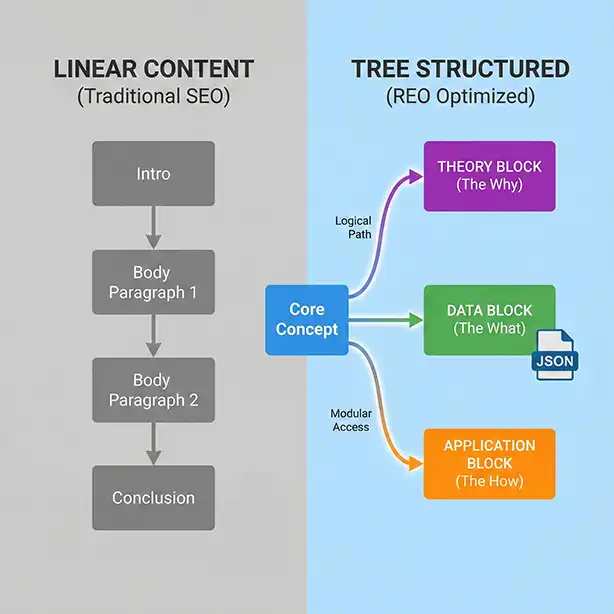
Most blog posts are linear. However, AI reasoning often uses a “Tree of Thoughts” approach, exploring multiple possibilities.
To optimize for this, use modular content blocks. Instead of one long narrative, break your complex guides into independent, logically sound modules.
- The Theory Block: The “Why” (Logic).
- The Data Block: The “What” (Raw numbers).
- The Application Block: The “How” (Execution).
This allows the AI to pick up just the “Data Block” to solve a math problem, or just the “Theory Block” to solve a strategic problem.
2. Optimizing for “Intermediate Steps” (The ‘Show Your Work’ Signal)
One of the biggest breakthroughs in AI was discovering that if you ask a model to “show its work,” it becomes smarter. Similarly, if your content “shows its work,” it becomes more authoritative to a Reasoning Engine.
Reasoning Engine Optimization requires you to publish the process, not just the result.
If you are a digital marketing agency publishing a case study, don’t just say “We increased traffic by 300%.” This is a “black box” claim that a Reasoning Engine treats with skepticism (low confidence score).
Instead, detail the intermediate steps:
- Diagnosis: “We identified a crawl budget issue on 40% of pages.”
- Intervention: “We implemented server-side rendering using Node.js.”
- Result: “Crawl rate improved by 200%, leading to a 300% traffic lift.”
By providing the causal chain, you become a Verifier Source. The AI can now use your content to validate other content. When another site claims “Node.js helps SEO,” the AI will cite your case study as the proof in its Chain of Thought.
This aligns perfectly with our previous discussions on learning Node.js for full-stack development, where understanding the backend logic is key to frontend success. The same principle applies here: understanding the backend logic of the AI is key to ranking.
3. The Rise of “Data Provenance” and Citation Value
In the world of Reasoning Engine Optimization, trust is mathematical.
LLMs suffer from “hallucinations.” Reasoning models fight this by assigning Confidence Scores to every piece of information they retrieve. Your goal is to have the highest Confidence Score in your niche.
How do you achieve this? Data Provenance.
Primary Source Verification
Never cite a statistic without linking to the absolute original source. If you cite a HubSpot article that cites a Forbes article that cites a study, the AI dilutes the value of your page. It prefers the shortest path to the truth.
To practice high-level REO:
- Host your own raw data (CSV or JSON files) alongside your articles.
- Use explicit citations.
- Update your data. A reasoning model knows that “2021 data” is logically less relevant to a “2026 prediction” than “2025 data.”
Semantic Triangulation
Reasoning engines use a technique called “triangulation.” If Website A says “The sky is blue,” and Website B says “The sky is azure,” and Website C says “The sky is green,” the AI uses authority signals to determine the truth.
To win this vote, your content needs to agree with the consensus of other high-authority entities while adding unique value. This is why technical SEO audits are vital—they ensure your site’s technical signals (HTTPS, structured data, speed) don’t disqualify you from the “trusted” pool before the logic check even begins.
4. Implement Logic-Based Schema Markup
We discussed “Action Schema” for agents previously. For Reasoning Engine Optimization, we need schemas that help the AI understand relationships and validity.
Standard schema (Article) is insufficient. You should look into:
ClaimReviewSchema: This is the gold standard for REO. It tells the AI, “Here is a specific claim, and here is the verification.”JSON{ "@context": "https://schema.org", "@type": "ClaimReview", "claimReviewed": "AI Reasoning Models prioritize logical structure over keyword density.", "reviewRating": { "@type": "Rating", "ratingValue": "5", "bestRating": "5", "alternateName": "True" }, "author": { "@type": "Organization", "name": "DigiWeb Insight LLC" } }DatasetSchema: If you provide tables or data, wrap them in this schema so the Reasoning Engine can ingest the raw numbers for its calculations.HowTowithStepLogic: Ensure your “How-To” guides are clearly demarcated. If the AI is trying to solve a multi-step problem for a user, it will pull “Step 3” directly from your code.
5. Write for “System 2” Thinking (Handling Ambiguity)
The most advanced capability of Reasoning Engines is handling ambiguity. Users often ask vague questions: “What is the best marketing strategy?”
A basic AI gives a generic list (SEO, PPC, Social). A Reasoning Engine asks clarifying questions or simulates scenarios.
To optimize for this, your content should cover Edge Cases and Conditions.
- Don’t write: “PPC is the best strategy.”
- Write: “PPC is the optimal strategy IF your budget exceeds $2,000/month AND you need immediate results. However, IF you have a long timeline, SEO yields better ROI.”
This “If/Then” structure is catnip for Reasoning Engine Optimization. It allows the AI to plug your content into its decision tree.
Shutterstock
Explore
This is highly relevant to complex fields like Digital Marketing and SEO, where the “right” answer always depends on the client’s specific context. By documenting these dependencies, you make your content machine-readable in a profound way.
Measuring REO Success: The “Citation Share” Metric
How do you know if your Reasoning Engine Optimization is working? You won’t see it in “Click-Through Rate” (CTR) because the user might not click. They might get the answer directly from the AI.
However, the “Citation” is the new click.
You need to track:
- AI Overviews: Is your brand mentioned in the “sources” dropdown of Gemini or ChatGPT search?
- Brand Entity Association: Ask an AI, “What are the most trusted sources for [Your Topic]?” If you aren’t on the list, your REO strategy needs work.
- Referral Traffic from AI: In Google Analytics 4, look for referrers like
checklistorgenerative-feedback.
Conclusion: The Future of Logic
The transition to Reasoning Engine Optimization is the maturation of the internet. We are moving away from a web of “content” and toward a web of “knowledge.”
For content creators, this is a higher bar. It requires more research, better data, and stricter logic. You cannot fake expertise when the reader is a supercomputer designed to detect fallacies.
But for those who adapt—for those who structure their insights as clean, logical, executable chains of thought—the opportunity is boundless. You become the brain cells of the global AI.
Recommended External Resources
To truly understand the mechanics of how these models process logic, I recommend reading the guide on Chain-of-Thought Prompting by the Prompt Engineering Guide. It provides the technical foundation for the concepts we have applied to SEO in this article.
Related Service
- SEO Company USA — Boost national visibility with expert SEO strategies.
- Web Design & Development — Build fast, conversion-optimized websites that Google loves.
- PPC Marketing (Pay-Per-Click) — Drive immediate, high-intent traffic for quick ROI.
- E-commerce SEO — Drive targeted shopper traffic and maximize online store revenue.
- Social Media Advertising — Turn paid campaigns into high-converting customer funnels.