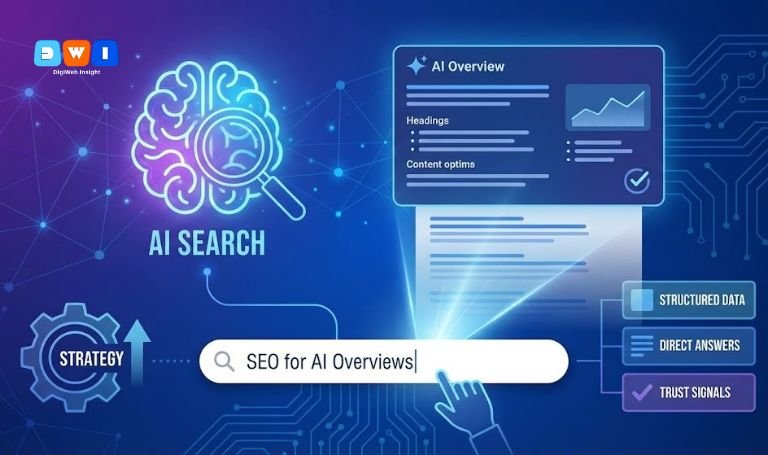
The search landscape has shifted permanently. You are no longer just fighting for the blue link; you are fighting for the “Zero Position.” SEO for AI Overviews is the critical new battleground for digital marketers in 2025. If you ignore it, you risk losing over 40% of your organic traffic to the automated answer box sitting at the top of the search results.
This guide reveals exactly how to structure your content to be “read” by machines and “trusted” by humans.
What is SEO for AI Overviews?
SEO for AI Overviews refers to the specific set of optimization techniques designed to make your content eligible for citation in Google’s AI-generated snapshots. Unlike traditional SEO, which focuses on keywords and backlinks, this new strategy prioritizes direct answers, structured data, and high information density.
Why is everyone talking about this today? Because Google has aggressively rolled out these overviews for complex queries. The “link” is becoming secondary to the “answer.” To survive, you must adapt.
1. Adopt the “Answer-First” Structure
To succeed in SEO for AI Overviews, you must stop burying the lead. Google’s AI models (like Gemini) look for concise, factual answers to specific questions.
How to execute this:
- Identify the core question your page answers.
- Place the direct answer in the first 10% of your content.
- Keep this answer under 300 characters (roughly 40-50 words).
Think of this as the “inverted pyramid” style of journalism. Give the summary first, then expand on the details later.
2. Leverage Structured Formatting
AI loves structure. It struggles to parse walls of text. If you want to master SEO for AI Overviews, you need to break your content down into digestible chunks that machines can easily categorize.
Use these formatting elements:
- Bullet points for features or benefits.
- Numbered lists for step-by-step instructions.
- Comparison tables for product reviews vs. competitors.
Short paragraphs are essential. They help the AI isolate specific claims and cite them as sources. If your content is a dense block of text, the AI is likely to skip it in favor of a competitor who used a list.
3. Target “Zero-Click” Long-Tail Queries
The queries that trigger AI results are often conversational. Users are asking full questions like, “What is the best SEO for AI Overviews strategy for small businesses?” rather than typing “SEO agency.”
You should target keyword phrases that are 6-10 words long. These specific, high-intent queries are the “sweet spot” for AI citations.
Pro Tip: Look at your “People Also Ask” (PAA) data. These questions are often the exact prompts the AI tries to answer.
4. Optimize for E-E-A-T and External Citations
Google’s AI prioritizes accuracy. It will rarely cite a source that lacks credibility. This is where E-E-A-T (Experience, Expertise, Authoritativeness, and Trustworthiness) becomes non-negotiable.
To boost your authority:
- Cite primary sources (studies, whitepapers).
- Include expert author bios.
- Ensure at least one external link with DoFollow content points to a highly authoritative site, such as Google Search Central’s documentation, to signal trust.
Additionally, linking to external resources validates your claims. If you claim a statistic, link to the source. The AI uses these outbound links as verification signals.
5. Implement Schema Markup
Schema markup is the language of search engines. By adding FAQPage, HowTo, or Article schema, you explicitly tell the AI what your content is about.
While schema doesn’t guarantee a spot in the overview, it removes ambiguity. A clear FAQ schema makes it incredibly easy for the AI to pull your specific Question/Answer pair directly into the snapshot.
6. Focus on Topic Authority, Not Just Keywords
Don’t just write one lonely post about a topic. SEO for AI Overviews requires you to build “topic clusters.”
If you are a web agency, don’t just write about “web design.” Write about the nuance of web design and development for specific industries. Link these articles together. The AI sees this cluster as a sign of deep expertise.
You should also be linking to other resources on website to create a spiderweb of relevance. For instance, connect your SEO guides to your pay per click (PPC) marketing services pages to show a holistic approach to digital marketing.
7. Keep Content Fresh and Updated
AI models favor current information. An article from 2021 regarding SEO for AI Overviews would be useless today because the technology didn’t exist then.
Regularly update your old content. Add the current year to your title, refresh your statistics, and ensure your advice aligns with modern standards.
Why Traditional SEO Still Matters
While optimizing for AI, do not neglect the basics. Your site must be fast, mobile-friendly, and secure. If your page takes 5 seconds to load, the AI crawler might timeout before it even reads your answer.
If you need help auditing your technical foundation, consider partnering with an affordable SEO agency USA that understands the nuances of both traditional and generative search.
Conclusion
Mastering SEO for AI Overviews is not about tricking the system. It is about providing the clearest, most structured, and most authoritative answer on the web.
By following these rules—using short paragraphs, focusing on conversational queries, and structuring your data—you can future-proof your traffic. Start today, because the websites that adapt now will own the answers of tomorrow. For expert guidance on navigating these changes, visit DigiWebInsight.