How Small US Businesses Are Using AI Chatbots to Cut Support Costs by 70%: The Ultimate Guide
In today’s competitive landscape, small businesses across the United States are facing immense pressure. Customers expect instant answers 24/7, while the costs of staffing a full-time support team continue to rise. For many, this creates an operational bottleneck that drains resources and stifles growth.
This is where the new wave of artificial intelligence steps in. The conversation has shifted from “if” businesses should use AI to “how.” The most powerful and accessible entry point? Using AI chatbots to cut support costs.
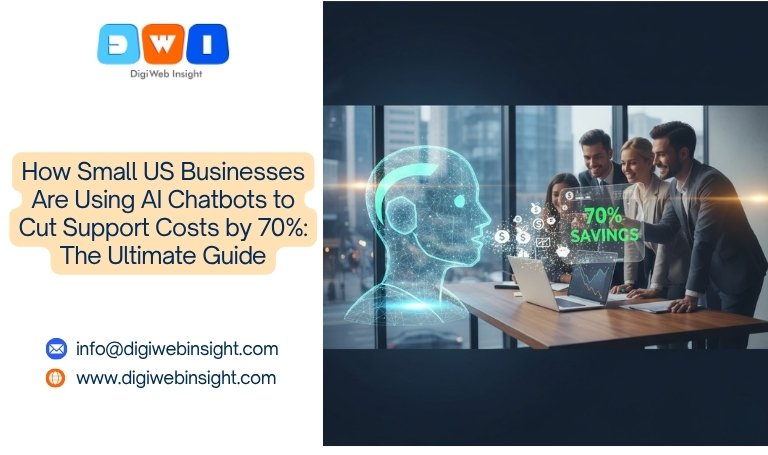
You’ve seen the claims: a 70% reduction in customer support expenses. It’s not just hype. This saving is achieved by strategically automating the 70-80% of routine, repetitive inquiries that tie up your human agents.
This article breaks down exactly how small US businesses are achieving these massive savings, transforming their customer service from a cost center into a lean, efficient growth engine.
The 70% Savings Breakdown: How AI Chatbots Cut Support Costs
The 70% figure isn’t arbitrary. It’s a direct result of automation and efficiency. Research shows that chatbots can successfully handle 70% or more of all customer interactions from start to finish.
Here’s how that translates into direct dollar savings for a small business.
1. Eliminating 24/7 Staffing Costs
Your customers are online at 2 AM, even if you’re not. Traditionally, providing 24/7 support meant hiring multiple agents for different shifts, complete with salaries, benefits, and overtime.
An AI chatbot is your best employee: it never sleeps, never takes a vacation, and never asks for overtime. It provides instant, accurate answers around the clock, capturing leads and satisfying customers while your team is at home. This alone can slash labor costs.
2. Automating High-Volume, Low-Value Tasks
Think about your inbox. How many emails are variations of the same 5-10 questions?
- “Where is my order?”
- “What are your business hours?”
- “What is your return policy?”
- “How do I reset my password?”
These are a drain on your team’s time. By training an AI chatbot with a knowledge base, it can instantly and accurately answer these FAQs, deflecting the vast majority of routine tickets. This frees your human agents to focus on high-value, complex problems that actually require a human touch.
3. Scaling Instantly During Peak Seasons
A human agent can realistically handle one, maybe two, customer conversations at a time. What happens during a holiday sale or a successful marketing campaign? Your support system breaks. Customers face long wait times, get frustrated, and abandon their carts.
An AI chatbot can handle 10, 100, or 1,000 conversations simultaneously without a drop in performance. This scalability means you no longer need to hire expensive temporary staff for peak seasons. The bot absorbs the surge, ensuring every customer gets an instant response.
Beyond Cost-Cutting: The “Hidden” ROI of AI Chatbots
While the primary goal may be using AI chatbots to cut support costs, the secondary benefits often provide just as much value. A well-implemented bot becomes a proactive tool for growth.
- 24/7 Lead Qualification: The bot can engage website visitors, ask qualifying questions, and identify hot leads. It can even book appointments or schedule demos, funneling high-intent customers directly to your sales team. This turns your support tool into a lead-generation machine, maximizing the value of your Pay-Per-Click (PPC) marketing campaigns.
- Drastically Improved Customer Satisfaction (CSAT): Modern customers hate waiting. In fact, studies show that an “immediate” response is the most critical factor in customer satisfaction. By providing instant answers, you eliminate wait times, reduce frustration, and build brand loyalty.
- Valuable Data Collection: Every question a customer asks your chatbot is a piece of data. This feedback loop is invaluable. You can identify common pain points, discover what products customers are asking for, and find gaps in your knowledge base, allowing you to make smarter, data-driven business decisions.
Real-World Examples: US Businesses Using AI Chatbots to Slash Expenses
This isn’t just theory. Small businesses across the US are already winning with this strategy.
Case Study: The E-commerce Boutique A small online clothing retailer in Texas was overwhelmed by “Where Is My Order?” (WISMO) inquiries. By implementing an AI chatbot integrated with their shipping software, they automated over 80% of these queries. This cut their support ticket volume in half, saving them the cost of hiring two additional part-time agents.
Case Study: The Regional HVAC Company A multi-state HVAC service provider used a chatbot for appointment booking and initial diagnostics. The bot filters out non-serious inquiries and gathers all necessary information (like the issue, address, and model number) before it ever reaches a human. This reduced non-billable phone time by 60% and allowed their dispatchers to be more efficient.
These businesses still need customers to find them in the first time. A powerful chatbot is most effective when combined with a strong online presence, which is why services from an affordable SEO agency in the USA are crucial for driving traffic to these automated systems.
How to Implement AI Chatbots for Maximum Cost Savings: A 4-Step Guide
Getting started is easier than you think. You don’t need a team of developers.
- Start Small: Don’t try to make your bot answer everything. Identify your top 3-5 most repetitive questions and build your bot to only answer those first. This is known as a “Minimum Viable Bot.”
- Choose a No-Code Platform: Tools like Tidio, Zapier, or HubSpot’s Chatbot Builder allow you to create powerful AI bots with a simple drag-and-drop interface, no coding required.
- Train Your Bot: The bot is only as smart as the information you give it. Feed it your existing FAQ pages, product descriptions, and help articles. This is the “brain” it will use to provide accurate answers.
- Create a Seamless Human Handover: This is the most critical step. The bot must know when it’s beaten. If a customer asks for a “human,” gets frustrated, or asks a complex question, the bot must instantly and seamlessly transfer the conversation (along with the chat history) to a live agent.
For a deep dive into the technical architecture, this step-by-step guide from NASSCOM provides an excellent overview of building a robust support bot.
The Human Element: AI Empowers Your Team, Not Just Replaces It
The fear that AI will replace all support jobs is misguided. The smart way to use AI chatbots to cut support costs is by pairing them with your human team.
This strategy creates a “hybrid” support model:
- Bots handle: The high-volume, repetitive, simple questions.
- Humans handle: The high-value, complex, emotional, and revenue-generating conversations.
This approach actually boosts employee morale. Your team is no longer bogged down by a boring, repetitive workload. They are elevated to the role of true problem-solvers, focusing on the customer relationships that build long-term loyalty and drive sales.
Your Next Step: From Cost Center to Growth Engine
The 70% cost-saving figure is not a fantasy. It is the tangible result of a smart strategy: automating the mundane to humanize the moments that matter.
For small US businesses, AI chatbots are the single most powerful tool available right now to cut support costs, improve customer satisfaction, and scale operations efficiently. This technology is no longer a luxury for large corporations; it is an essential, accessible tool for survival and growth.
To make this strategy work, it must be built on a solid foundation. This includes a professional website and a clear digital strategy.
Ready to transform your customer support? Contact DigiWeb Insight today. We can help you integrate these powerful AI tools directly into a high-performance website with our expert web design and development services, turning your customer service into your new competitive advantage.