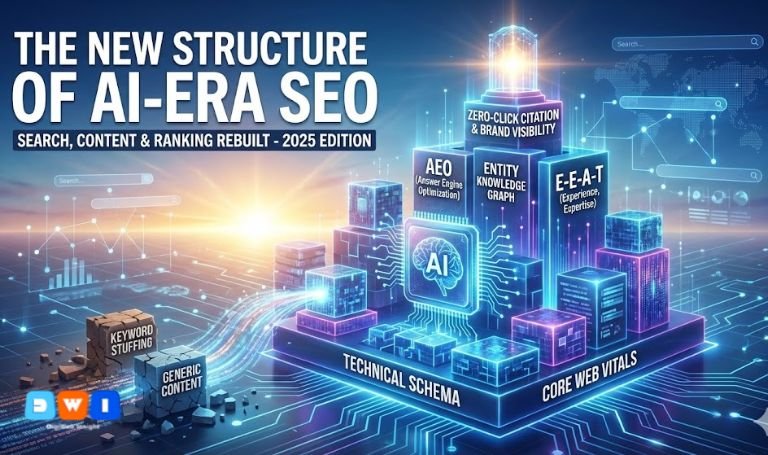
The familiar blue links are fading. In their place, a dynamic, generative interface is emerging, fundamentally changing how users discover information. The New Structure of AI-Era SEO is no longer just about matching keywords to queries; it is about providing the raw material for artificial intelligence to synthesize answers.
As we move deeper into 2025, the “ten blue links” are becoming the “three generative citations.” Google’s AI Overviews (formerly SGE), Bing’s Copilot, and emerging competitors like Perplexity are prioritizing content that is structured, authoritative, and concise.
If you are still optimizing for 2020, you are invisible in 2025. Here is how The New Structure of AI-Era SEO is rewriting the rules of engagement and what you must do to adapt.
1. The New Structure of AI-Era SEO Favors “Answer Engine Optimization” (AEO)
The most immediate shift is the move from “Search Engine Optimization” to “Answer Engine Optimization” (AEO). In the past, you wanted a user to click your link. Now, you want the AI to read your content and cite it as the primary source in its generated summary.
The New Structure of AI-Era SEO demands that your content be “machine-readable.” This means using clear, direct language. When a user asks a question, your content should provide a direct answer in the first 50 words.
Think of your content as a database for the AI. Use bullet points, bolded key terms, and logical hierarchies (H2s and H3s) that allow bots to easily extract value. If your answer is buried in paragraph four behind a wall of fluff, the AI will ignore it in favor of a competitor who got straight to the point.
To ensure your site architecture supports this new structured approach, working with a team skilled in web design and development is essential for creating the clean code base that AI crawlers prefer.
2. Entities Over Keywords in The New Structure of AI-Era SEO
Keywords are not dead, but they are no longer the primary currency. The New Structure of AI-Era SEO relies on “Entities”—concepts, people, places, and things that search engines understand as distinct objects with relationships.
Google’s Knowledge Graph doesn’t just look for the string of letters “best running shoes.” It looks for the concept of running shoes and connects it to related entities like “durability,” “marathon training,” “arch support,” and specific brand names.
To rank in this environment, you must build “topical authority.” You cannot just write one blog post about a topic; you must cover the entire entity cloud. This signals to the AI that you are a subject matter expert, not just a keyword stuffer.
For businesses looking to build this kind of comprehensive topical map, an affordable SEO agency in the USA can help plan a content strategy that covers all relevant entities in your niche.
3. Experience (E-E-A-T) as the Ultimate Filter
With the internet flooded with AI-generated content, trust has become the most valuable commodity. The New Structure of AI-Era SEO places a massive premium on E-E-A-T: Experience, Expertise, Authoritativeness, and Trustworthiness.
AI models are trained to avoid “hallucinations” (making things up). To do this, they prioritize content from sources that demonstrate real-world experience. A generic article about “how to fix a leak” is less valuable than a video or guide from a certified plumber with 20 years of experience.
You must showcase your authors. Use schema markup to link your content to real profiles (LinkedIn, bios). Include original data, case studies, and unique “I” statements that an AI cannot replicate.
4. The “Zero-Click” Funnel and Brand Visibility
One of the harsher realities of The New Structure of AI-Era SEO is the rise of zero-click searches. Users often get their answer directly in the AI snapshot and never visit a website.
Does this mean SEO is useless? No. It means the goal has shifted. You are now optimizing for “Brand Visibility” and “Citation.” Even if the user doesn’t click, seeing your brand cited as the source of the answer builds immense trust and authority.
Furthermore, when users do click, they are much further down the funnel. They have already done their research via the AI and are ready to convert. This makes your bottom-of-funnel pages more critical than ever.
Combining this organic visibility with a targeted Pay Per Click (PPC) marketing strategy ensures you capture those high-intent users who are ready to buy after reading the AI summary.
5. Technical Excellence Supports The New Structure of AI-Era SEO
Finally, the infrastructure of your site matters more than ever. AI crawlers are resource-constrained. If your site is slow, bloated with JavaScript, or hard to navigate, the AI will simply move on.
The New Structure of AI-Era SEO requires a technically flawless foundation. This includes:
- Schema Markup: Tagging your reviews, products, and FAQs so the AI knows exactly what they are.
- Core Web Vitals: Ensuring instant loading speeds.
- Mobile-First Indexing: Your mobile site is the only site that matters to Google.
Conclusion: Embracing the Shift
The transition to The New Structure of AI-Era SEO is not a trend; it is the new operating system of the web. The days of tricking an algorithm are over. The era of educating an artificial intelligence has begun.
By focusing on structure, entities, experience, and technical health, you position your brand not just to rank, but to be the “source of truth” for the next generation of search.
If you are ready to audit your current strategy and align it with these new realities, visit DigiWeb Insight to start your transformation.
According to recent data from Search Engine Land, sites that optimize for AI Overviews are seeing a higher conversion rate despite lower raw traffic volume, proving that quality traffic is winning over quantity.