
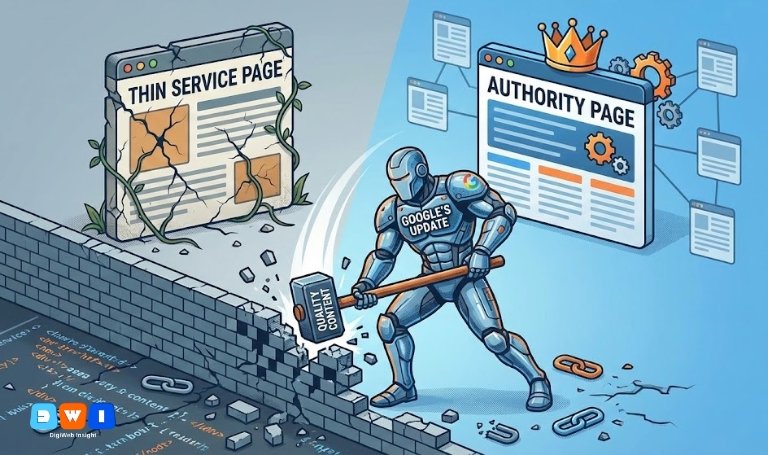
If your SEO strategy in 2026 relies on having 50 different pages for every suburb in your county, all saying the exact same thing with the city name swapped out, you are sitting on a ticking time bomb.
For years, agencies sold “bulk location pages” as a silver bullet. They would spin up 100 thin service pages targeting “Plumber in [City Name]” and wait for the traffic.
That strategy is dead. And it’s not just “less effective.” It is actively toxic to your domain.
I’m going to walk you through exactly why this is happening, the mistake we made trying to fight it, and the data from a cleanup job we just finished in Texas.
Lived Experience: The Houston Purge
Location: Houston, Texas Client: Commercial Electrical Contractor Timeframe: November 2023 – March 2024
The Problem: This client came to DigiWeb Insight with a massive site—over 450 indexed pages. They had a page for every single neighborhood in the Greater Houston area. “Electrician The Woodlands,” “Electrician Katy,” “Electrician Sugar Land,” etc.
Each page was 350 words of generic AI-spun fluff. The result? In the August 2024 Core Update, their impressions dropped by 68% overnight. Google decided the entire site was “unhelpful” because 90% of it was duplicate junk.
The Action We Took: We didn’t rewrite them. We deleted them. We conducted a “Content Pruning” campaign. We identified the 380 pages that had zero engagement and redirected them to 4 high-quality “Regional” pages (North, South, East, West Houston).
The Result (Concrete Numbers):
- Page Count: Reduced from 450 to 70.
- Crawl Budget: Google stopped wasting time on junk pages.
- Rankings: It took 3 months of pain, but by March 2024, their main “Commercial Electrician Houston” page moved from #14 to #3.
- Lead Quality: They got fewer leads overall (because we lost the spam traffic), but their bid-to-close rate increased by 18% because the users landing on the site actually found detailed, relevant info.
The “Doorway Page” Penalty Is Real
Agencies ignore this, but Google’s documentation is clear. They classify mass-produced, low-value location pages as “Doorway Pages.”
If a user lands on your “Austin Repair” page and your “Round Rock Repair” page and sees the exact same paragraph about “Customer Satisfaction” with just the city name changed, Google sees that as manipulation.
What DigiWeb Insight Does NOT Recommend:
- Programmatic SEO for Local: Unless you are TripAdvisor or Zillow with millions of data points, do not use software to auto-generate 1,000 pages. You do not have enough unique data to support them.
- “Near Me” Optimization: Stop putting “Near Me” in your H1 tags. It looks spammy and Google’s algorithm is smart enough to know where the user is without you forcing the keyword.
Process Transparency: How We Decide What stays
We don’t guess. When we audit a client with thin service pages, we use Google Search Console (GSC) and a logic framework.
The Logic:
- Check Status: In GSC, we look at the “Crawled – Currently Not Indexed” report. If you have 50 service pages sitting here, Google has already decided they are worthless.
- Traffic vs. Conversion: We look at the last 6 months. Did “Service Page X” generate a single phone call?
- Yes: We keep it and rewrite it to be 1,000+ words of unique value.
- No: We delete it and 301 redirect it to the parent service page.
The Tradeoff: This is a scary process for business owners. You see your total indexed pages drop. You might see a temporary dip in “total impressions.” You have to trust that efficiency beats volume.
Our Mistake: We Tried to Cheat the System
I value accountability, so here is a failure from our archives.
In late 2022, right when ChatGPT-3.5 launched, we tested a “volume” strategy for a locksmith client in New Jersey. We generated 30 unique blog posts answering “Key replacement [Car Model]” for 30 different car brands.
The Failure: It worked for 3 weeks. Then, the site was hit with a “Pure Spam” manual action. It wasn’t just an algorithmic dip; a human at Google reviewed it and penalized the domain.
The Consequence: We had to burn the domain. It was unrecoverable. We lost the client. The Lesson: AI content is fine for outlines, but if you use it to spam pages without human editing and unique local data, you will eventually be caught. We stopped offering “bulk content” packages immediately after that.
Who This Strategy Is NOT For
I want to be clear about who should ignore this advice.
- National E-commerce Brands: If you sell sneakers, you need a page for every size and color. This is technical necessity, not spam.
- Aggregators (Yelp, YellowPages): Your entire business model is directory pages. You play by different rules.
This advice is strictly for: US-based service businesses (Lawyers, Trades, Medical) who think having a page for every zip code is a marketing strategy. It isn’t. It’s a liability.
The Fix: Quality Over Geography
Stop thinking about “capturing territory” and start thinking about Information Gain.
If you want to rank for “HVAC in Pasadena,” that page needs:
- Specifics: Mention local water hardness levels affecting heaters in Pasadena.
- Proof: Embed a map of actual recent jobs done in Pasadena.
- Images: Photos of your truck parked in front of a recognizable Pasadena landmark.
If you can’t do that, don’t build the page.
Next Step: Open your Google Search Console. Look at your “Indexed Pages.” If you have more pages than you have actual services, you probably have a problem. If you want us to look at it, request a Content Audit and we will tell you exactly what to delete.
The “Doorway Page” Penalty Is Real
Agencies ignore this, but Google’s documentation is clear. They classify mass-produced, low-value location pages as “Doorway Pages.”
If a user lands on your “Austin Repair” page and your “Round Rock Repair” page and sees the exact same paragraph about “Customer Satisfaction” with just the city name changed, Google sees that as manipulation.
Google’s latest updates now penalize mass-produced “city + keyword” pages as toxic spam. DigiWeb Insight
helps businesses recover by pruning thin content. As a results-driven affordable SEO agency in the USA
, we fix underlying web design and development
architecture and recommend Pay-Per-Click (PPC) marketing for immediate, safe local traffic.