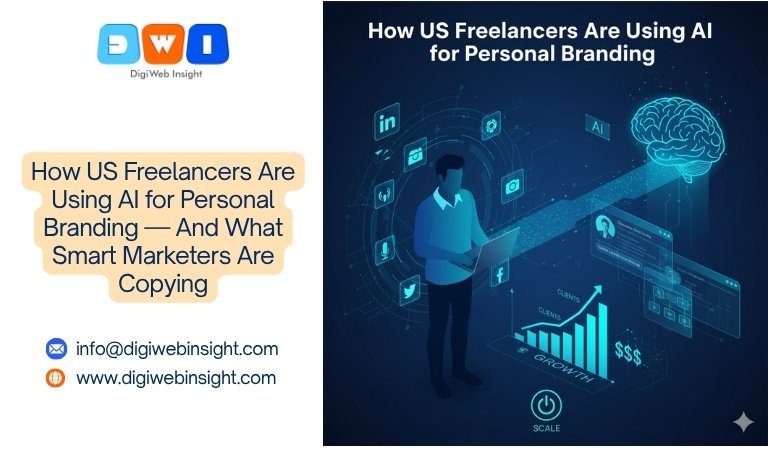
In today’s competitive digital economy, a freelancer’s most valuable asset isn’t just their portfolio—it’s their personal brand. It’s their reputation, their voice, and their primary client-acquisition engine. The problem? Building and maintaining a strong personal brand is a full-time job of content creation, social media engagement, and outreach.
Enter the new “unfair advantage.” A savvy wave of US freelancers are using AI for personal branding to operate like a one-person media company. They are not using AI to replace their personality; they are using it to scale it.
They are conquering the feast-or-famine cycle by building a consistent, magnetic brand presence that works for them even when they’re busy with client work. This shift is so effective that smart marketers are taking notes and copying their playbook. This is a trend any affordable SEO agency in the USA needs to understand to stay competitive.
The Old Way vs. The AI-Assisted Freelancer
The “old way” of personal branding was a manual grind:
- Staring at a blank page, trying to brainstorm a week’s worth of content.
- Spending hours writing one blog post, only to be too exhausted to promote it.
- Sending generic, cold outreach emails and getting zero replies.
The AI-assisted freelancer treats AI as a creative partner. It’s their strategist, their copy editor, and their social media assistant, all in one. This frees them to focus on the high-level strategy and client relationships that truly matter.
Core Strategies: How US Freelancers Are Using AI for Personal Branding
This isn’t about “fake” content. It’s about smart systems. Here are the core strategies freelancers are using right now.
1. The “Infinite Idea Engine” for Content
The blank page is a freelancer’s worst enemy. Instead of guessing, freelancers use AI to become instant strategists.
They feed prompts into tools like ChatGPT or Claude, such as:
- “I am a freelance UX designer. What are the 10 biggest frustrations my potential clients (tech startups) have with their current conversion rates?”
- “Generate 20 hooks for a LinkedIn post about the importance of brand voice.”
- “Analyze the top 5 blog posts for ‘freelance writing tips’ and identify the missing content angles.”
The AI delivers a content plan in seconds, allowing the freelancer to create content that directly addresses their audience’s pain points.
2. The 24/7 Content Repurposing Machine
The “cook it once, serve it five times” model is on steroids. A freelancer can now write one in-depth blog post and use AI to instantly repurpose it.
Example Prompt: “I’ve written this 1,000-word blog post. Turn it into:
- A 5-part LinkedIn post carousel, with a summary for each slide.
- Three engaging Twitter (X) threads.
- A script for a 60-second TikTok/Reel.
- A summary for my weekly email newsletter.”
This strategy multiplies their output, ensuring their brand is visible on every platform without a 10x effort. This is similar to how a strong web design and development framework allows for content to be displayed beautifully across all devices.
3. Hyper-Personalized Outreach That Actually Works
Generic cold outreach is dead. Successful US freelancers are using AI for personal branding by applying its power to sales.
Instead of “Dear Hiring Manager,” they use AI to scan a prospect’s recent LinkedIn activity or company news. They then draft a hyper-personalized message.
Example Prompt: “Draft a 100-word connection request for a Marketing Director who just posted about their company’s new ‘sustainability’ initiative. I am a freelance copywriter specializing in green-tech. Connect my skills to their recent announcement.”
This targeted approach feels less like spam and more like a relevant, helpful conversation—much like the targeting logic behind successful Pay Per Click (PPC) Marketing.
4. Training AI to Be a “Digital Twin”
The biggest risk of AI is sounding generic. The smartest freelancers solve this by training their own AI.
They feed the AI their past blog posts, successful proposals, and favorite social media content. Then, they create a “style guide” prompt that the AI must follow.
Example Prompt: “Always write in an expert but approachable tone. Use short sentences. Avoid business jargon. Reference concepts from ‘Building a StoryBrand.’ My primary goal is to be helpful and empathetic.”
This ensures the AI-generated draft already sounds 90% like them, allowing them to edit for perfection instead of creation.
What Smart Marketers Are Copying
This freelance-led revolution hasn’t gone unnoticed. Corporate marketing teams are now applying these same tactics to their own brands:
- Scaling Executive Thought Leadership: Marketers are using AI to interview their CEO or Head of Product for 30 minutes, then turning that transcript into a month’s worth of LinkedIn content for them. It builds the executive’s personal brand, which in turn builds the company’s authority.
- Rapid A/B Testing of Brand Voice: Marketers are using AI to generate 10 different versions of ad copy or email subject lines in different tones (witty, serious, urgent) to quickly test what resonates with their audience.
- Localizing Campaigns at Scale: Just as freelancers personalize to a person, marketers are using AI to personalize to a region, tweaking a national campaign’s copy to reflect local events or dialects.
The Risk: Authenticity in the Age of AI
The strategy is not without risks. An over-reliance on unedited AI can lead to a “sea of sameness,” where everyone’s brand voice sounds like ChatGPT. As Forbes notes, the key is disclosure and authenticity.
The freelancers winning this game use AI as a lever, not a crutch. The AI provides the draft; the human provides the final insight, the personal story, and the expert filter.
Conclusion: The New Standard for Personal Branding
The narrative of US freelancers are using AI for personal branding is not about deception. It’s about efficiency. It’s about reclaiming time to focus on the human-centric parts of their business: strategy, client relationships, and high-level creativity.
By using AI as a personal strategist and assistant, freelancers are building stronger, more consistent brands than ever before. Marketers and businesses who fail to adopt this “AI-assisted” mindset risk being out-maneuvered by a global army of one-person powerhouses.
To learn how to integrate these AI-driven strategies into your own marketing, contact the expert team at DigiWeb Insight today.