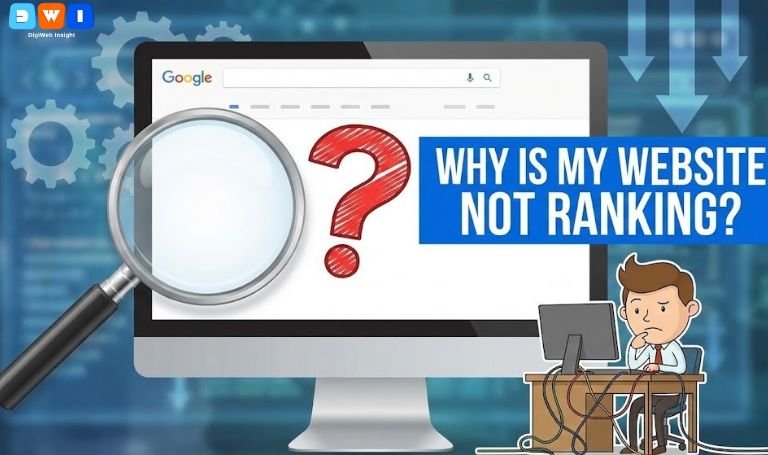
You built a sleek website, published content, and waited for the traffic to roll in. Months later, your analytics show a flatline. You are likely asking the frustrating question: “Why is my website not ranking on Google?”
It is the most common hurdle for businesses in the competitive USA digital landscape. Having a website isn’t enough anymore; it needs to be technically sound, trusted by Google, and incredibly valuable to users. If you aren’t on page one, you are essentially invisible to your target customers.
If you are tired of seeing competitors steal your potential leads, it’s time to diagnose the problem. This guide breaks down the seven most critical reasons why your website is invisible in search results and provides actionable fixes for the US market.
1. Google Hasn’t Indexed Your Site Yet
Before you panic about ranking, you must ensure you are even in the game. The simplest answer to “Why is my website not ranking on Google?” is often that Google doesn’t know it exists.
Google uses “crawlers” to discover new pages. If your site is brand new, it might just take time. However, sometimes technical blocks prevent indexing.
The Fix: Go to Google and search site:yourdomain.com. If no results appear, you aren’t indexed. You need to set up Google Search Console (a crucial external DoFollow resource) and submit your sitemap. Check for any “noindex” tags in your site’s code that might be accidentally telling Google to stay away.
2. Your Target Keywords Are Too Competitive
Many USA businesses make the mistake of targeting broad, highly competitive keywords right out of the gate.
If you are a local plumber in Ohio, trying to rank for just “plumber” nationally is nearly impossible against giants like Roto-Rooter. You are fighting a losing battle against domains with massive authority.
The Fix: Shift your strategy to “long-tail keywords.” These are longer, more specific phrases with lower search volume but higher intent. Instead of “CRM software,” try “best CRM software for small real estate agents.” These are easier to rank for and often convert better.
If you are struggling to identify profitable, low-competition keywords in your niche, partnering with an affordable SEO agency USA can help you pivot your strategy toward achievable wins.
3. Your Content Lacks “EEAT” and Helpful Insight
Google’s algorithms have evolved. They now heavily prioritize content showcasing E-E-A-T (Experience, Expertise, Authoritativeness, and Trustworthiness).
If your content is thin, duplicated from elsewhere, or reads like it was generated by basic AI without human review, Google will ignore it. Thin content—pages with 200 words that don’t solve a problem—is a major ranking killer.
The Fix: Review your main pages. Are you providing unique value that isn’t found elsewhere on page one? To improve EEAT:
- Include author bios showing expertise.
- Cite reputable sources.
- Ensure the content thoroughly answers the user’s search intent.
4. Poor Mobile Experience (Mobile-First Indexing)
Google now uses “mobile-first indexing.” This means Google predominantly uses the mobile version of your content for indexing and ranking.
If your website looks great on a desktop in a New York office but is impossible to navigate on an iPhone in California, you won’t rank. In the USA, where mobile usage dominates search, this is non-negotiable.
The Fix: Use Google’s Pagespeed Insights to check your mobile usability. Ensure buttons are clickable, text is readable without pinching, and elements don’t shift around while loading.
5. Technical Issues and Slow Loading Speeds
User experience (UX) is a ranking factor. Google knows that US consumers are impatient; if your site takes longer than 3 seconds to load, users bounce back to the search results. High bounce rates signal to Google that your result isn’t valuable.
Furthermore, a messy site structure, broken links, or confusing navigation will frustrate both users and search engines.
The Fix: Optimize your images, use browser caching, and upgrade your hosting if necessary. Sometimes, the issue is the foundation of the site itself. A professional overhaul focused on web design development can resolve underlying code bloat and structure issues that hurt rankings.
6. You Have Zero Authority (No Backlinks)
Think of backlinks (links from other websites to yours) as votes of confidence. If high-quality sites link to you, Google trusts you more.
A brand-new site with zero incoming links has no “domain authority.” Why would Google rank an unproven entity over established competitors?
The Fix: Start building ethical white-hat links. Create high-quality “linkable assets” like infographics or original research data. Reach out to relevant partners or local business associations for links. Avoid buying cheap, spammy links, as these will result in Google penalties.
7. You Have a Google Penalty
This is rare but possible. If you have engaged in “black hat” SEO tactics in the past—like keyword stuffing, buying link farms, or hiding text—Google may have manually or algorithmically penalized your site.
The Fix: Check the “Manual Actions” tab in Google Search Console. If there is a notice there, you must fix the listed issue thoroughly and submit a reconsideration request.
Conclusion: Moving from Invisible to Visible
Answering “Why is my website not ranking on Google?” requires an honest audit of your technical setup, content quality, and off-page authority. Ranking takes time, especially in the competitive US market. It requires consistent effort and adherence to Google’s ever-changing guidelines.
While organic SEO is a long-term play, sometimes you need traffic immediately. For instant visibility while your SEO kicks in, consider utilizing Pay Per Click (PPC) marketing to appear at the top of search results.
For a comprehensive strategy that combines technical excellence with content that converts, explore the full suite of services at DigiWeb Insight.