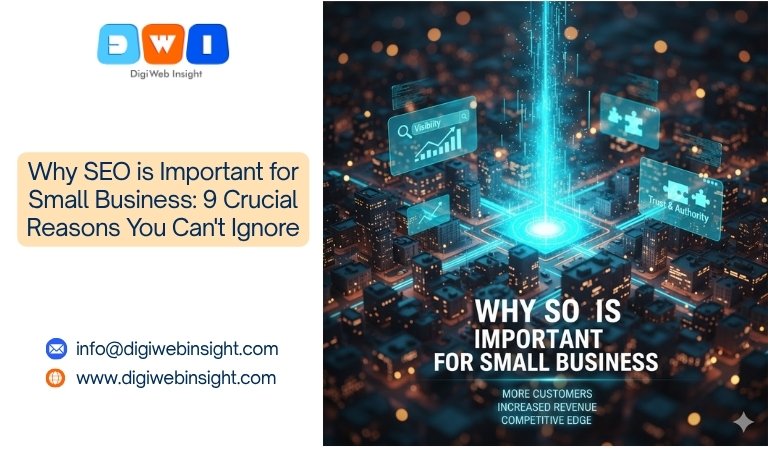
You’ve built a great small business. You have a professional website, excellent service, and happy customers. But there’s a major problem: your ideal clients can’t find you online. This is where understanding why SEO is important for small business shifts from being a “nice to have” to a core survival strategy.
Many business owners ask, “Why do I need SEO when I have social media?” The answer lies in intent.
Search Engine Optimization (SEO) is the art and science of helping your website rank higher in search engines like Google. When a potential customer actively searches for “best bakery near me” or “emergency roof repair,” they aren’t just browsing—they have an immediate need. SEO puts your business directly in their path at that exact moment of intent.
If you’re not on the first page of Google, you are effectively invisible to the vast majority of your potential customers. Here are 9 crucial reasons why SEO is a non-negotiable for small business growth.
1. SEO Drives High-Intent, Quality Traffic
Traffic from SEO is the best traffic, period. Why? Because it consists of users who are actively searching for a solution you provide.
Unlike outbound marketing (like cold calls or display ads) that interrupts a user, inbound marketing (SEO) attracts them. They are already looking for you. This “pre-qualified” traffic is far more likely to convert into a lead or a sale.
2. It’s One of the Most Cost-Effective Marketing Strategies
A small business budget is tight. While paid ads offer instant visibility, that visibility stops the second you stop paying. SEO, on the other hand, is an investment that builds long-term, sustainable “free” traffic.
While strategies like Pay-Per-Click (PPC) marketing have their place, the organic leads generated by SEO often have a much higher return on investment (ROI) over time. You are building a business asset, not just renting ad space.
3. SEO Builds Trust and Credibility (E-E-A-T)
Ranking on the first page of Google is an powerful endorsement. It signals to users that Google—the most trusted search engine—sees your site as relevant, helpful, and authoritative.
This aligns directly with Google’s E-E-A-T guidelines (Experience, Expertise, Authoritativeness, Trustworthiness). A strong SEO presence establishes your expertise and builds instant credibility before a user even clicks on your site.
4. It Gives You a Powerful Competitive Advantage
Your competitors are likely already using SEO. If they aren’t, you have a golden opportunity to get ahead.
By optimizing your site and content, you can systematically outrank your local and digital competitors, capturing the market share they are ignoring. If you’re both competing for the same customers, the one with the better SEO strategy will win.
5. You Can Dominate Your Local Market
For brick-and-mortar businesses, local SEO is everything. According to BrightLocal, 97% of people learn more about a local company online than anywhere else.
Searches like “near me” have exploded. A strong local SEO strategy—focusing on your Google Business Profile, local keywords, and citations—makes you the default choice for customers in your immediate area.
6. SEO Improves Your Website’s User Experience
Google’s algorithm is designed to reward websites that provide a great experience. This means SEO is no longer just about keywords; it’s about:
- Site Speed: How fast your pages load.
- Mobile-Friendliness: How your site looks and functions on a smartphone.
- Easy Navigation: A clear and logical site structure.
These factors are a core part of professional web design and development. By improving SEO, you are simultaneously making your website better for your customers, which reduces bounce rates and increases conversions.
7. The Results are Measurable and Actionable
How do you know if your marketing is working? SEO provides a wealth of data.
With tools like Google Analytics and Google Search Console, you can track:
- Which keywords are driving traffic.
- How users are navigating your site.
- Your conversion rates.
- Where your traffic is coming from.
This data allows you to make informed decisions about your business, products, and services based on real customer behavior.
External Link: To understand what Google values, it’s best to go to the source. This How Search Works overview from Google is a high-authority (DoFollow) resource that explains their ranking philosophy.
8. SEO Builds a Long-Term, Sustainable Asset
A top-ranking blog post can generate leads for years after it’s published. SEO is the definition of a “compounding” investment.
The effort you put in today—creating helpful content, building links, and optimizing your site—builds on itself. Unlike a paid ad, your organic rankings won’t disappear overnight. They create a durable, 24/7 marketing engine for your business.
9. ## So, Why is SEO Important for Small Business in a Nutshell?
To put it simply, why SEO is important for small business is because it directly addresses the number one challenge: visibility. It connects you with customers who are already looking for you, builds your brand’s authority, and provides the best long-term ROI of any digital marketing channel.
In today’s digital economy, not investing in SEO is the same as building a shop on a side street with no sign. You may be the best at what you do, but no one will ever know.
Don’t Stay Invisible
Your customers are searching for you right now. If you’re not on page one, they are finding your competitors.
If you’re ready to turn your website into a reliable engine for growth, DigiWeb Insight LLC can help. As an affordable SEO agency in the USA, we specialize in creating data-driven strategies that deliver real, measurable results for small businesses.